
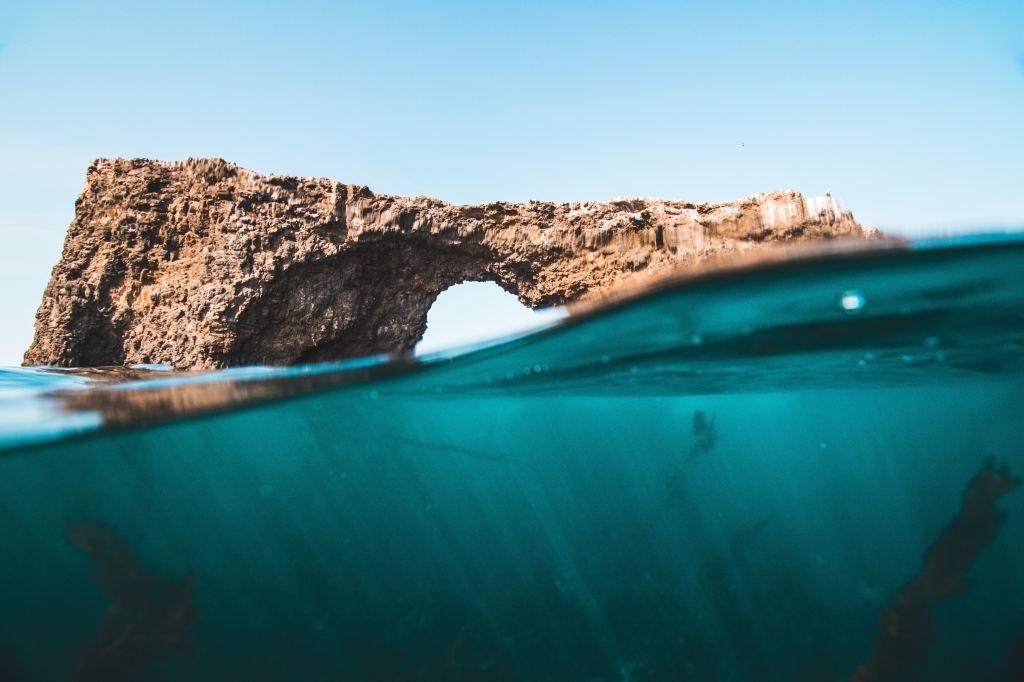
I think we all sometimes get this need to just run away from it all. We all try to find that place where you can forget about everything. This place for me is underwater, a place I found whilst freediving. It’s the harmony that I feel when submerged, which I think can be found in every moment, but for everyone there is a place and time when this synchronization feels more like home.
Although the ocean might not be so calm for most, it is only with gentleness that you may tame it and in return it might tame you. I love this state of freediving where your mind accepts that it must relax and your body obediently follows. Before I dive too deep into the more abstract side of freediving, let me resurface and explain the basics.
What do I mean by freediving, what is freediving? Another word for freediving is ‘apnea’ which translates from Greek for ‘without air’. You explore and experience the ocean, whilst reaching extreme depths, all done with one breath. Freediving to me is this in between, between snorkeling and scuba diving. You start your freedive by taking a deep breath and then diving down; some will try to reach deeper ends, but others will use one breath to explore the ocean floor. It must be done ‘without air’ or in other words, without breathing. I believe the word freediving originates from the fact that you’re diving, but free from any gear. Although, I think the word ‘free’ also goes a long way to describing how you might feel.
Lately freediving got put into the spotlight, after Netflix released ‘The Deepest Breath’. The movie is a documentary that takes us through the freediving career of Alessia Zecchini with the help of safety diver Stephen Keenan. I hope this movie does justice to these incredible people. From within that tv, they took a grip on my heart and most definitely managed to affect me. It takes us through the extremes of competitive freediving, paying attention to all its dangers, but also incorporating all these incredible feats which can be achieved.
What is it about freediving? It must differ per person, whether freediving really is as magical as it seems to me. Let me try and open your mind by comparing it to something magical like floating around in space; although you might not be in space, you’ll feel weightless, but in contrast to space you’re in an environment that’s full of life.
I think that the lack of oxygen forces us to adapt to new internal conditions. There is a scientific term for it too, ‘the mammalian dive reflex’. I’ll get more into what the effects are of the mammalian dive reflex, but before I get into that I wanted to explain that it is a 50/50 between how freediving affects someone and how someone goes about freediving. The preparations I take before diving down for extended periods of time, to optimize these dives, make a big difference to how I experience them and how ‘successful’ they are. I think this pre-dive optimization plays a big role in my experiences, but just like they can change the experience of my dives, so can they be used to change all the experiences in my life. It’s about calming down and understanding why, why do I drag myself through this day, why not live it? The influence of the pre-dive prep is just as important as the dive itself.
To get back to the mammalian dive reflex; it is a reflex, expected by scientists, to affect most if not all mammals. Humans experience it too, we are born with it, it is an evolutionarily developed reflex to preserve life. It basically calms us down when we hold our breath and submerge ourselves in water. When water comes in contact with our face and we hold our breath, causing there to be a fixed amount of air in our lungs, our bodies respond. The heartbeat slows and the blood in our body is withheld, redistributing it primarily to the vital organs. This is the mammalian dive reflex trying to preserve oxygen. That’s why you might be surprised sometimes by how long you can hold your breath when submerged, compared to when on land.
I don’t want to forget to appreciate the ocean for what it is. Freediving is just a means to appreciate the most incredible of ecosystems, diversity and wildlife our world has to offer. Our seas might not be meant to house humans, but we can live there. Humans have a need for water, but also for the seas. For centuries we have lived mostly in coastal areas, the sea made it possible for us to explore further, and even to this day most of our goods and products are transported by sea.
To live the ocean!
Alexander van der Velden
Sources:
theguardian.com – freediving is this a sport or french existentialist swimming
Breatheology.com – the art of freediving
ncbi.nlm.nih.gov – physiology, diving reflex
youtube.com – why is being underwater so peaceful
 VOICES
Leave a comment