
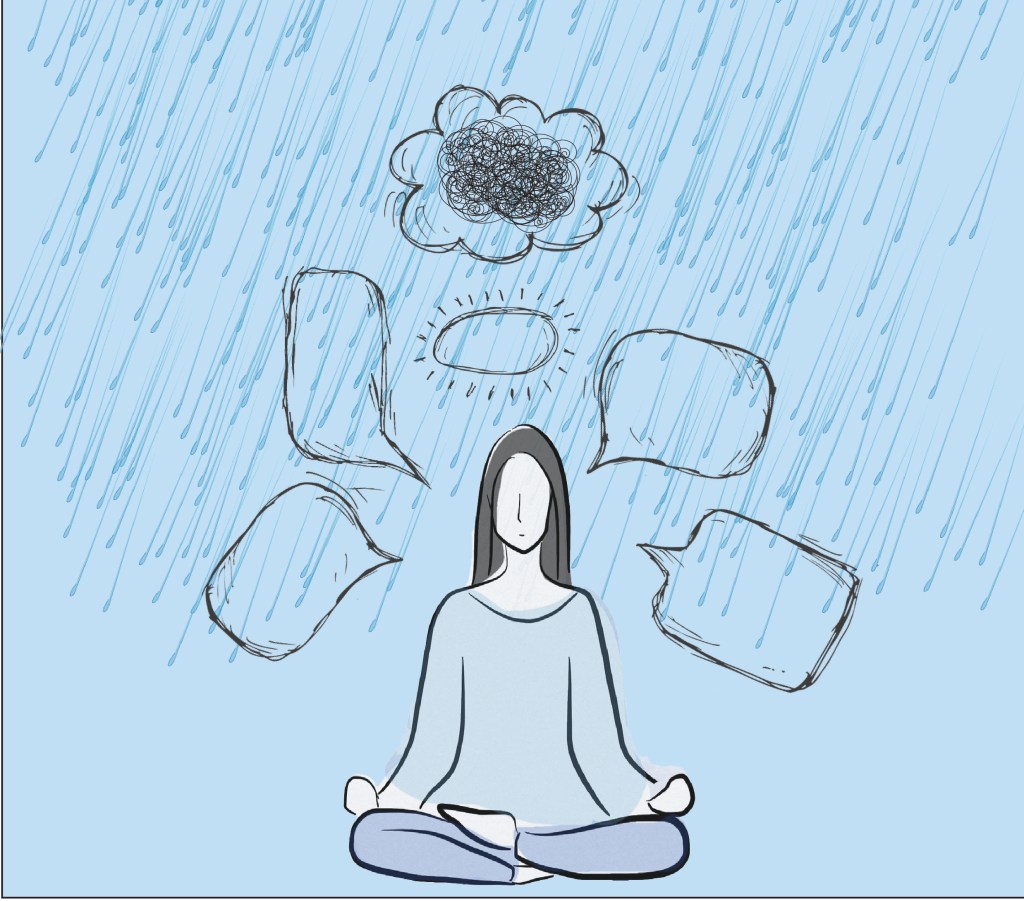
Do you know this feeling when you’re breathing, and your heart sped up in a stressful moment? Or the sensation of having something heavy that weighs on your chest just before an important event? It could be excitement, fear, or stress. For a lot of young people, it has a name: anxiety. What does it mean to be anxious today? What are the reasons? How can we live with it? And why has the rate of anxiety among young people just continued to increase these last years?
Living with anxiety is not easy every day. There are several types of anxiety all affecting life at different levels. And yes, there is a difference between stress and anxiety. Stress is a feeling that everyone can feel in their life in a situation where the threat is real and immediate, for example, when there is a fire or an attack; we call it acute stress. The second type is chronic stress, when we repetitively produce these hormones of stress. Often, in the end, when this stress is too much, we can’t make the difference between threatening information and those that aren’t. And this type of stress becomes anxiety. In the end, this is how anxiety works: you imagine that the next situations are going to be worse, they are threat to you, even if you can’t know, because nobody can predict the future. Anxiety is a combination of fear and stress at a high level.
There are three types of anxiety: state anxiety, trait anxiety, and anxiety disorders (which contain different kinds).
- The state anxiety is a temporary emotional state that only occurs in response to an anticipation of stressful events, like an exam, or a competition.
- The trait anxiety is more related to the personality of someone, when by nature is just more stressed and more worried about everything.
- Anxiety disorders is mental illness, and there are several of them: Generalised Anxiety Disorder (GAD); Social Phobia; Panic Disorder, Agoraphobia; Post-Traumatic Stress disorder (PTSD); Obsessive-Compulsive Disorder (OCD).
But why is anxiety so common among teenagers, students, and young adults? It increased in the last few years, caused by many factors, like sleep issues, loneliness, performance at school, social pressure… The report in 2018 of the American College Health Association National College Health Assessment shows that 63% of college students in the US felt overwhelming anxiety. And it was before the pandemic Covid 19, which heightened loneliness with lockdowns and distance learning.
The Mondial rate of anxiety and depression increased by 25% according to the World Health Organization (WHO), and young people have been more impacted (20-24 years old). The pandemic caused social isolation, loneliness, suffering, loss of family, grief, and financial issues, which are factors of anxiety and lead after all to depression. The WHO made an important call to the governments to step up mental health to a better level and stop normalising its weight. But giving better help for the people, means more money to take care of the mental health and the anxiety. For now, the WHO revealed that countries in the world provide an average of 2% of their budget in care for mental health.
COVID-19 was a rough period for everyone, but especially for students who were living alone, losing their jobs, and had to face economic issues and social isolation, at a time when social life had a big place in their early adulthood.
Dealing with stress and anxiety means handling life’s problems and facing responsibilities while entering adult age. It’s starting to live alone, managing a budget, paying rent, not forgetting food, having a social life, succeeding in your studies, and thinking for the future… Everything can be very overwhelming when you don’t have any help, support, or family, and so leads to anxiety and intense stress.
On the other hand, anxiety can be brought about by something external to the life of a young person. Like on something where you have neither control nor solution, about the context of your life, traumatic events, ecology known as eco-anxiety, geopolitics, and international relations. Trauma in childhood, or youth, like death, or divorce, can lead to stressful moments, anxiety, or depression.
So, let’s talk about one example that I think is essential in our society today, and in our world: eco-anxiety, which can be defined as a particular type of anxiety that we feel in response to climate threat. This eco-anxiety can become an eco-anger when there is no action taken by politics, and we are just powerless witnesses facing natural disasters; extreme heat, as heatwaves of the last summer which created forest fires like in Greece in 2023; or floods in Libya, those killed thousands of people; famines; or earthquakes in Syria and Turkey last February which also caused ten of thousand deaths and became one of the deadliest for this century. The future of the planet is more uncertain day after day, we see the amount of natural disasters increasing in the world. Eco-anxiety is feeling useless, between fear and anguish. And when you are young between 18 and 35 years old, you experience this anxiety in a more intense way.
But there are solutions that help dealing with anxiety. Not avoiding your feelings and your problems is a first step. Don’t be too hard on yourself, having a healthy life can help as well. In my case, I’m trying to drink less coffee and listening to podcasts and music. We can find answers to our stress and anxiety when we start to talk about it, identify the reasons of our anxiety, approach it, and learn how to live with it. So, the possibility to talk to someone if you feel that you need help can also be a good help. Don’t let your anxiety lead your life, it’s my best advice.
Chloé Le Cair
Sources:
Cairn – Eco-anxiety: Between anxiety and lucidity
United Nations News – Covid-19: Depression and Anxiety increased over 25% in one year.
CalmClinic – The 6 Main Types of Anxiety – Which do you have?
Medical News Today – Trait anxiety and state anxiety: What to know
Health Harvard – Anxiety in college: What we know and how to cope
 VOICES
Leave a comment