
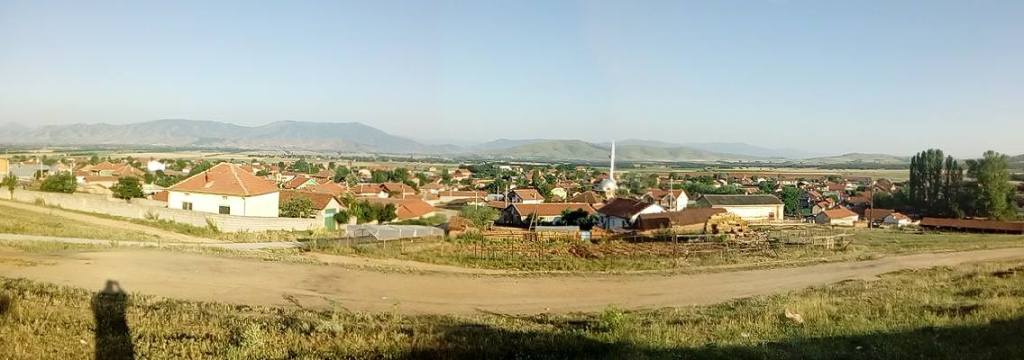
Difficulty, longing, pain, hope are always in the saddle bag of immigrants. The difficulty of leaving, the pain of giving up, the longing towards and hope to reach – what is yours – are always a burden that we carry draggingly. For the one who left themself in certain places…
The topic of this article is my trip to one of the greatest and living Turkish villages of Macedonia where my ancestors were born and compelled to migrate around 1960, the Kanatlarci village.
My ancestors are from a Turkish village that migrated from the centre of Anatolia which is Karaman to Kanatlarci which is located between Bitola and Prilep in the 15th century. Despite the exact time of the establishment of the village is not known, since the oldest document that mentions the name of the village belongs to 1470, it is obvious that the village has a long history. In the historical documents the name of the village first is Avramotski. Then the name was changed to Kanatlarci. There is a legend that is narrated among the elders of the village explaining that change. According to it, the respective Bektashi leader Dikmen Baba (like saint Dikmen) had come to the village by flying. For this reason, the name was replaced with Kanatlarci which means “wings” in Turkish.
It is not coincidental that my ancestors chose Kanatlarci for the settlement. Like other states of the 15th century, the main economic activity of the Ottoman Empire was agriculture. The reason why people migrated to Kanatlarci is also related to agriculture. Kanatlarci is within the borders of Pelagonia and it has lots of flat ground unlike the general topography of Macedonia from the geographical perspective. The Kanatlarci valley which is surrounded by mountains has a very proper place for agriculture and animal husbandry. In parallel to these, an elderly person that I encountered during my trip, said to me that in the past there was an idiom to highlight the value of their village as “the valley of Kanatlarci is a gold source”. (kanatlar ovası altın yuvası).
Although Kanatlarci has a peculiarity in terms of population and agricultural importance, it surprised me that there is no regular local service to reach there from Prilep. However, this situation did not deter me from following the signs of my ancestors. The miles and kilometres are worthless to reach my village which I grew up with its stories – the stories that I felt from miles away and which I had only opportunity to see through a screen. I got a ticket for the Skopje-Bitola bus and got out in Topolchani which is 7 km far away from Kanatlarci. Since there is no public transportation, I had to walk 7 kilometres. However, walking 7 km wasn’t different from walking 7 steps for the sake of my village. In the 5th minute of walking, a car that was going to Kanatlarci picked me up, and I arrived in the village easily. After I got out of the car, I followed the first street I saw and found the mosque. The Imam who saw me in the mosque yard greeted me among the children playing there. When I told him that my grandparents had to migrate to Istanbul from Kanatlarci in 1960 and from that time on none of our family members had the opportunity to visit, except my uncle, Ibrahim Imam offered to guide me on my trip. I gladly accepted the offer of Ibrahim Imam who is aware of his social duties. Also, since he was sent to the village 4 years ago, I was happy to find a person who had the opportunity to observe the daily life of the village from the eyes of an outsider. The first point that we visited in the village was the Bektashi Tekke, which is a place where believers of a sect of Islam come together on some special days alongside the mosque. The feature that makes Kanatlarci different and important from the other villages is its multicultural, multi-religious structure. Kanatlarci has experienced more than 500 years of Ottoman rule, since the Ottoman Empire was a multicultural society, this value has been continued after its rule. For instance, according to the 1899 population counting the village included 840 Muslims, 55 Christians, and 20 Roma people. Although the exact number is not known at the moment, the population rate did not change but the numbers doubled. Now even some Bosnians live in Kanatlarci. For this reason, Kanatlarci has a Mosque, Bektashi Tekke and Church.
The first thing that attracted my attention was that the door of Tekke was not locked. This is a symbol that anybody, no matter their faith, can visit the Tekke. Alongside it is a prayer place, it also has the function of entertaining guests. Almost any village of Anatolia has similar buildings that are peculiar to those who were coming to the village from outside. When there is a guest in those houses, the residents of the village are responsible to present food to them by order. After visiting other casual places, Ibrahim Imam invited me to his house for lunch. Since I know the meaning of that invite, I did not hesitate to accept, because my grandparent taught me that even asking the guest whether they are hungry is a shame. You should present guests without asking. Feeling the same tradition was making me more emotional. However, the importance of hospitality is not restricted with these applications. According to another tradition, if a guest brought a gift to the house owner, the owner of the house would shout the name of the giver very loudly from the window. At lunch I had a great opportunity to ask a lot of questions to Imam.
During the time when my grandparents were in Kanatlarci, the greatest economic activity was around tobacco, watermelon cultivation and animal husbandry. Now, although tobacco and watermelon cultivation has preserved its importance, there is not that much animal husbandry compared to before. Kanatlarci, which is within the boundaries of Pelagonia, has very fertile land for tobacco cultivation. My grandparents were always mentioning the difficulty of processing the tobacco since there was not that much machinery. Although people benefit from machines a lot, still they have to wake up at 2 a.m. to collect tobacco leaves and process them. After they dry, they are ready to be sold. Beside agriculture, I found out that some of the young people also work in two different factories around Prilep. The economic opportunities of the village is one of the reasons that Kanatlarci preserved its population. Moreover, since the school in the village provides 9 year education, families do not have to migrate outside for their children’s education.
After lunch, I started to walk in the streets of Kanatlarci. I don’t know what I was searching for but I couldn’t stop myself from searching for something. I guess I started to journey towards the longing that I felt through the narrations of my parents. During this search, I came across some elders that showed me the location of my parents’ house. Furthermore, when the young or elderly saw me in their streets for the first time, they tried to talk to me and to find out who I am. After every talk, I turned from foreigner into domestic. However, my longing did not fade and eventually I noticed that this is something that can never fade away. It is very deep in my mind and heart. I was always asking my grandparents for the reason for their migration. Most of the time, my grandparents were not providing me with concrete reasons. But, like all, I am also aware of the difficulty of leaving the land that you were born and grew, leaving behind loved ones and memories. We are not alone. Almost 30% of Türkiye consists of Balkan immigrants who migrated in the last 150 years. There is always a reason for migration. The war and famine always sparked the migration. My grandparents who were born in the beginning of WW2 have lived very tough times. The first years of Yugoslavia were also very difficult for them. My grandfather who is more than 80 right now still remembers the winter that their family only ate corn bread. So for him who claims he even almost all nights have dreams about himself in Kanatlarci, here is not just a land, here is also a far homeland.
Muhammed Emin Ersan
Sources:
KUZEY MAKEDONYA-KANATLAR KÖYÜNDE ANLATILAN EVLİYA MENKIBELERİ – dergipark.org
A Bektashi Village In Macedonia: Kanatlar – cms.hacibayram.edu
 VOICES
Leave a comment