
Nature is blooming, the days are getting longer, and the weather is warmer. Yes, finally, summer is slowly arriving. We can wear something other than hoodies, sit in the park, and go swimming. But just as we are excited, so were our ancestors. There were and are many celebrations on or around May 1st for different reasons, or are they all the same?
Beltane
Beltane is one of the four seasonal Gaelic festivals between the spring equinox on the 21st of March and the summer solstice on the 20th or 21st of June. May 1st is in the middle of those dates and it is supposed to be the day on which the veil between the spirit world and ours is thinnest. Beltane is the festival of fire and fertility, therefore there are many traditions around it. “Beltane” means something like a bright fire, which underlines the meaning: the dark winter is over and the bright half of the year is there, so during celebration there is always a bonfire lit. The Celtics believed that the fire and the smoke were healing and had protective powers, so they would move their cattle through the fire to protect them in the field. Coincidentally, sacrifices of animals and humans were common to honour their pagan gods.
When the Romans came to the British Islands, the traditions of Beltane and the Roman festival “Floralia” mixed.
Floralia
Floralia is an ancient Roman festival to honour Flora, the goddess of flowers, vegetation, and fertility. The festivities usually lasted from April 27–28 to May 3, since flowers usually start blooming in April. People would wear crowns made out of flowers during the festival and attend the Ludi Florales, which were performances that included theatre, mimics, and circus games on the last day, as well as prostitutes. Some thought that the goddess might have been a prostitute herself, because it was a common name for a prostitute. No one celebrates this roman festival anymore, but many similar traditions can be found today. Many people wear flower crowns and the maypole also survived. The Dance of the Maypole is to celebrate fertility and can be found in many countries for May 1 or midsummer.
Today, there are still people who celebrate Beltane. The biggest festival is the “Beltane Fire Festival” in Edinburgh, where people dress in costumes and watch multiple performances and parades. The main performances are from The Green Man, who is the pagan god of the forest and The May Queen, who historically is the prettiest girl from the region dressed in white and is the lead of the parade.
Walpurgis Night
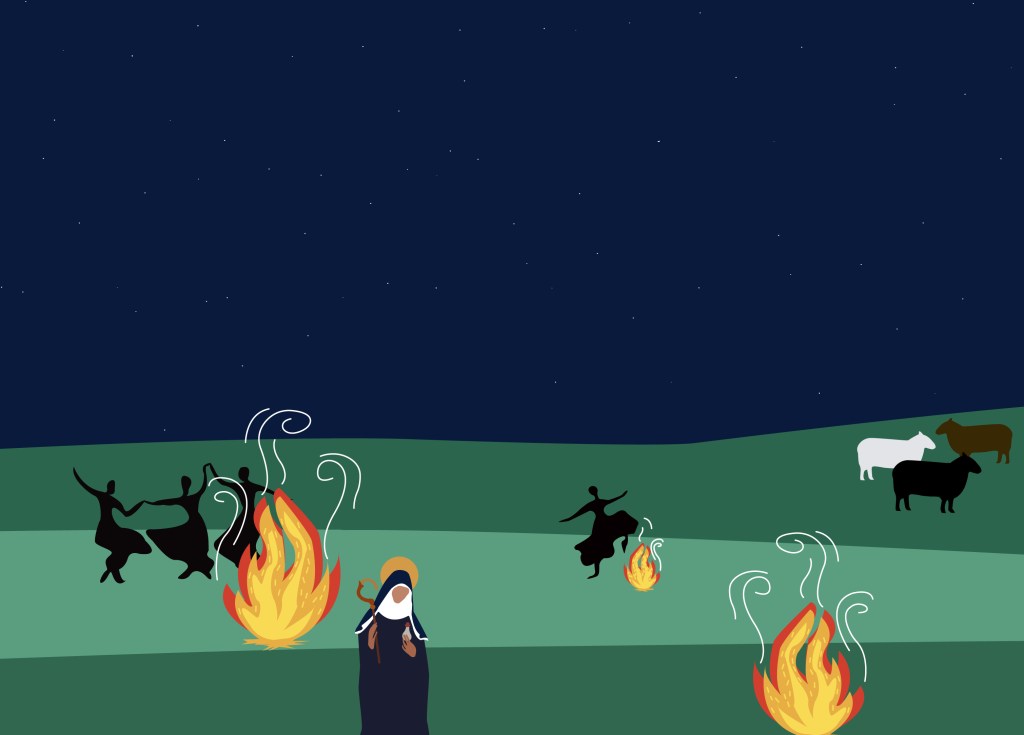
The night is both for and against witches. The Pagan May Celebration “Beltane” was also celebrated in other parts of Europe, such as Germany. It was believed that witches and other evil spirits would meet at the Brocken (a mountain in Harz, Germany) and dance with the devil. This belief became more popular through Faust Part 2, which was written by Goethe and describes this night. Today’s celebrations, from April 30 to May 1, are named Walpurgis Night, which coincidentally stands for the complete opposite of witches. Saint Walpurgis was born in England and studied medicine. She is known for fighting against diseases like pests, rabies, and whooping cough, but mostly witchcraft. May 1, 870, is the day of her canonization, a recognition of her being a saint. Since then, people have celebrated Walpurgis Night, Vappu (Finnish), Valborg (Swedish), or different names starting with “V.”. Similar to Beltane, people would light big bonfires to protect themselves. In this case, from witches or other pagans.
This piece of history shows how Christianity took over the pagans. We are still able to find many pagan traditions in our celebrations.
Today, Walpurgis Night is still celebrated. In Germany, it often has the name “Tanz in den Mai,” so dance into May, which is a good excuse for a party and lying in bed on International Workers Day the next day. Towns around the “Broken” people dress up as witches, play pranks on each other, and celebrate with a bonfire. When the flames are low enough, some jump over the fire. On other occasions, like Easter (more common in northern Germany) or Saint John´s Eve, bonfires are also common. Saint John’s Eve is around the summer solstice (June 24), but also shows many similar celebrations like bonfires, wearing flower crowns and having a feast.
Ederlezi
There are multiple very different names for spring celebrations in Turkey, Macedonia, and other Balkan and Slavic countries. A few of the names are Ederlezi, Hidirellez, Saint Georg´s Day, Đurđevdan, or ѓурѓовден. Those who use the Julian calendar celebrate the day on May 5–6. After the Georgian calendar, the day falls on the 23rd of April. Both Christians and Muslims celebrate this day, and the festivities are mixed with pagan traditions. For the Romani people, it is one of the most important days of the year. It is a spring festival, but the celebrations go back to the golden legend (by Jacob de Voragine). According to the legend Saint Georg slayed a dragon in order to save a princess. Later, he died for the Christian faith and became a martyr. On this day people visit churches and graveyards. During the festivities on 06.05, friends and family come together, sing songs like “Ederlezi,” which is a song specific to the tradition, and share a sheep. There is often a sheep competition on the 2nd of May, which determines the most beautiful sheep which is then butchered. There are many decorations with flowers and twigs, and people take baths with flowers.
For Muslims, this day celebrates two different people. Hizir, or Al-Chidr, is a holy figure in Islamic belief. He is seen as the personification of the good and the vegetation. İlyas, or Elijah, is an Islamic prophet with the mission to guide the children of Israel and prevent idol-worshipping. Hidirellez is a combination of both of their names, since the day celebrates their meeting on earth. Hizir supposedly has the power to make wishes come true on the night from the 5th to the 6th of May. So people would draw pictures of the things that they wished for on the earth near a rose bush. Additionally, they would bury a coin, which they dug up the next day, and carry it around for the whole next year. In that way, their wish is always with them.
Since 2017, the celebrations in Macedonia and Turkey have been on the list of UNESCO’s Intangible Cultural Heritage to preserve.
Throughout history, several ethnic groups have been formed with different traditions and cultures. However, when we look at those traditions now, we can see similarities. On May Day, many celebrations involve making a big bonfire, wearing crowns made out of flowers, hoping for protection against evil, and wishing for a good year to come. After taking a closer look at the history, it turns out that they share similarities but often celebrate completely different things. Even though they have different backgrounds, the spring is the common ground and we can find joy in all of the Traditions.
Fiona Schaumann
Sources:
The Roman Festival of Floralia – thoughtco.com
Paganism – Wikipedia
May Day – Wikipedia
Hıdırellez – Wikipedia
What Is Beltane? And, How Do You Celebrate It? | The Pagan Grimoire
Walpurgisnacht (Hexennacht): The German Night of the Witches explained (iamexpat.de)
Mazedonien feiert Ederlezi – Roma Feiertag von der UNESCO geschützt — Blog — Balkan Prime Tours | B2B Culture & Adventure Tour Operator
Golden Legend: Life of Saint George – christianiconography.info
 VOICES
Leave a comment