
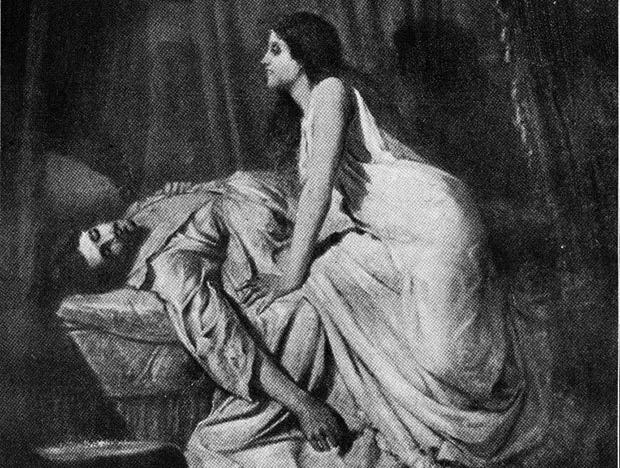
Most likely, the word “vampire” brings up these same images in our brains: bats, blood, sharp teeth, and very pale skin. But what makes us think of these images? From the “Twilight” saga and the “Blade” trilogy, to teenage dramas such as “Buffy the Vampire Slayer”, the depiction of vampires differs, but their most common features remain: they are seductive, elite, and intelligent. They cannot live under daylight, do not have reflections, and they can turn other people into vampires. If you are also interested in horror and gothic themes like I am, vampire content is an essential part of your consumption of speculative fiction. I hope this article will succeed in giving you insights into vampires and their intersection with today’s media and cultures.
Etymology
Regarding the etymology of the word “vampire”, there are several theories so it can be said that its roots are unclear. The first theory relates the word “vampire” to its Slavic synonyms “upior”, “uper”, and “upyr” which all relate to the old Turkish word “ubır” meaning witch. As a person whose mother tongue is Turkish, I also recently found out about the “ubır” from old Turkish folklore. Apparently, they are reanimated corpses that suck the essence of their victims. The second etymological theory connects the word “vampire” to Greek and Roman words “stryx” and “strigoi”. This theory is considered to be the classical origin of the term. The Serbian origin as “вампир” correlates with Slavic languages, but the source of the word vampire is the Hungarian word “vampir”.
History
Arguing the history of vampires started with Bram Stoker’s “Dracula” would oversimplify this legend which goes back for centuries now. The myths around monsters drinking the essence of living creatures, the blood, were spread across various cultures in different parts of the world. Having different names such as “Lannashtu”, “Striges”, “Manananggal”, and “Ubır”, the ancestors of vampires that we know today travel all the way from Mesopotamia, Ancient Greece, the Philippines, and Turkish communities, respectively.
Eastern European folklore constitutes the roots of the modern history of vampires. Real-life incidents happening in the newly taken lands of Austrians from the Ottoman Empire in 1718, which coincides with modern-day Romania, inspired many gothic writers and poets. During that time, the strange habit of digging up graves and burning dead people’s hearts was spreading among the local communities. The reason for this custom in today’s Romania was to prevent the dead from rising up and sucking the blood of the living. The events have spread through literary works in the 19th century with “The Vampyre” (1819), “Varney the Vampire” (1840s), and “Carmilla” (1871). These works heavily influenced Bram Stoker’s clear and definitive depiction of vampires in “Dracula”.
It has been said that “despite the domination by the character of Dracula in both film and fiction during the past hundred years, some of the memorable vampires have been female” (Holt, 1999). As mentioned above, “Carmilla” has the most famous female vampire narrative which depicts a vampire who is younger, more aggressive, and more sexually active. Not only unnatural and undead, but female vampires were also lesbian or bisexual. This is an obvious depiction that breaks the traditional Western norms and culture at the time. Thus, their destruction at the end of the stories and movies was a cause to reinforce heteronormativity. Aside from “Carmilla”, the life of a Hungarian countess Elizabeth Bathory, born in 1560, was also a major source of inspiration for the female vampire. Bathory was brought to trial for the torture and murder of approximately 650 young women. Her legend of drinking and bathing in her victim’s blood inspired numerous literary works and films.
Evolution in the Pop Culture
I especially wanted to focus on popular culture since it’s a mass media tool that has the power to shape people’s ideas, and thus their everyday lives as well. That is why the perception of vampires has evolved with the changing media and societal values. I particularly found it fascinating and ironic that vampires as folklore beings found their way into popular culture. This integration happened due to the popularity of vampires in movies and TV Shows as horror/thriller objects.
Vampires, especially Count Dracula, appeared in the movies for the first time in 1922, in the German production “Nosferatu”. Dracula continued to be a part of movie theatres throughout the 20th century, but some parodies of him were also created which caused him to lose some of his power as people started making jokes and not taking him seriously anymore. Later, in the late 20th-early 21st century vampires in movies were unable to bring the terror of old vampires back, since most of the new stories like “Twilight” and “The Vampire Diaries” romanticised vampire figures. So, the initial vampire figure was taken out of the context of its origins and was turned into either a joke or a desirable figure. I mean, in a way it sounds perfect to marry Edward Cullen and live forever.
On the other hand, we also see a change for the better. Vampire media was dominated by white actors because of the famous description of having pale skin. Later adaptations of movies and TV shows opened space for diversity, challenging the old traditional stereotypes. An example is Blade, who is one of the most famous vampire hunters and a human-vampire hybrid (dhampir). My personal favorite vampire character is Marceline the Vampire Queen from the TV Series “Adventure Time”. Overall, stories of vampires started to host characters that are more complex and nuanced than ever before.
In the end, what makes the vampires live forever is re-imagining “the vampire” and its continuous storytelling. For this reason, I see that it is possible for vampires, whose history goes way beyond Dracula, to stay in the spotlight for the upcoming generations of fiction lovers as well.
Ece Nur Özkaya
Sources
The History of the Word “Vampire” – Katharina M. Wilson
Not All Fangs Are Phallic: Female Film Vampires – James Craig Holte
Vampire History – history.com
Vampires: Folklore, fantasy and fact – Michael Molina
The History of the Vampire in Folklore, Literature, and Film – Megan Bryan – youtube.com
Vampire – Wikipedia
Lesbian vampire – Wikipedia
 VOICES
Leave a comment