
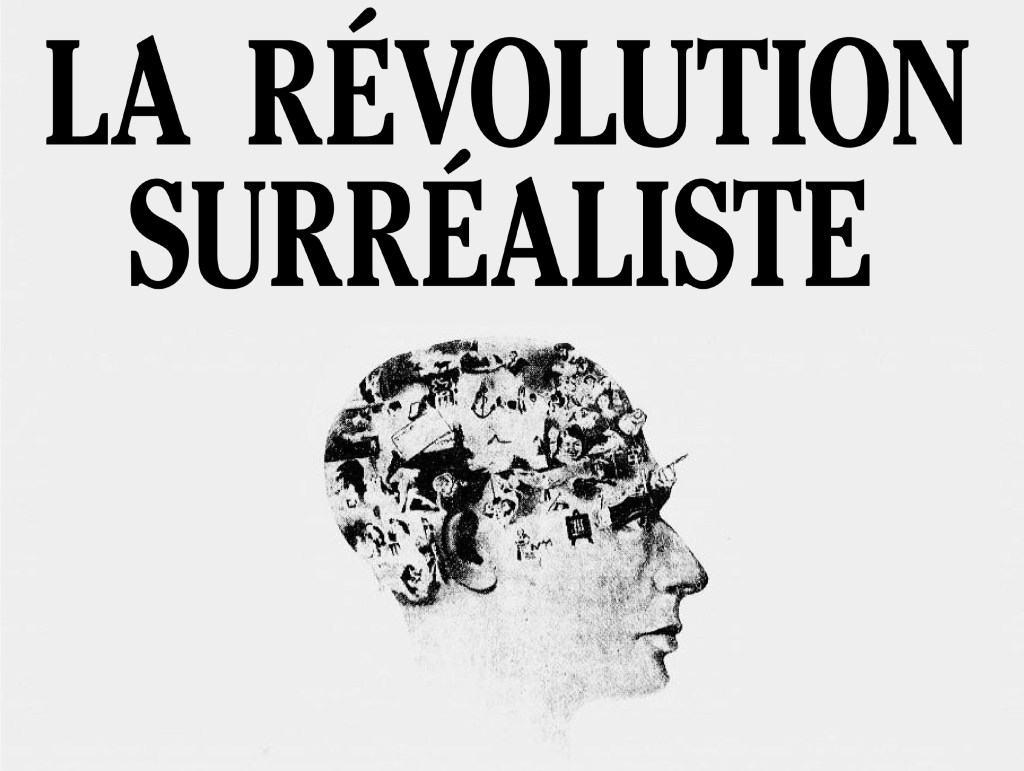
A hundred years ago, André Breton published the first “Manifeste du Surréalisme”, the surrealist manifesto. It made the case for a new wave of ideas turned into writing and visual arts, including paintings, photography, theatre, and installations. He then became the leading voice in the surrealist movement.
Breton led a group of surrealists based in Paris. They published a magazine called “La Révolution surréaliste” (The Surrealist Revolution). The journal focused on writing, but published artworks as well.
As the name suggests “over real”, the surrealists were concerned with everything beyond the logical. Inspired by Freud and his study of the unconscious, they wanted to unleash the hidden parts of the human mind. At the same time, they responded to the trauma experienced in the First World War. It was a new way to make sense of the world while overthrowing conservative notions of what art even is.
According to surrealists, creativity can be found if you break out of the boundaries of your mind. Any aesthetic ambition, logical thinking or even morale restricts the artists. There is no objective truth, therefore language (or art in general) will never tell the full truth. Instead, “automatism” should reveal the pure thoughts: the ones we find in dreams, where, as Freud believed, everyone is a poet. Automatism is a technique where the artist creates rapidly and without boundaries, to reach their subconscious. When writing, it resembles a train of thought, but with even fewer restrictions.
Today, one of the most remembered artists of the surrealists is the Spanish artist Salvador Dalí. He was a painter, author, sculptor, and stage designer. Born on the 11th of May 1904, he was 20 years old, when the first surrealist manifesto was published. In the late 1920s, he created his first surrealist paintings, which gained recognition from Breton and other surrealists. Following their invitation for a solo exhibition, he joined the Surrealists at the beginning of the 1930s.
“The Persistence of Memory” picturing melting clocks in a desert, is maybe the most famous surrealist painting. It can be interpreted as a reaction to Einstein’s theory of relativity, which turned every perception of time upside down. Later, he stated he had been inspired by a melting Camembert. Even though very prominent in the movement and to the public, Dalí and the other surrealists parted ways in the late 30s. The reason was an unshared philosophy of surrealism including political views. The surrealists accused Dalí of sympathy for the new rising fascism, a fascination of Hitler and Franco in Spain. This wasn’t compatible with the left and communist views of Breton and the others. Though Dalí rejected all allegations, Breton couldn’t see a common future, since he defined political activism as part of the art.
Nevertheless, Dalí remained a prominent figure and the face of surrealism to this day.
Like the surrealist movement is a philosophy that runs through the entire life, it is also expressed in all art forms. Some other prominent artists are Luis Buñuel, a director, Max Ernst, a painter, and Man Ray, a photographer and installation artist. Lots of artists experimented with different mediums and didn’t restrain themselves to one art form.
Besides surrealism being quite a man-dominated movement, there are women artists as well. Very few joined the tight circle around Breton and some others, usually also partners of the male artists, were part of exhibitions. While a lot of them never gained the same recognition as their male colleagues, the most prominent to this day is Mexican artist Frida Kahlo. Her characteristic self-portraits depict her in colourful clothes and a monobrow. She dealt with questions of the role of women, identity and Mexican indigenous culture.
Although she used some surrealist elements in her paintings, she cannot be called a surrealist. Even though Breton labelled her a surrealist artist, she never saw herself as such. Her paintings showed her reality, not impulse-led, but intellectually controlled art. Still, she participated in the International Surrealist Exhibition in 1940 in Mexico City.
In addition to France, surrealism spread throughout Europe, especially in Spain, and across the Atlantic to the United States and Mexico. With the “Second Manifeste du Surréalisme” (1930), (The Second Surrealist Manifesto), Breton added a political orientation to surrealism. This led to a few expulsions from the group, like Dalí later. Only the ones who agreed with his political ambitions were allowed to remain in the group. Some, like Dalí, were still included in exhibitions because of their popularity. For around ten more years, the group was active. Other groups worked after the same principles, like the surrealists in Belgrade around the journal “Nadrealista Danas i Ovde” (Surrealism Here and Now).
At the beginning of the 1940s, the group around Bretons started to fall apart because of political differences. Even though the movement lost its cohesiveness in the following years, there were still active surrealists, even after Breton died in 1966. The movement had a big political influence on the New Left and the French revolt of May 1968 and still influences pop culture. As the surrealists turned more towards politics, the surrealist philosophy was replaced with new philosophies like existentialism.
Johanna Krautkrämer
Sources:
surrealismtoday.com – The First Manifesto of Surrealism
youtube.com – Dada, Surrealism, and Symbolism: Crash Course Theater #37
eppendorfer.de – „Frida Kahlo war keine Surrealistin”
en.wikipedia.org – Surrealism
de.wikipedia.org – Salvador Dalí
archive.org – Breton, A. Manifestoes of Surrealism. Ann Arbor Paperbacks, 1972
Picture: wikimedia.org – Sade Eluard (edited)
 VOICES
Leave a comment