
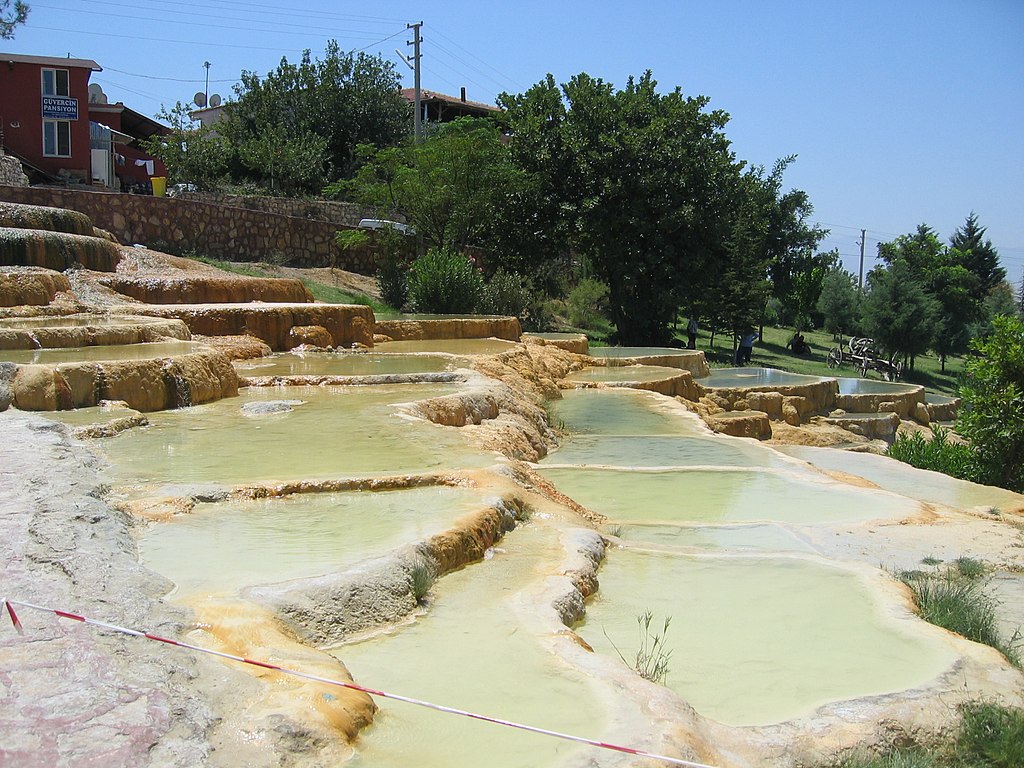
Pamukkale, with its attractive snow-white travertine terraces and pools of various sizes, fascinates anyone who sees it. It encompasses the terraces and travertines formed by carbonate minerals remaining from flowing waters, known as the City of Thermal Springs. Travertines form through the interaction of various chemicals and appear as nature’s mesmerizing masterpiece. Not only for its appearance but also for its reputation for providing relief for many ailments, Pamukkale’s travertines are a topic of conversation.
Pamukkale is a natural site located in the Denizli province of Turkey’s Aegean region.
Situated in the Menderes River valley, belonging to the Denizli province in Turkey’s Aegean region, Pamukkale enjoys a mild climate. Just 5 km away lies the village of Karahayıt, an international thermal center.
Attractive destination favored by lots of tourists.
Travertines of Pamukkale are one of the most special and beautiful places in Turkey. In addition to their visual richness with healing thermal springs. They are beneficial for many ailments such as heart conditions, rheumatism, and skin disorders.
One of Turkey’s most popular tourist destinations, the Pamukkale Travertines, along with the nearby ancient city of Hierapolis, are also listed as UNESCO World Heritage Sites. This white paradise in Denizli attracts a flood of local and foreign tourists year-round.
In 2023, Pamukkale was visited by 2.2 million people. Surpassing its own record from 2022, when 1.85 million people visited Pamukkale.
So what is travertine and how is it formed?
Travertines are chemical sedimentary rocks formed by the precipitation of calcium carbonate found in underground water due to conditions such as evaporation, reduction of pressure on the water surface, or contact with oxygen.
At a temperature of 35.6°C emanating from the source, the water containing a high amount of calcium hydrocarbonate comes into contact with oxygen in the air, causing carbon dioxide and carbon monoxide to evaporate, leading to the precipitation of calcium carbonate and the formation of travertine.
There are lots of places to visit around Pamukkale Travertines for you.
- Hierapolis Ancient City
- Antique Pool
- Hierapolis Theater
- Hierapolis Archaeology Museum
- Crying Rock
- Karahayit Red Springs
- Hierapolis Ancient City
The ancient city of Hierapolis is located in the same position as the Pamukkale travertines, just above the terraces. Meaning “Holy City,” Hierapolis Ancient City awaits exploration with its bathhouses, the tomb of Saint Philip, one of the 12 apostles of Jesus, the largest agora of its time, an ancient theater where you’ll witness a magnificent view, and its bathhouses. Additionally, you can discover the Plutonium (Gate to Hell), found in 2013, considered in the ancient world as the “gateway to the underworld,” and one of the original sources of the thermal waters that formed the Pamukkale travertine pools.
- Antique Pool
Another precious feature that sets Hierapolis apart from other ancient cities is the Antique Pool, where it is said that Cleopatra herself swam. In the pool, which maintains a temperature of 38 degrees Celsius year-round, you can enjoy swimming among ancient ruins.
- Hierapolis Theater
When Hierapolis is mentioned, one of the first structures that comes to mind is the magnificent Ancient Theater, leaning against the hillside in the style of a Greek theater, consisting of 300 feet. Relief statues can be seen on the stage of the theater.
- Hierapolis Archaeology Museum
In addition to artifacts unearthed from excavations in Hierapolis, the museum also houses artifacts from cities in the Lycos (Çürüksu) Valley such as Laodikeia, Colossai, Tripolis, and Attuda. And it provides some of the finest examples of the Bronze Age.
- Crying Rock
Located approximately 24 kilometers from Pamukkale Travertines, the Yeşildere Waterfall is also known as the “Crying Rock.” The reason for the name “Crying Rock” is that the green stream waterfall in the area has created a natural wonder resembling a crying rock. Especially popular among travelers visiting Pamukkale during the hot summer months due to its cool air.
6.KARAHAYIT RED SPRINGS
The temperature of the unique healing thermal water and thermal mud, which emerge from their main source throughout the year, is 58 ºC. According to the report by the Institute of Hydroclimatology at Ege University, it is a unique source of health due to its rich mineral content. There is Red-Water Wellness Park for the outdoor visit to the hot springs in Karahayit. The water is known as the cure for rheumatism, sciatica, calcification in the bones, renal stone, neural system, dermatological diseases, muscle pains, gynecological problems, varicose veins, and infertility.
I recommend putting this white paradise – which is one of the places everyone should see at least once in their life – at the top of your travel list. Have a great time in advance!
Süleyman Çelik
Sources :
Miniyol – Pamukkale travertenleri
tr.wikipedia.org – Pamukkale
oggusto.com – pamukkale hakkinda her sey
guneyegeturkiye.com – hierapolis antik kenti ve pamukkale travertenleri
Photo: Nihat1988 – via Wikimedia Commons
 VOICES
Leave a comment