
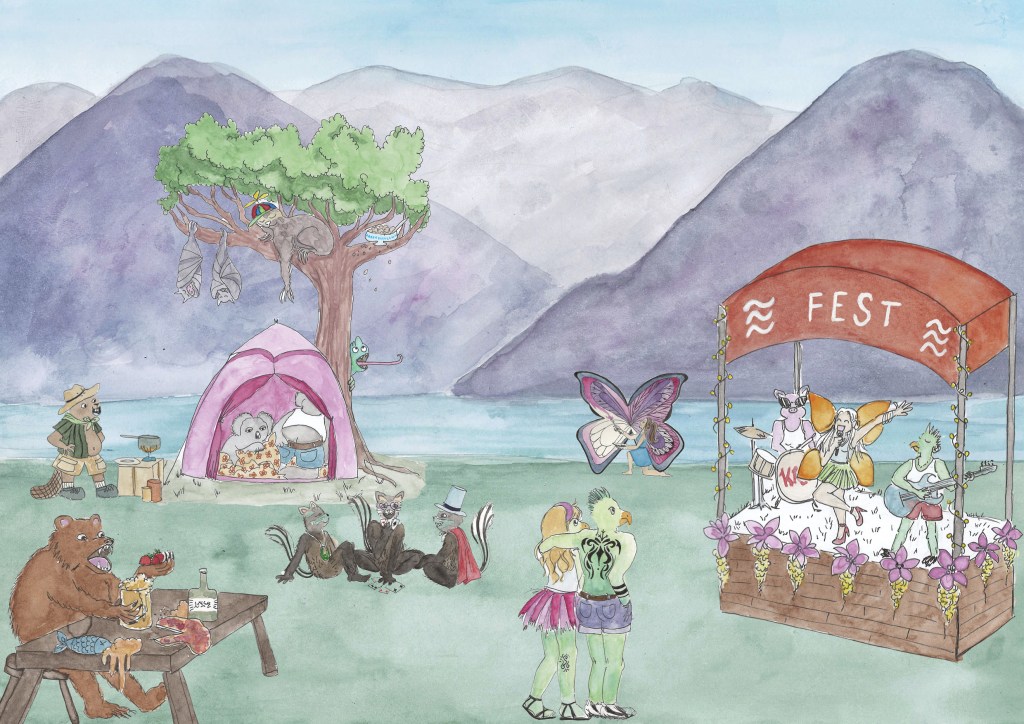
Going to Dojran’s D-Festival for the first time is a life-long memory that one cannot forget easily. Amongst all the activities that you can enjoy during a festival, I wonder if you ever tried one of our favourites. If your secret wish was to become a wildlife reporter, you here have a chance to realise it and sneak perfectly discreetly into the amazing life of the festival fauna.
But we must warn you: this job is clearly not an office job where you can take it easy. Camping for three days in the middle of the merciless wilderness with the sun beaming down on your body all day long, being constantly on the alert for your own safety and hoping to take the best shot of one of the famous endemic species is not a resting holiday.
As two wildlife reporters wandering around D-Fest in Dojran, we wanted to do some research about animal species that we could present to you.
Zoé has experimented with several types of festivals over the years. “It has been quite a while since I have heard about D-Fest and I was very curious about it. You know, when you have travelled for long, you kinda get the “knows-it-all syndrome” where all animals tend to look alike. And I have also some fellow colleagues that tried to investigate there but I kinda have no news about them since they went there. But in Skopje, I met people who taught me a little more about Dojran’s fauna and its unique peculiarity. I had to see it by myself, Emre and I were clearly not disappointed. We have a contact with National Geographic and they said if we do a good job, they might dedicate a full reportage about this yet undocumented animal kingdom.”
Emre used to work in the office, but his dream for being wildlife reporter had not been extinguished, that is why Zoé took him in. “When I stepped into the festival grounds for the first time, a rush of excitement and curiosity washed over me. Curiosity of finding new species as an inexperienced wildlife reporter. It took me a while to adapt. After a day I spent alone, observing the surroundings of lake Dojran, I was ready to do some research. Besides that, I had difficulties getting enough sleep because my tent was in the sun all day long. But it gave me the opportunity to wake up very early in the morning and observe rare animal species. Also, I was clearly not paid enough for this job. -I guess I shouldn’t have said that. Can you cut this part from the interview?- I hope after this reportage someone will recognize my talent.” says Emre.
After days of data analysis and picture studying, we are proud to present the outcome of our work, our “Wildlife Encyclopedia: Dojran Special Edition”.
Butterfly: This species shows its best pair of wings during that particular time of the year. The elegance of their non-feathery flying devices can be observed in a great diversity of colours and shapes. The butterfly girl can take a lot of time and dedication to recreate the pattern of her wings with specialised tools every morning or afternoon, when the previous night could have damaged it. They have difficulties staying in the same spot; they try to catch the pollen of activities, concerts, and other individuals. Male version: appears with no t-shirt at all, preferably with big chest tattoos. The sound volume of its voice pitch is naturally pretty loud, but it likes to utterly increase it.
Koalas or sloths: The koala/sloth genes feature a special genome that maintains its energy stock at a very low level through the day. Hence, he has a very sleepy and tired personality, but somehow still gathers every year with the rest of the animal kingdom in Dojran. The tent is his favourite sleeping spot, but you can also easily find him lying on the grass, enjoying the nice shadows that a tree can offer.
Lizards: Hot blooded, the lizards must stay for a considerable time under the sun to maintain body high temperatures. Lakesides, grass fields, playgrounds and even benches are its favourite places to fill their biological needs. The lizard can be equipped with a various range of tools: blanket, sunglasses, sunscreen are the usual panoply. You will very rarely lay down without shorts or swimming suits, but sometimes with a spent cigarette aside his hand.
Bats: Knowing that bats are nocturnal animals, it is not always easy to spot them during the day. To increase your chances to observe them, look for a rather big tree with big shadowy leaves. Do not get fooled by their diurnal sleep though: the bat gets very active at night and attempts almost all concerts from the moment they do not take place under the daylight.
Roosters: Stay awake during the day but still able to wake everyone up with their shouting at 7am and are very punctual for yoga class.
Bears: Not bothered by outrageous mixing of food and alcohol. Constantly looks around if someone left food over, or can even ask other campers if he can finish their food. They can experience partial depression when the festival is over: the regret of ingesting too much food and alcohol is so strong that getting into hibernation is the only way to cope mentally and physically with it.
Polecat: The polecats are naturally stinky but they are perfectly comfortable with it. Very common species. You can inspect them by constantly walking around the toilets. For some types of animals, portable toilets can be a bit of nuisance. But this is never a problem for a polecat. They are also famous for not taking showers during the 3-day festival time. Inside the camping site, you can see a wide variety of animal species questioning polecats and looking at them strangely.
Lovebird: That specific type of bird enjoys the festival almost exclusively with his/her lover, and you hardly see them without their pair. Holding hands permanently, walking at the exact same pace, not getting away further than a few steps from each other, glancing at least 30 seconds per minute, sharing absolutely every food, drink, activity they can encounter are signs you should pay attention to if you want to strictly recognize the lovebirds. Attention: do not confuse them with other types of birds that can be very close physically to each other due to the atmosphere of the festival and their consumption of mixed ethanol.
Sea turtle: If you are lucky, you might spot a few individuals of this very old species. Friendly with strangers as with their own peers, they enjoy the festival period at their pace. Comfortable with the ground, they do need to refresh from time to time in the lake and unlike more urban species, they do not complain about the quality of waters.
Beaver: Very organised animal, trying to maintain a normal routine despite the mess of the festival. For a 3-days long festival they brought a lot of gear. For them, it is a perfect way to feel at home. They mostly spend time in their tents, which can accommodate approximately 6 to 7 beavers.
Racoon: Racoon moves very quietly and carefully. After thoroughly inspecting the campsite they identify the areas where food can be smuggled in and think about putting that plan to work. But sometimes, because they didn’t plan it well enough, they get caught and have to get out of the camping area. But they never give up. After making plans after plans, they finally manage to smuggle the food in. But the job is not finished yet. They have to wash the food in a very secretive way without being seen by any guards. Then, they find a shady spot, enjoy their meal and continue to appreciate the festival. Very common species!
Hippopotamus: Also a common species in Dojran, although very rare within the borders of the festival and during all of this period. The “party hippopotamus” steps out of its habits and abandons the waters where you can usually observe it. We thought we would see some but we did not.
Lobsters: The lobster feels most of the time more comfortable in water. Although its inner body is protected with a solid shell, the lobster, unlike the hippopotamus, does not naturally produce sunscreen. You can easily recognize this species by the orange-reddish tint that colours its shell after a couple hours of swimming or drying by the lakeside.
Seal: The naturally cold environment in which the seal usually evolves makes its resistance to Dojran’s heat pretty difficult. Its body produces a remarkable quantity of sweat that it uses to glide easier on the ground. You can sometimes discover them trying to sleep on children’s slides.
The question is now yours to be asked: what animal did you observe yourself during the festival? What kind of species are common at your local festivals? Please help us with your future contributions: Emre and I would really like to appear in the National Geographic and become the next Bear Grylls! (We also would love to get paid enough to do more crazy discoveries). Don’t forget to send us an e-mail and tell us what species we should observe.
Zoé Marilier and Emre Görkem Bolat
 VOICES
Leave a comment