
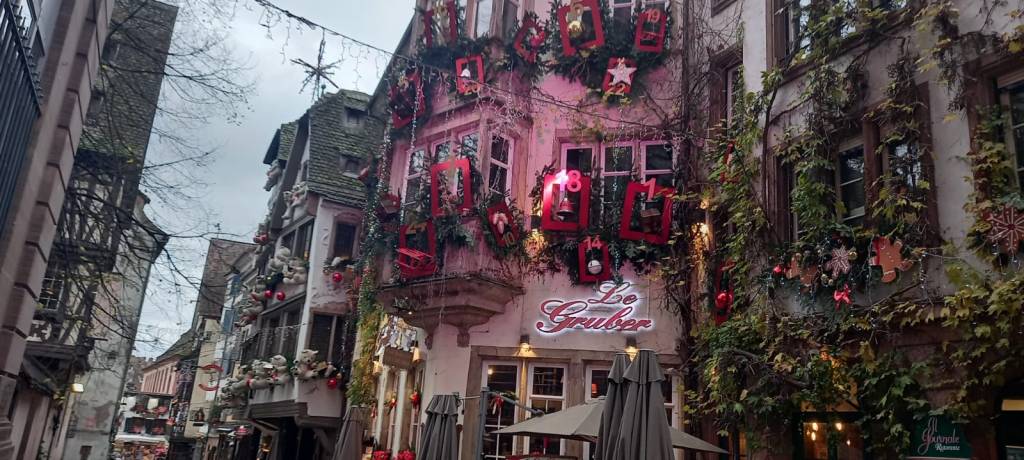
Over the decades Strasbourg has become famous worldwide as the “Capital of Christmas” thanks to its Christmas Market and its picturesque scenery and fairytale spirit. But do you really know how the Christmas market tradition started? Or, how Strasbourg gained its nickname?
Before diving in the enchanted world of Strasbourg’s Christmas market, let’s go back in time and focus on the origins of the practice. At first, Christmas markets didn’t exist in the same form as we know them today. In fact they were closer to some “December fairs” that had nothing to do with any particular celebration and originated in the German speaking world. There are also traces of the existence of “Saint Nicholas markets” taking place around the 6th of December, which makes sense as he was the one to be associated with gift giving before Santa Claus became such a prominent feature of Christmas celebrations.
As for Strasbourg it is commonly known that the Christmas market, or rather Christkindelsmärik (Christ child market), started in 1570. As mentioned previously, it is likely that this market evolved from a “Saint Nicholas” market that had to develop and change its name mostly due to the impact of the Reformation that discouraged the worshipping of saints.
Now let’s focus on Strasbourg. First, it is important to know that the market started to resemble its current form during the 19th century after changing locations in the city several times. In addition, something that not many people may know is that the “Capital of Christmas” nickname was created in 1992, as a way to attract tourists again after a period of decline in the previous decades. This new strategy also impacted the rest of the region, as many small Christmas markets started to appear in smaller towns. One of the symbols of the Christmas market also made its appearance in 1994, as the giant Christmas tree emerged on Strasbourg’s main square Place Kléber for the first time.
However, even though each year thousands of tourists come to Strasbourg to feel the magic of Christmas, not everything is so festive in its organisation. We can, for example, mention the scandal around the “banned items”, and indeed, in an effort to preserve traditions of the region some products are forbidden from being sold on the market. The problem is the logic behind this list of products, as it seems quite inexistant by moments. Why would dishes like tartiflette be prohibited from being sold, while Italian products and hot-dogs are authorised under some conditions. Some general Christmas souvenirs and articles are also supposedly banned, though from what I remember of my experience at the Christmas market in the previous years, they were still sold at some stands.
Whilst the municipality claims its trying to preserve the traditional ambience of the market, one of the main complaints of locals is the over-commercial and overdone aspect that has now taken the market, which makes it lose all its traditional aspect. Indeed, the market has nothing to do with a magical event for many, as it just prevents them from living their usual lives. The complaint doesn’t only come from the excess of tourists present in the city in December, but also from the security measures that for some are just too much. Even though we can all agree that security plays a significant part in the organisation of such an event.
However, it’s also important to point out the good initiatives that were put in place to try to make the market more sustainable. For example, we can mention the reduction of light pollution with the Christmas lights only being turned on during a specific period of time. We can also talk about the “Sharing Village”, a small market dedicated to voluntary organisations which allows them to make their missions and work known to more people.
As we can see, the history of Strasbourg’s Christmas market is very long and complicated. After changing its locations and forms many times, it finally found its current one, which will also have to change sooner or later if we want it to continue existing. Its organisation needs to evolve in order for it to be pleasant both for touristic purposes and most importantly for the locals. However, despite all the issues with the Christmas market it is still a symbol for the city, and will hopefully continue to be one for a long time.
Chloé Gaschy
Sources:
English language:
A Brief History of Christmas Markets | Smithsonian
Marché de Noël à Strasbourg – Noël à Strasbourg
Culture and Traditions – Noël à Strasbourg
French language:
La véritable histoire du marché de Noël : près de 500 ans de commerce et de tradition à Strasbourg
Marché de Noël de Strasbourg : ce qui est autorisé ou interdit | France Culture
Stras Wars : la liste des produits interdits au prochain Marché de Noël crée la polémique
On a discuté avec les Strasbourgeois qui n’aiment pas le marché de Noël
Further Reading:
The surprisingly sordid history of Germany’s Christmas markets
Salle “Le marché de Noël “- Exposition “Fêtes de fin d’année, fins d’années en fête” –
 VOICES
Leave a comment