
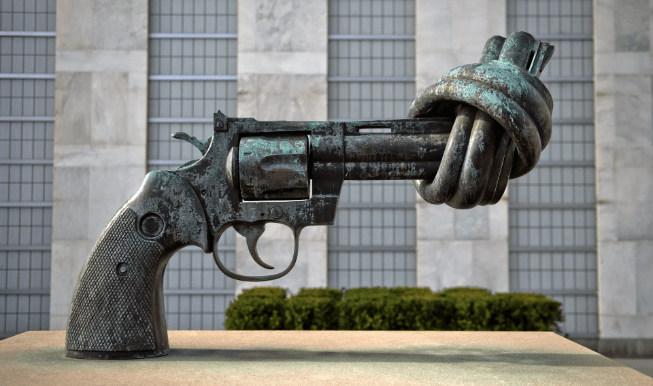
The main question we can have in our century is: How to deal with violence in 2024? This is asked every year by a lot of historians, scientists, and teachers, who meet to talk about how much violence is present in our lives unconsciously. In this way, they try, by their research, to make people understand that even if we know violence exists we aren’t aware of that in our own life. Indeed, every day and everywhere, violence is around us, and to understand why, some answers have been found.
Our current society increasingly sees the question of living together coexisting with current societal violence. This is due to different elements of fractures that we have seen accumulating for some years, it’s what Roland Javier, a French social scientist, explains. First, we have the gender fractures, with the MeToo movement which revealed to the general public the sexual and gender violence present in the world, which are silent violence but they are violence. Second, geopolitical fractures, like wars, occur in many countries worldwide (eg. Ukraine and Russia war). Third, joins the second fracture, the religious fractures because the relations between religious communities are more and more violent, as we can see with the War in Palestine and the Israeli-Palestinian conflict. Fourth, the territorial fractures, at the level of housing for example with the different territorial inequalities. Fifth, the social fractures which are the widest but nevertheless the most present in the world. Sixth, technological divides with complicated access to digital as well as access to services for people without digital knowledge or equipment. Finally, environmental divides as we often reduce this question because of the difficulties and costs related to climate change, however, this question remains very important.
These fractures, according to scientists, show the degradation of a near and certain future. The whole society must build a new narrative and societal project that advocates equality, support, and solidarity. However, despite this urgency and ambition, it is necessary now to face ruptures historical and individualistic. There is also the breakdown of trust, which is important to note. Worldwide citizens no longer have confidence in institutions, in all political or social themes, which are much questioned on their legitimacy. This is why social work is important because social intervention practices are part of new forms of action within these institutions that no longer carry within them the myth of a perfect society. From researchers, the challenge would then be that, in social intervention practices, society assumes its biodiversity as well as its institutional violence.
To do this, it would be necessary to establish an inclusive society in which inclusion is based on the premise that all people, whatever their particularity, are a social resource. Thus, everyone must defend this inclusion. This is possible by opening spaces for debate to deliberate collectively on the paths of solidarity, on how to act concretely in the territories to demonstrate that discussion with everyone about the violence present in our lives, is today an important investment, even essential to our society. It’s also necessary to succeed in working on the empowerment of all the population and actors through non-violence to move towards human and collective security. Moreover, the change in the mentalities of society, regarding the subject of non-violence and violence, is important and can be done gradually by sharing experiences and memories. The strength of this action is the common vision of an inclusive and relational society. In addition, the importance is to speak directly about the current problems that the populations are experiencing. It is necessary to have a discussion with everyone with all these points of view as well as the usefulness of finding a compromise (we agree to put aside certain things to find an “agreement”).
This discussion with everyone can make us realize the place of violence in our lives. When we hear violence, we don’t often think about ourselves, because for us violence is necessarily physical, with visible damage to our bodies, but what we forget it’s that, most of the time, the violence leaves invisible marks inside of our souls. However, we cannot deny that violence exists and is there, which is why we find the word “violence” in the term non-violence. We cannot deny that violence is deeply rooted in our daily lives, but we can try personally to fix that in our routines. For this, we try to apply non-violent communication.
That’s why going to the conflict is an important thing to apply. We don’t talk about violence and physical conflict, but more about idea’s conflict. When you do not agree with someone the most important thing is to talk with them. But how to do this without violence? This is the goal of non-violent communication and it’s to avoid as much as possible that the conflict leads to aggression or violence. Indeed, the conflict is neither good nor bad in itself, it is positive when it leads to dialogue, negotiations, or new agreements. Conflict is nevertheless something necessary in human relations, it allows to highlight the emotions and feelings of everyone, in order to find a compromise. We must not wait for the crisis to manifest itself, it is one of the doctrines of non-violence.
Another doctrine of non-violence is to admit that the escape doesn’t represent weakness. It simply shows that we were not prepared to respond, so we do not flee; we withdraw in order to move away to come back to face the situation or the crisis better.
This shows the importance of the emotions that enter into the strategy of non-violence, in particular, love, which is the heart as well as the starting point of non-violence. Love allows respect but also the opportunity for others to listen to us. In addition, emotions are very important to understand the conflict. What causes them is the personal analysis that we make of it. When faced with the same situation, according to the analysis that we make of it, we do not experience it the same way, which is why we cannot blame someone for the emotion that they make us feel. So, to defuse a conflict and calm a situation, we must enter the other person’s emotional level, to establish non-violent communication. We must distinguish between the person’s fundamental needs and the solutions found. The bases of this reflection are emotional intelligence and active listening: we must understand their emotions, and those of others and collect them, then take into account the point of view of the person opposite to succeed in bringing them to our point of view and understanding them. What is major in non-violent communication is listening when we use it to gain perspective and talk about our emotions.
To conclude, we have understood that emotions are the main thing to understand to allow us to communicate non violently with everyone. By understanding each other’s feelings, we can talk calmly about what is going on and settle the conflict.
But we must be careful about how we want to do it because we take the risk of identifying the other with ourselves, which is not good on our part. Indeed, by doing this we reduce the other to our posture and our profile, we do not identify him as a full-fledged individual. In this way, we do violence to his integrity and his person by imposing our vision of his life, his experience, and his emotions. That’s why, non-violent communication is a lifetime’s work, we need to push ourselves in this mindset to start to apply it. Even if this is special work, it’s, for me, the only way to start living in a better society; a society that takes care of everyone, where every human finds their place where they want to be, a society founded on solidarity and equality.
Lilou Baudin
 VOICES
Leave a comment