
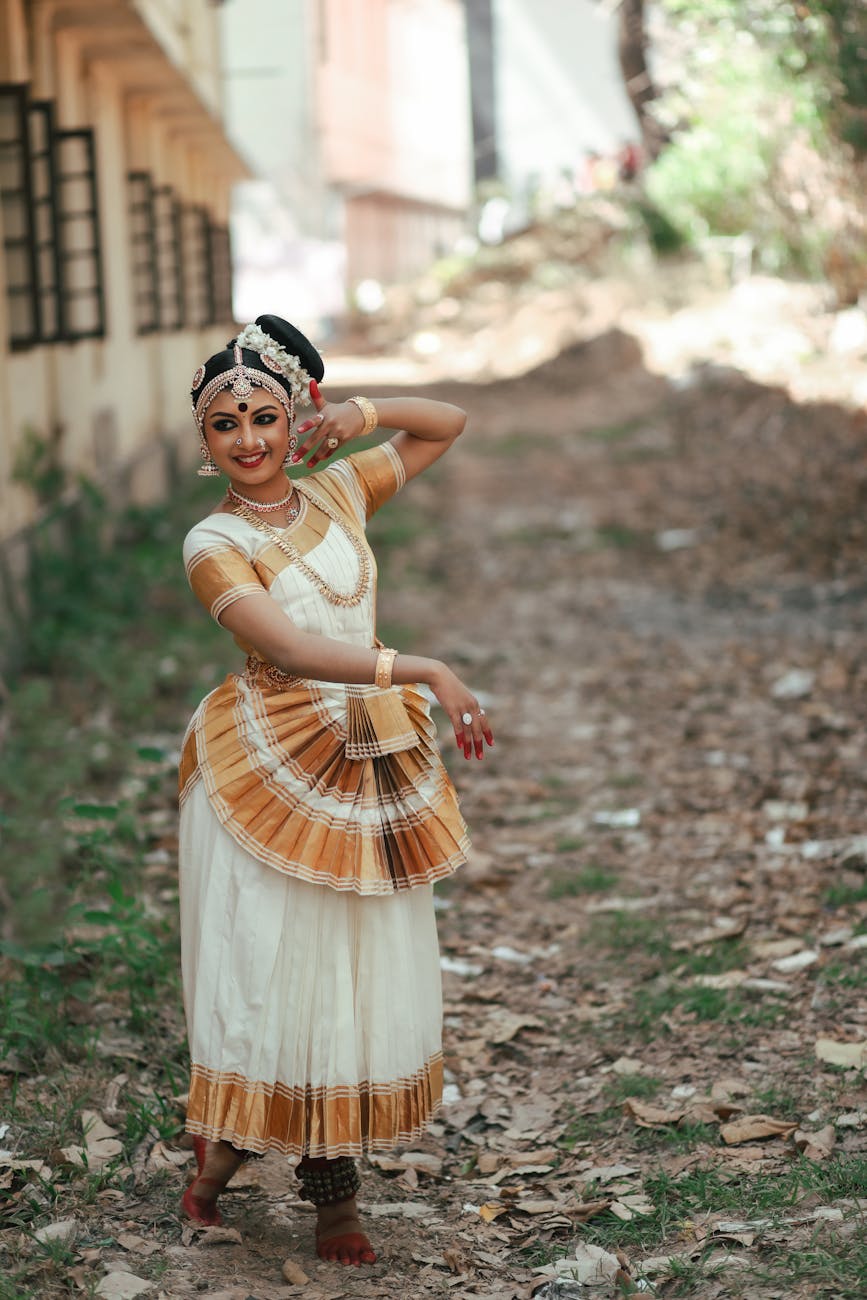
Bharatanatyam is considered India’s oldest traditional dance form, blending classical form and martial art.
This art came from Tamil people, in South India, and is practiced especially in Tamil Nadu and Tamil Eelam (Ceylon Island), but very popular in the whole Indian subcontinent. Since then, it has been linked to the region’s religious practices. Indian dance is connected to the soul, spirits, and ancestors.
It has its God in India, Shiva, precisely Nataraja, the dancing avatar of Shiva. We can find writings on Bharatanatyam dating back to a century BC, and the oldest book we have nowadays is called Natyasastra, from the 2nd century. It is still used to practice Bharatanatyam to transmit this art in the best possible way.
The word “Bharatanatyam” has three syllables referring to three Tamil words: “Bavam” meaning facial expression, “Ragam” – music and rhythm, and finally, “Thalam” – the mudras (the gesture with the hands). It also refers to the supposed creator, Bharata, an Indian sage. Bharat is also the name of India in Hindi.
During the British colonization, Bharatanatyam was prohibited, considered useless, impure, and pervert according to the British settlers. Actually, they forbid a lot of cults from Hinduism, treat the devadasis (dancers devoted to Devas) as prostitutes, and use them to display obscenities.
But it was not forbidden in the French part of India, Puducherry. When the French deported Tamil people to the Caribbean and the Mascarenes, they still practiced this art and brought it abroad. Nowadays, Bharatanatyam is still popular in these places with the same codes as when it was created, and it’s part of its preservation.
Actually, thanks to the strict codes, they preserved it; there are two main times for the performance: Nritta, the first part, abstract, very strict and codified, more aesthetic. Natya, the second part, is more theatrical, narrative, and creative: they use mudras and facial expressions to relate feelings and emotions.
Mastery of this art requires many years of hard training, to ensure that the mudras are perfectly coordinated with the position of the feet. When you learn this for a long time, you cannot forget it, even if they deport you, even if they don’t allow you to dance. It’s ink in the DNA.
Tamil people also transmit this heritage through the sculptures and writings on the walls of the temples. The most famous temple with traces of this art is Chidambaram temple, district of Cuddalore, Tamil Nadu. Built during the Chola Dynasty, there is a gold sculpture of Nataraja, and Devadasis used to do devoted dances for Shiva in this temple.
Finally, the culture of Bharatanatyam abroad is well-preserved, thanks to the representations of this art in Kovils (Hindu temples), also during religious celebrations, like Tamil New Year, Samblani, or Holi. Which is celebrated obviously in India, likewise in Trinidad and Tobago, Guyana, Reunion Island, Guadeloupe, and Guiana. In these places, Bharatanatyam is a bit different from India, because Hindu people practice an ancient form of Hinduism, which is influenced by their own regional culture from Tamil Nadu, and Creole culture, with the respect of their ancestors.
Terry Ruart
Sources:
Nataraja: How the dancing avatar of Shiva made his way from rock sculptures to modern physics
ANNEXE DANSE ETHNOCULTURELLE : Inde – Bharata natyam
 VOICES
Leave a comment