
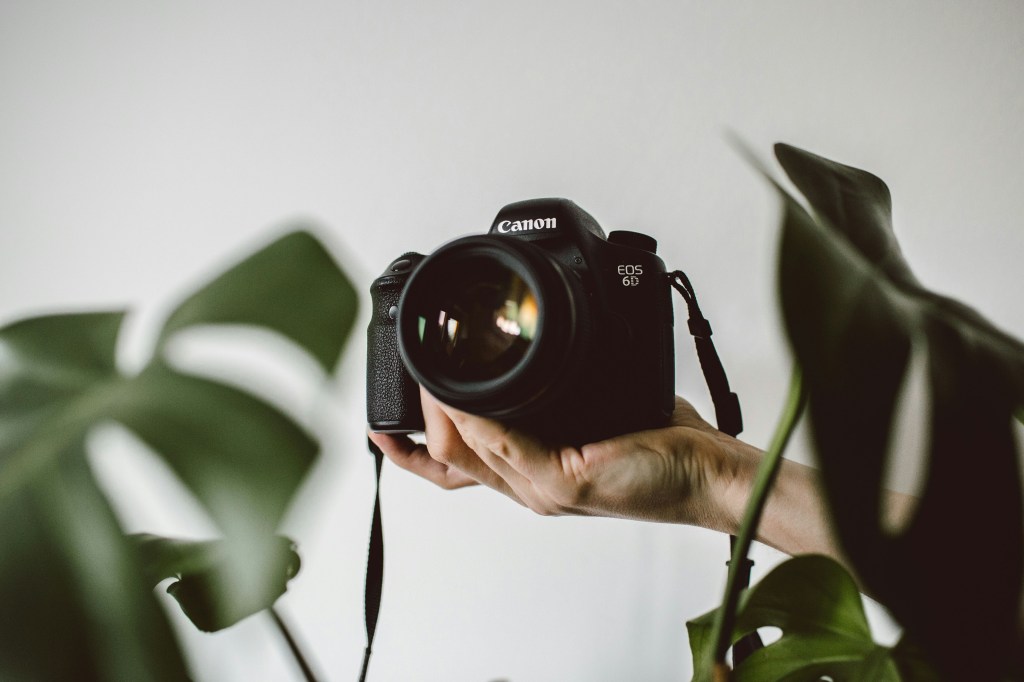
In the beginnings of photography, the dark room was used by Aristotle, by the Persian scholar Ibn Al-Haytham and by Leonardo da Vinci. The darkroom consists of a closed room with only a small hole so that light can pass through and print the desired subject on a flat surface. This concept is fundamental to photography today.
With the first discoveries of the dark room and the heliography (an early photographic process, based on the hardening of bitumen in sunlight). The first photographic process was invented by Nicéphore Niépce around 1824. And at the same time, he did the first pictures. “The Set Table” is the first fixed still life and one of the first photographs, taken on an unknown date in the early 1820s or 1830s.
A few years later, Louis Daguerre, an inventor, an artist and a painter, interested in photography showed the world his revolutionary discovery, the process discovered allowing for the first time to take detailed portraits.
But, how? Daguerre realized that by soaking the plate in a saline solution, he could prevent the image from darkening over time. By discovering the principle of latent image development, Daguerre shortened the exposure time to a few tens of minutes.
In 1839, he promoted his invention to the scientist and deputy, François Arago, who gave him his support. Thus, the conventional date of the invention of photography is January 7, 1839, the day of Arago’s presentation to the Academy of Sciences of Daguerre’s “invention”.
The evolution of the cameras
List of the Evolution of the Camera Timeline:
The Camera Obscura: The first camera – 400 BC to early 1800s
A camera obscura (camerae obscurae or camera obscuras, from Latin, camera obscūra ‘dark chamber’) is the natural phenomenon in which the rays of light passing through a small hole into a dark space form an image where they strike a surface, resulting in an inverted (upside down) and reversed (left to right) projection of the view outside.
The Daguerreotype Camera: Early photography – early 1800s to late 1800s
To create an image, a daguerreotype would polish a plate of silver-plated copper to a mirror finish, sensitize it with fumes, expose it in a camera, reveal the latent image with mercury vapor, fix it with a chemical treatment, rinsed it, dried it, then protected it behind glass.
Roll Film: Multiple Exposures – 1888 to 1934
Roll film or rollfilm is any type of spool-wound photographic film protected from white light exposure by a paper backing. The term originated in contrast to sheet film. Confusingly, roll film was originally often referred to as “cartridge” film because of its resemblance to a shotgun cartridge.
35mm Film – 1934 – early 2000s
135 film, more popularly referred to as 35mm film or 35mm, is a format of photographic film with a film gauge of 35mm (1.4 in) loaded into a standardized type of magazine (also referred to as a cassette or cartridge) for use in 135 film cameras.
Polaroid – 1948 – 1990s
Polaroid is an instant camera that allows you to take silver photographs directly, without having to go through the separate operations of developing the film and printing on paper.
Digital camera – 1969 to current
A digital camera, also called a digicam, is a camera that captures photographs in digital memory. Most cameras produced today are digital, largely replacing those that capture images on photographic film or film stock.
Smartphones – 1999 to current
Now, the majority of people in the world use their phone to take photos. It’s easier for everyone, old or young; with a cheap phone or an expensive one.
Comparison and notable differences
Accessibility: Photography used to be the preserve of professionals or wealthy amateurs due to cumbersome cameras and films that required chemical development. Now, smartphones have revolutionized photography by making it possible for anyone to take high-quality photos instantly.
The quality: In the past, resolution was low, colors limited and inaccurate, and photos were often in black and white. Now, images are in high definition with a wide color gamut.
Editing: In the past, retouching was done by hand, requiring specific skills in the darkroom. Today, software such as Lightroom, Photoshop and mobile applications enable complex retouching with professional rendering.
Sharing and diffusion: Sharing photos used to be limited to paper prints or slides at family or professional gatherings. Now, social networks and online platforms enable instant, global sharing.
Whether you’re an amateur, a professional or just a person who likes to observe the beauty of the art of photography; whether you have a simple smartphone or a bulky, heavy camera; whether you like to give the photo the final touch or just keep it in its natural beauty – it’s fascinating for everyone to know all the stages photography has gone through and how it has developed over the years.
Mathieu Trupin
Sources:
https://www.capture.com/blogs/insights/evolution-of-the-camera
 VOICES
Leave a comment