
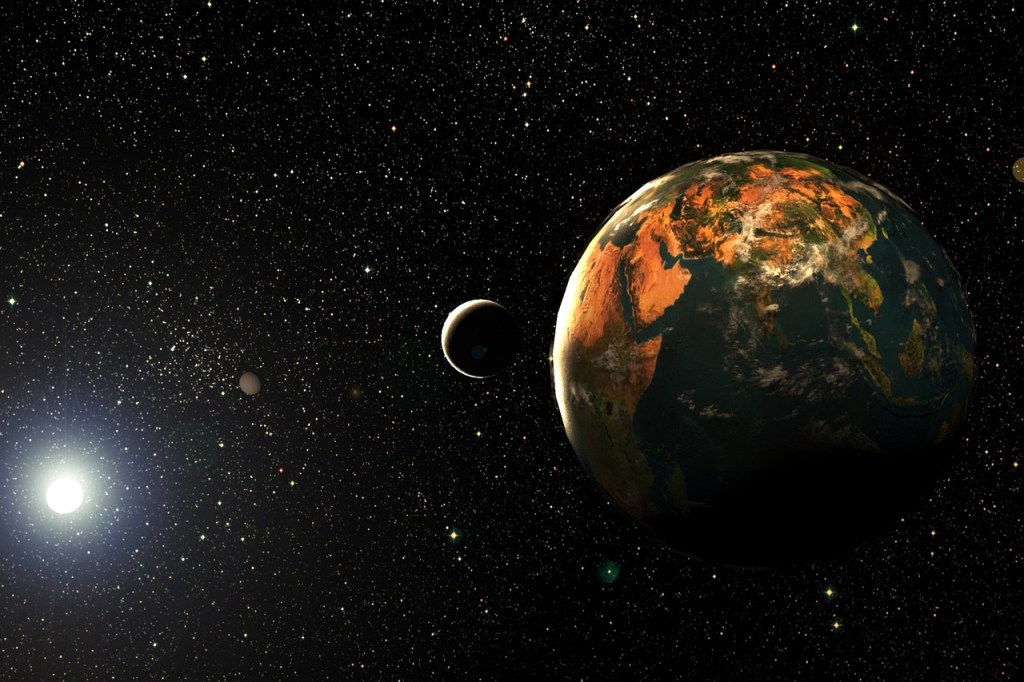
Have you ever thought about how cool it would be to live on Mars? You are not alone with that thought. Space is one of the things that fascinates people the most and science-fiction fans, as well as scientists, are fantasizing about the idea of living on another planet.
To find a planet that is habitable for humans there are two different ways scientists go. On the one hand, astronomers search for exoplanets (planets outside of our solar system) that already have characteristics that we need for human life. Of course, if we find planets like this there is also the possibility to find Earth-like life already there. In the solar systems e.g. Trappis or Kepler there are some possible planets that could be suitable. However, we haven’t even found a way to send a person to Mars yet and as fascinating as life in space is, going to another solar system is pretty unrealistic for now.
The second way scientists go is to find ways to change the characteristics of a planet or even a moon of our solar system to make it suitable for human life. This idea is called Terraforming. NASA has defined the main habitability criteria as “extended regions of liquid water, conditions favorable for the complex organic molecules, and energy sources to sustain metabolism”.
But what does that mean specifically? In the end, the idea is to have appropriate environmental conditions for humans and plants to be able to survive without any special equipment. Firstly, we need a temperature in a habitable range. We need an atmosphere in which we can breathe, the pressure is regulated and it should protect us from solar radiation and sun storms. For the protection against sun storms also a magnetic field would be useful. Apart from the characteristics of the setting, we need some requirements to not only be able to exist on the planet, but to sustain life and have a whole ecosystem there. For that, we need to meet some elemental requirements, like the elements all life is built on (carbon, hydrogen, nitrogen, oxygen, phosphorus and sulfur), some other specific elements, solvents, good composition of the soil and of course, the most important thing – having liquid water. We need a habitat suitable for plants and preferably animals to sustain a well-nutritioned diet with access to sugars, fats and proteins. Additionally, there should be some way to get electricity e.g. through solar panels, and there should be some gravitation to not just fly away.
Regarding this criteria, we can now look at our solar system to determine which planet would be most suitable for living and how we can adapt it to actually be habitable. In our solar system there are 8 planets and over 170 moons. So with which planets or moons to start? Firstly, Jupiter and Saturn are gas planets…this means they don’t really have a surface that you can live on. Looking for example at Venus, there is acid rain. At the moment, Mars and some of the gas planet’s moons are the most promising terraforming candidates. Regarding the fact that Mars is the closest one to Earth and also in many aspects the most Earth-like planet, I will focus on this one, to get an idea of what needs to be done to terraform a planet.
Scientists believe that Mars once had a more Earth-like environment. So, why did Mars change to be different from Earth? Due to the smaller mass and gravitation of Mars than Earth, it cooled down and changed. Looking at Mars now there are some main problems. It only has a small magnet field (it covers around 40% of the surface) for protection against sun storms. Also due to the less gravitation it lost parts of its atmosphere so that it now has a too thin atmosphere and not enough pressure. Because of that the temperature on Mars is also not in a viable place. On the other hand, we have similar geographics on Mars like on Earth and many other similarities with which we can work. Mars has frozen water in the ground and there is bound CO2 (the former atmosphere) as potassium carbonate, that we can use.
The idea of terraforming Mars logically following is to warm up the planet again to reverse the effects of the cooling down. That would include building an atmosphere and having liquid water. If warmed up the bound CO2 in the ground would become gas again, build an atmosphere and raise the pressure. Due to CO2 being a greenhouse gas, the temperature would continue rising and the frozen water would become liquid. For this process you need more greenhouse gases than CO2, so a special mixture needs to be invented. Then we have the basic underlying aspects that we need for life. Nevertheless, we still can’t breathe in the atmosphere and would need to go out with O2-tanks. This is where algaes are joining the equation. They can resist a high CO2 concentration and change it to oxygen. Another way to do that would be to use electrolysis. Then you could implement plants that hold the concentrations steady. However, if we are at this point problems in the far future appear. Mars only gets 43% of the sunlight of Earth, so after a long time it would cool down again. Also, a built magnet field would be lost again in a long time. To prevent this we need more solutions.
There are many different ideas on how to do the actual heating of Mars, some more realistic, some less. The first idea is to implement gigantic mirrors in space that send the sunlight back to Mars to heat it. This isn’t that realistic though, because you need a lot of materials and transport these into space. There isn’t a plan yet about what to do with the gigantic mirror after the terraforming is completed. So, let’s continue searching for ideas. You could cover the poles of Mars with black powder, so they don’t reflect, but absorb the sunlight. Another really crazy idea is to use nuclear bombs to bomb the polar caps, so that it frees the stored CO2 and also warms up the atmosphere in the meantime. Then also you can let machines spread greenhouse gases like Methane and PFCs in the atmosphere to start a greenhouse effect. That’s a lot of ideas that need to be examined and further developed. Also, a combined way of methods would be possible, if not necessary regarding the fact that NASA found out that the CO2 on Mars isn’t enough to make Mars viable.
If all of that doesn’t work, there is still the option to use paraterraforming, which means building huge habitats in which you can breathe freely. This would be possible with our current technologies, but has some risks like leakage and a lot of effort for construction and maintenance. Also, partly terraforming a planet for plants and living in a habitat could be an option, as well as using paraterraforming as a temporary solution until the terraforming is done.
A lot of questions and just some answers, as you are probably thinking right now. Somehow you are right. Terraforming seems really like out of a science fiction movie and not really realistic. For now, that is definitely true, however, with terraforming being recognized as a possibility by NASA and SpaceX with research groups, it could be possible some day. Although, even if we would already have all the technological skills and start terraforming today, we would still need an incredibly long time to have a somehow habitable planet (definitely wouldn’t be possible in our lifetime). For today’s world it (still) seems more like something to explore in science fiction, but it could become reality.
Nevertheless, with the idea being a possibility, an ethical and environmental discussion regarding terraforming was born. Ethically speaking, the discussion is about how to balance the preservation of humanity and the value of existing planetary ecologies. On the one hand, people argue that it’s the obligation of humanity to make other planets habitable for humans to continue the transforming of the environments on Earth. They say that humans are facing a long-term decision between going extinct and terraforming, because the Earth would at some point be destroyed out of a natural course. Also, they believe that terraforming completely barren planets, it’s not morally wrong, because it doesn’t affect other life. On the other hand, people state that it’s unethical to interfere with nature, also regarding the fact how we treated the Earth’s nature.
People in the middle between these opinions, for example, believe that we can terraform once it is sure that there is no life on the planet, but not for human use, but to help alien life to be built and co-evolve and exist with humans. From an economical point of view, the research for terraforming and the terraforming itself needs massive resources that are even hard to imagine. To get an idea of it, imagine the effort of building and transporting a mirror with a diameter of 100-200 km, which is somehow as big as Cyprus. For now, these resources are unimaginable.
From my personal point of view, I love to fantasise about possibilities like terraforming and living on another planet, but for me they aren’t really realistic. Before we think about terraforming another planet, we should first think about how to stop the human-made climate change and maybe save our planet, before trying to make another planet habitable. The money flowing into the research could be used for a lot of better causes, scientific as well as social. However, we should never stop to imagine possibilities like this and keep on exploring and dreaming.
Maike Seuffert
Sources:
Wikipedia – Terraforming (en, de)
Wikipedia – Terraforming Mars (en, de)
Focus online – Terraforming Mars: So kann der rote Planet für Menschen bewohnbar werden
Techzeitgeist – Terraforming des Mars: Wie der rote Planet zur neuen Heimat der Menschheit wird
SWR – warum besteht das Leben aus Kohlenstoff
 VOICES
Leave a comment