
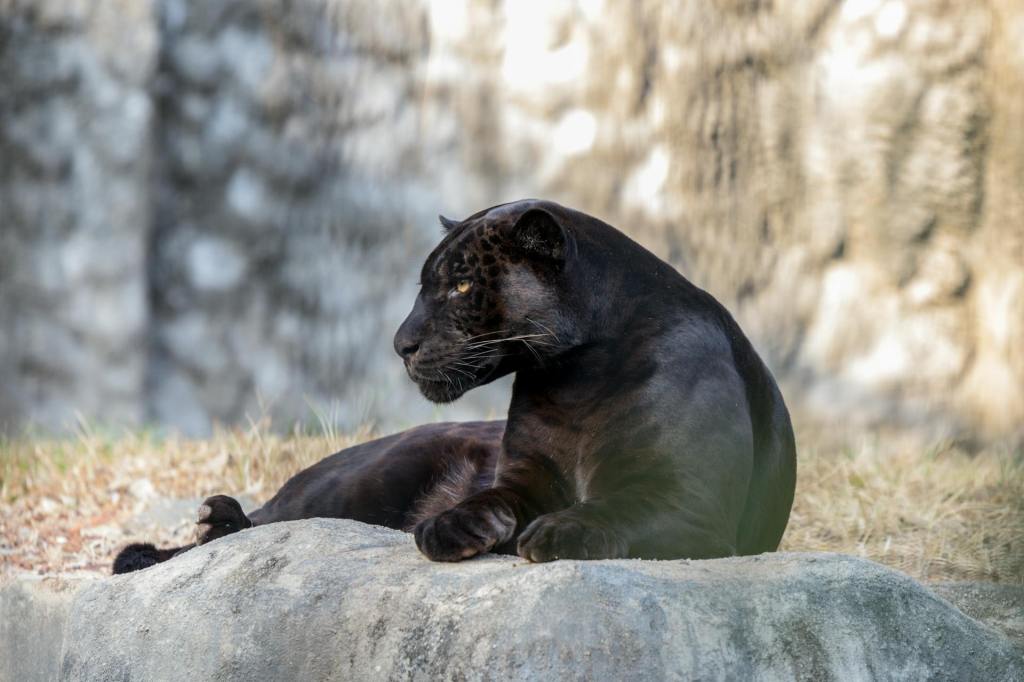
When a casual and mostly even as “fun” categorized activity turns out to become an earnest evaluation of a time, you know with quite some certainty that you are reading a poem from Rainer Maria Rilke. In one of his most well-known poems, “The Panther”, written between 1902 and 1903 Rilke performs precisely this brilliant move by using a visit in the Parisian “Jardin de Plantes” as opportunity to assess the prevalent loneliness, passivity, and lack of autonomy under the harsh, restrictive social rules and constraints of the time around the turn of century.
Rilke’s “Panther” is characterized by a meticulously clear and rigorous structure: The poem consists of twelve verses, evenly distributed over three stanzas. With the exception of the last verse, the verse meter is a steady five-beat iamb. Through the use of the cross rhyme as a rhyme scheme, alternating female and male cadences are created. Thereby the poem’s formal composition takes on an aesthetic yet strict form that not only symbolizes the cage of the panther on display described in the work, but also the metaphorical cage in which a notorious society concerned more about superficial appearance than inner wellbeing puts the individual.
In the poem’s first four verses composing the first stanza, the lyrical narrator describes the panther pacing up and down behind the bars of its cage which constrain his existence to the space within. With the beginning of the second stanza the attention of the lyrical speaker shifts to a closer examination of the panther’s gait and its circular path. At last, the lyrical subject points out the occasional opening of the panther’s eyes, reporting that this permits the panther to perceive the world around him but remains without any effects on his state of mind.
Throughout the whole process of observation captured in the poem, the lyrical narrator remains in the background without being ever mentioned explicitly. Likewise, the panther is only named in the title and in the first stanza only referred to through the two personal and possessive pronouns “Sein” (v. 1) and “Ihm” (v. 3). In all the following stanzas it is only implied that the subject of the lyrical speaker’s observations is the titling panther. With this reduction of the lyrical subject to the recipient’s lens and the panther to their observation, a very objective, almost sterile atmosphere is created right from the start resembling the scientific research conducted at the site of this lyrical piece, the Jardin de Plantes in Paris.
That the panther serves the poem as an object, that its role is a strictly passive one, is as well apparent with regards to the numerous personifications. On this occasion, not the panther but items and abstract processes such as the gaze, the bars, the will, and a picture get assigned human traits (see v. 1, 8, 10). All of these things are accused of active actions, while it appears that the panther is not doing anything, but rather only being done to. Nevertheless, the many personifications are not only demonstrating that even items and abstract processes seem to be more vivid and dynamic than the panther but even more so, the attributed actions appear to mirror the panther’s state of mind. Every action has something lethargic and melancholic about it: the “gaze” (v. 1) is “tired” and “holds nothing anymore” (v. 2), the “will” is “numbed” (v. 8) and the “picture” (v. 10) “ceases to be in the heart” (v. 12). In this way, the panther’s feelings are expressed indirectly: it seems to have lost interest in its life and the outside world, it has grown weary of it (cf. v. 1f.), its once ‘great will’ (v. 8) is numb, thus no longer existent, and every external impression leaves it internally unmoved, numb, and indifferent (see v. 10ff.).
The close connection between the panther’s state of mind and his imprisonment is most evident in the first stanza. In the first verse, the bars of the panther’s cage are repeatedly mentioned (see v. 1, 3, 4). On the one hand, they are held responsible for the tiring of the panther’s gaze (see v. 1). On the other hand, the bars limit his space to live thus mark the borders of his world as expressed with the help of a metaphor reinforced by repetition (see v. 3f.). The repetition of the contradictory hyperbole “a thousand sticks […] a thousand sticks” (v. 3f.) creates the impression of seemingly boundless limitation and thus emphasizes the panther’s perception of his captivity as monotonous and hopeless, which is the basis not only of the animal’s despair but also of its resignation and weariness with life.
Containing two consecutive alliterations that have a tone-painterly character, firstly “Gang geschmeidig” (v. 5) characterized by soft G and D sounds and secondly “starke Schritte” (v. 5), which is characterized by hard K and T, the poem’s fifth verse describes the softness and smoothness of the panther’s gait the power just as it does the strength and power of the predator. The thereby implicitly and explicitly created image of a majestic animal is supported by comparing the gait to a “dance” (v. 7). However, the comparison as well functions as a bridge to the limitations of the panther expressed by the hyperbole in verse 6, since the dance is bound to a fixed “center”. This leads to the impression that the outward elegance of the panther does not help against the limits that are set for the animal, perhaps precisely because of its inherent grace breaking its “will” (v. 8).
In this regard, the panther can be interpreted as a symbol of individuals trapped between social conventions and duties limiting their perception and dulling their spirit in the same way as the panther’s captivity. As a consequence, individuals become as lethargic and numb as the panther in the last stanza of the poem. On the rare occasion that individuals, like the panther, perceive something outside the boundaries of their very own cage, it still fails to touch their hearts and provoke a reaction. The poem can therefore be read not only as a mirror of the zeitgeist around the turn to the 19th century, but also as social criticism, a criticism of restrictive social constraints, but also individual passivity. Hence Rilke’s “Panther” is to be located on the literary spectrum somewhere between naturalism and aestheticism for its underlying social critique on the one hand and almost playfully regulated structure and the choice of the motif of the panther in the cage. In any case, the poem is a well-known work of the form of object poems focusing on the panther as an otherwise voiceless object and exploring its perspective getting down to the essence of not only the animal’s state of mind but rather the individual’s passivity within the tight-knit web of social norms, constraints, and hierarchies. Elaborating on the themes of experience, perception, and loneliness the poem is unquestionably a programmatic work of the literary era of the “fin de siécle”.
Sophia Abegg
Find the poem in German and English here: The Panther (poem) – Wikipedia
 VOICES
Leave a comment