
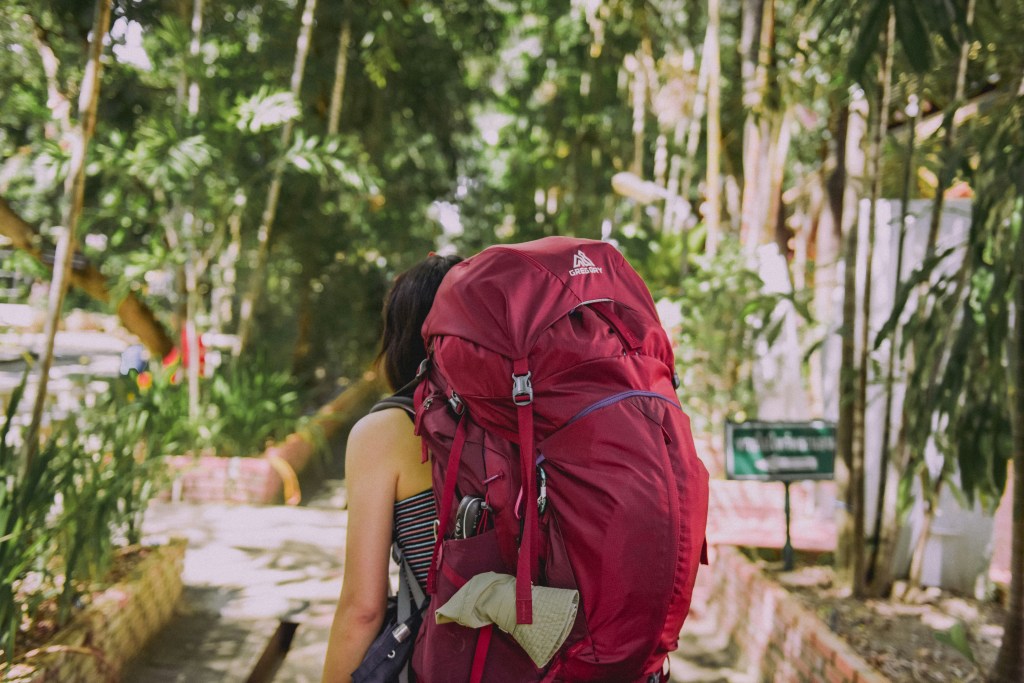
A one way ticket, no concrete plan, a dangerously low budget, and a complete trust in the good will of local people – such clichés and many others have been pivotal in constructing an idealised stereotype of backpacking, and the rituals that define the practice. Although these associations remain relevant, the art of backpacking itself has undergone a dramatic metamorphosis in recent years. In the context of Southeast Asia, an increased popularity amongst Western European youth shifted the raison d’être of backpacking as globalisation streamlined our travelling culture. Therefore, how can we find purpose in the current iteration of backpacking culture, and what are the collective responsibilities associated with this style of travel?
Navigating an extensive period of time away from home has never been for the faint-hearted. Ingrained in Western ideas of contemporary ‘exploration’, this style of wandering, spontaneity and naïve world curiosity could be situated somewhere between long-term travel and a curated lifestyle. For most, it presents a unique opportunity for an honest immersion into local society and culture, adopting similar techniques used for ethnographic research. This often manifests itself through a collective desire to ‘be like a local’, aiming to achieve a casual relationship with members of the host society. However, it is no short of a challenge – particularly in areas where cultural and political differences were not negotiated, or historical traumas can remain.
But it is the challenge itself that was so commonly sought after. What we would consider as ‘essentials’ today would be perceived as a luxury for many classical backpackers. Even as online forums became a popular medium for exchanging tips and recommendations, independence and uncertainty remained central to the experience. In this context, the idea of ‘comfort’ be in came, in a sense, quasi-antonymous with the culture itself. As such, backpacking can be considered as a sort of paradox. Its inherent drive towards openness, flexibility and curiosity comes with a caveat – resisting any deviation into conventionalism. This search for authenticity thus becomes a clear motivation behind the vision of an ideal backpacking experience.
With the rise of mass tourism, this culture of wanderlust is something that has seemingly vanished amongst the majority of contemporary backpackers. As global networks expanded, travelling has become much faster and simpler to navigate. The digitalisation of information and logistics alleviates the pressure of preparing such a long journey, opening the possibility of backpacking to a much larger audience. In this sense, challenges have become obstacles rather than opportunities. But what has been more pivotal in changing backpacking culture is how curated media redefined the expectations of many destinations. In the case of Southeast Asia, tourist hotspots are often promoted as a form of ‘tropical paradise’ which has successfully captivated a large audience of young people. This aesthetic trap means that many places had to adapt to the genre of activities that Western tourists expect to guarantee consistent revenue. Therefore, it becomes a routine and replicated experience. Many backpackers will stay in the same hostels, return to the same beach bars and temples, swim in the same waterfalls and engage in some version of this itinerary in each following place they visit.
Changes in travel culture consequently had material changes in popular destinations. Southeast Asia has seen rapid development to adjust to this new surge of backpackers, with some areas isolating further from the everyday life and practices of locals. Taking Canggu as an example, this small town on the Balinese coast has become dominated by concrete buildings accommodating almost any activity popular in Western countries. It has become a confluence of exoticism and gentrification, attempting to navigate the expectations of both in one place. Sunrise surf classes, upmarket brunch spots, beach bars, padel courts and networking spaces are plentiful. Tourism has been put in direct tension with tradition – whether this is in culture, industry or lifestyle. With rising costs, Bali’s agricultural sector has been declining to free space for commercial expansion. Even green belt initiatives do not suffice to protect local people or guarantee liveability, particularly as the economic potential from tourism trumps that of any farming potential on the island.
It has become a familiar image across the region. Krabi, Phi Phi and Phuket in Thailand have also transformed into backpacking havens, offering nightly fire shows, boat day trips, snorkeling with sharks and ample opportunity to party. Hostel chains emerge frequently and en masse in desired locations; areas of natural beauty are desecrated by ostentatious Hollywood-like signs and crowds competing for the ideal photo spot. For those who defend backpacking orthodoxy, the only difference between typical tourists and the current backpacker culture is that they wear a bag on their back instead of bringing a suitcase.
Nonetheless, there are lessons to be learned from both sides. For someone who is eager to embark on a long-term voyage and get lost in the world, this tendency towards the mainstream can be disheartening. However, it is equally as important to maintain a level of sensibility. The pressure to continually immerse yourself in authentic, irreplicable experiences can be exhausting. There is nothing wrong with going on a popular excursion, booking a hotel to rest, eating pasta instead of pad thai, and most importantly, taking care of yourself. Not every day requires an exhilarating experience to feel fulfilled, and you do not need to return home as a changed person. Long-term travel carries the same personal responsibilities, sensitivities and challenges as it would back home. Moreover, the purpose of your trip can change over time, too. Creating distance from expectations within travel subcultures can help to separate societal pressure from what you truly feel you want to experience and achieve. Altering your perspective and remaining honest will help to find true purpose and meaning in your journey.
What is equally crucial is maintaining a sense of awareness for local society, culture and environment. Our travelling footprint can leave just as much an opportunity as consequences for our hosts. We need to be conscious of our choices, and try to reflect on how we can best impact the places in which we travel. Even challenging stereotypes, both when travelling and back home, can help to improve awareness and remove any stigma. Being aware of your own positionality can make genuine differences, no matter how small they are.
So how can we find purpose and meaning? It all depends on the individual. There are no right or wrong answers, but there are conscious choices you can make to reduce negative impacts on yourself and others. In the context of Southeast Asia, as one of the most popular regions of backpacking, there are plenty of fellow backpackers who engage in different activities, plans and perspectives. Anyone can find something that suits their needs and goals with patience, honesty and curiosity.
Dawid Kościelniak
Sources:
Medium – Expats Living in Bali Are Contributing to Gentrification
Modern Diplomacy – Travel Colonialism in Bali: How Tourists’ Dreams Become the Local’s Nightmare
Aninjustice Mag – Concreting Bali’s rice fields: The price we pay for paradise?
National Geographic – The student gap year is evolving — and travel with purpose is more popular than ever
ScienceDirect – A postcolonial analysis of backpacking – ScienceDirect
ResearchGate – Backpacking Southeast Asia – Strategies of “looking local”
Nomadic Matt – Travel Writer Rolf Potts on Backpacking and Travel
 VOICES
Leave a comment