
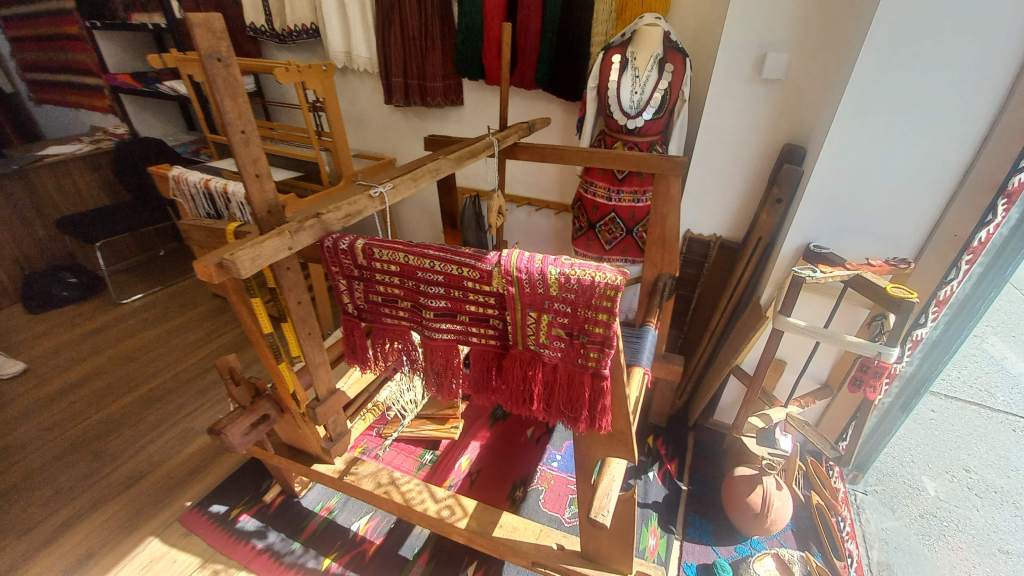
The idea for this article came to my mind while I was doing the design for my previous article titled “A Linguistic Tapestry of the Balkans”. I have always been drawn to traditional clothing from different countries, especially to the often colorful and intricate designs embroidered on them. So, this was the perfect occasion to interview Damjan and Sara. They’re two young and passionate people who also happen to be the owners of Народни Носии/Narodni Nosii (Folk Costumes), a store, which is located in the heart of Skopje. Thus, Damjan and Sara spoke with us about the ancient and delicate technique of weaving on a loom and their love for preserving traditions and traditional Macedonian clothing.
When you enter the store, you may first notice the presence of several mannequins dressed in full traditional outfits. While preparing the questions for this interview I found out that Damjan is also a collector of such outfits, so naturally, I asked them if they were part of their private collection, and Damjan explained: “Well, no, the work is divided into two parts. One part is my private collection that we have at home, which has nothing to do with this store”.
Some may be surprised by Damjan and Sara’s young age, especially when you discover that they know how to weave. However, everything starts to make sense once you know that Damjan grew up in an environment that really focused on traditions, and thus on their preservation. From seeing pictures of relatives in traditional clothing to inheriting pieces that were made and worn by relatives and that are now part of a private collection. About this collection, I wondered if there was any piece that was more valuable than the others. “To be honest all the pieces are valuable but the most valuable are the ones that are from our ancestors, that is, from my family” – Damjan explained.
It is quite interesting to know that weaving was more of the starting point of this now passion for traditional clothes. It is even more interesting to know that what is now a business started as a random discovery. Indeed, despite starting to be taught at 15 how to weave by his grandmother, we found out that he was the one who asked her to teach him, after a random discovery. “Honestly, she didn’t want to teach me. However, it happened spontaneously, after seeing some YouTube video, about women in Serbia, who weave rugs, and are known worldwide”. While at first she may have been a bit reluctant to teach him, she eventually helped him learn all the complex processes of weaving step by step.
Now one might wonder how the idea to turn this passion finally became a business. Well, Damjan and Sara always sort of had the idea that if weaving really became a serious thing they should start a business, “to show to not only young people, but to everyone that weaving is not extinct, that young people are learning and practicing it”. This dream became a reality in part thanks to a grant from the Employment Service Agency, which helped them to start a business from scratch. That is from renovating the place to materials such as fabrics or even a second weaving loom.
On the topic of business, I was also really curious about who the public for the store was, as a traditional costume business is a really niche thing. At first, I thought that foreigners could be the main clientele. However, it turns out that Macedonians are actually the main customer base, especially folk ensembles, as they order the costumes in bulk. Moreover, I think everyone will be surprised to learn that Narodni Nosii is actually the only store in Macedonia that sells traditional costumes in which you can see how they are made. Since the pieces are handmade, each one of them is unique. As Damjan showed us, some will have additional colored details or have wider elements.
Apart from ensembles, some locals, or Macedonians that live abroad also buy some things because they want to preserve traditions and wear traditional costumes. While tourists mostly just buy the small souvenirs that the store sells, or small elements like belts, scarves, or vests that can be worn more easily in everyday life.
But “Narodni Nosii” is not just a business. Somehow, it’s also a way, especially for young Macedonians like Damjan and Sara, to remember their traditional clothing and most importantly their cultural significance. As Damjan told us, maybe some families don’t have gold or money to pass on to new generations, however, they may possess some piece of folk clothing which in a way is a direct connection with their ancestors. And that’s the most valuable thing, as it is always essential to remember your roots and heritage. This point is also connected with the little piece of wisdom Damjan chose to share with us on traditional Macedonian clothing. Which is that everyone should make an effort to preserve their own tradition, whether it is clothing, music, instruments, or even oral tradition. If everyone were to work on this common goal, then it would not only be better for us as individuals, but also as a whole.
This interview, especially the last part, encourages us to reflect on our country’s traditions and folklore. Indeed these cultural elements are too often taken for granted, in the way that we don’t necessarily realize that we collectively have to make efforts to preserve and transmit them. However, if no one passes on this knowledge it risks being forgotten. So maybe we could all use a bit of time to reflect on the traditions of our countries, and how we could contribute to their passing on.
Finally, I’d like to thank Damjan and Sara once again for agreeing to do this interview! And I’d also like to thank my fellow volunteer Jakub for accompanying me to the interview. For me, it was an interesting challenge to conduct it in Macedonian despite not being fluent in it. And I hope this article will make you want to visit their store.
Chloe Gaschy
Find them at:
Narodni Nosii, ul. Dimitrie Cupovski 2A, Skopje, 1000
instagram: @narodninosii33
 VOICES
Leave a comment