
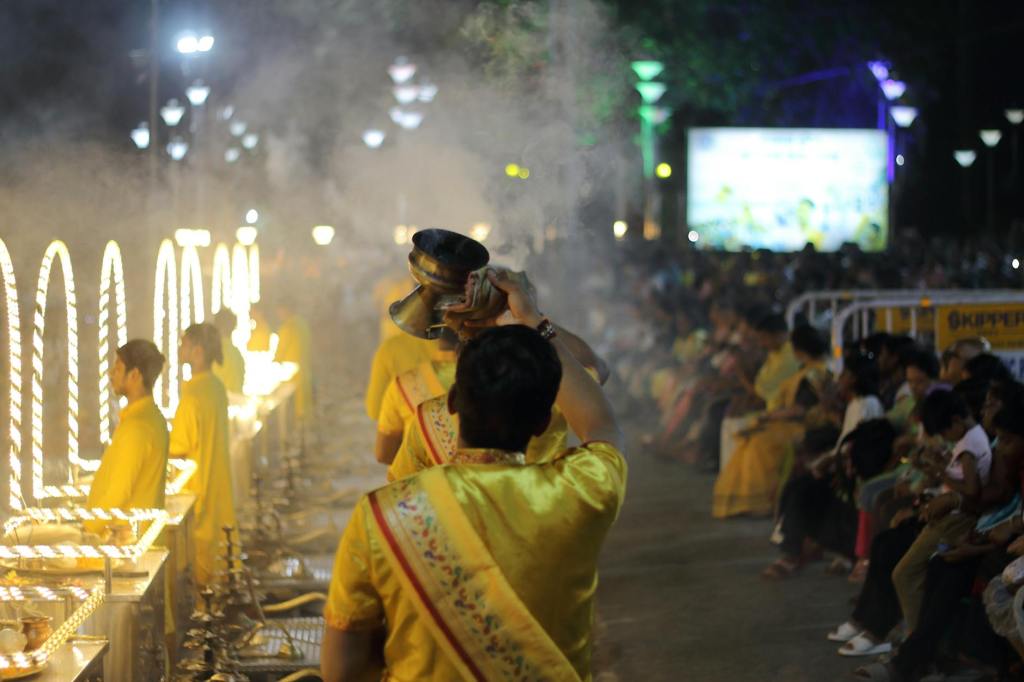
I’ve talked a lot about the Caribbean already and mentioned that Hinduism is the second-largest religion in this area. How is that possible?
How does Hinduism appear in the Caribbean?
During the second part of the XVIII century, the British and French brought South Asians to the Caribbean and the Mascarenes to replace enslaved Africans and Indigenous laborers. They received the same treatment as the slaves, facing harsh conditions: forced labor, conversion attempts to Catholicism, and physical punishment. But unlike enslaved Africans, they were allowed to keep their religion, except for the practice of cremation.
Despite the hardships, many of these migrants found ways to adapt. They accepted Catholicism, but at the same time, they built kovils (Hindu temples) and began blending Hinduism with Catholic elements, a form of religious syncretism. They call it Caribbean Shaktism because of the mix between Shakti Kali and Amma, Tamil deities in Hinduism. In the French Caribbean in particular, the worship of Murugan and Amma became central, especially among Tamil communities. Shiva and Lakshmi also became popular.
Hinduism is widely practiced in parts of the Caribbean, though often infused with Catholic tones, especially in places like Trinidad, Guadeloupe, and Martinique, where French colonial influence was strong.
You might be thinking, “Wait, isn’t Trinidad an old British colony? Don’t they speak English?” You’re absolutely right. But before the British took over, Spain colonized Trinidad and Tobago, and then France. Even the capital, Port of Spain, reflects this colonial history. And yes, they also speak Creole there.
Similar blends of Hindu and local traditions can be found in Mauritius, Réunion Island, and South Africa, largely due to the Tamil diaspora. The form of Hinduism practiced in the Caribbean differs significantly from Indian Hinduism. Even within India, practices vary by region, and the caste system still plays a major role. However, in the Caribbean, many of the Indians brought over were Dalits, those outside the traditional caste system, who faced severe discrimination back home. For some, migration was also a form of escape from colorism, violence, and systemic exclusion. Ironically, while their situation was initially very difficult in the Caribbean, it offered a chance to rebuild a religious and cultural identity on different terms.
Even if it was worse at the beginning.
Today, in Guadeloupe alone, there are over 500 kovils. We celebrate Deepavali, Holi, Pongal, and Samblani, Caribbean style. These festivals have grown so much that they may soon become official public holidays, just like in Réunion and Mauritius. In Trinidad, Guyana, and Suriname, they already are. That makes sense given the demographics: Indians make up about 40% of the population in Guyana and Trinidad, 30% in Suriname, but only 25% in Guadeloupe and 9% in Martinique.
Suppose you have the opportunity to travel across the Caribbean. In that case, I recommend that you visit the Temple in the Sea in Carapichaima (Trinidad), Arya Diwaker in Paramaribo (Suriname), Sri Sri Gaura Nitai Ashirvad Mandir, and Hare Krishna Study Centre in Georgetown (Guyana), and Changy temple in Capesterre-Belle-Eau (Guadeloupe). If you want to enjoy your trip in the Caribbean, you should appreciate all the cultural elements it offers: Caribbean, African, native American, and Indian. Try all the food you can, visit everything, and appreciate the vibe. You will thank me later.
Terry Ruart
Guadeloupe : Celui qui revendique la part hindoue de son identité – Vos photos notre histoire
 VOICES
Leave a comment