
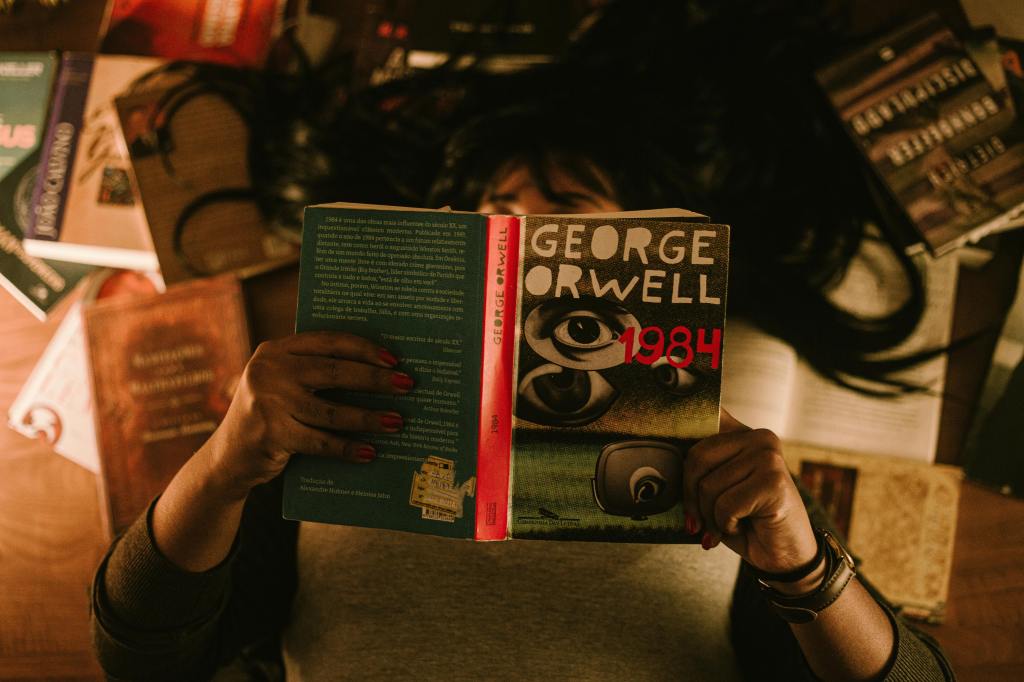
Review on George Orwell’s Novel 1984
1984 is not just a classic or a “good” book that the high school literature teacher propagates with all her pathos. Treating it as such would diminish its values and cloak it with a certain cynical mediocrity.
“War is Peace. Freedom is Slavery. Ignorance is Strength” is the refrain accompanying the reader throughout this book. At first glance, this might seem like the product of a delirious mind, but in fact, it seeks to communicate something crucial to the audience.
Reading this dystopian fiction, far from commercial or lightweight, transforms you. Like the 30 days of a butterfly’s life cycle, the 300 pages of 1984 “metamorphose” and “illuminate” your psyche deeply, imperceptibly, and in an atypical manner.
“If you want an image of the future, imagine a boot stamping on a human face… forever,” are the words with which O’Brien, one of the book’s characters, paraphrases the future.
At the time of its publication in 1949, when it depicted the year 1984, the book was seen as a provocative work shrouded in a dark, ominous veil. The public was legitimized to perceive it as a kind of Nostradamus-like prediction in a world then “threatened” by the claws of totalitarian regimes. The author illustrates a dark, apocalyptic, and far-from-promising future throughout the narrative.
The globe in the Orwellian year “1984” is divided into three massive totalitarian states: Oceania, East Asia, and Eurasia. These states are in endless wars and alliances with each other, which seem to lead nowhere and bring no benefit or advantage.
In the ideas of the 19th-century Italian philosopher Giovanni Gentile, we can discern the secret reason for these seemingly “idiotic” wars. He stated that war is necessary to consolidate the state’s unity. It doesn’t matter if it ends in victory or defeat; it might even be better to end in loss. The feeling of humiliation from foreigners and shared shame would strengthen national unity.
This notion is precisely the logical motive that throws the fictional Oceania, Eurasia, and East Asia into successive battles. There must be an enemy, someone, or something to target and become united in opposition. If it doesn’t exist, then let’s invent it, this is the spirit that keeps these totalitarian states alive and solid.
The narration in this text is done with very few characters. Winston, Julia, and O’Brien are the three central characters who play almost the entire drama. Some secondary characters with miniature roles also help in setting the tone of event development and conflict.
Orwell, in this novel, has painted, albeit with a poor palette and few colors, the entire nature of humanity at its core. Line after line, the readers gradually discover themselves and are “forced” to think, even to abstract about existence.
The main character of this work is Winston, an entirely ordinary man, 39 years old, living in the center of Oceania, in London. He is a secondary party member, an employee of the bureaucratic apparatus of the Ministry of Truth, but secretly opposes the regime. His job is to “rewrite history” according to the interests of the party led by the state leader “Big Brother”.
“Who controls the past, controls the future, who controls the present, controls the past,” O’Brien, a high-ranking party official, confidently reasons during a conversation with Winston. This statement brings to mind the famous saying that history is written by the winners, and consequently, it becomes relative and unbelievable.
Modifying the past by making citizens remember only the past recreated by the government’s administrative structures becomes the engine of forgetting and proper functioning of this dictatorial state. Citizens cannot remember or believe in the existence of a past for which there is no trace that it ever existed.
Saint Augustine noted that if you forget partially, you remain aware of the lapse, but if you forget entirely, it appears as though nothing was ever forgotten. This captures the deceptive mechanism of selective memory in the regime of the book.
The novel clearly shows how every citizen of 1984’s Oceania (except for the proletarians who were considered worthless) is constantly under audiovisual surveillance through monitors (a type of televisions placed everywhere). Are we not still part of a technological matrix that increasingly tends to resemble the surveillance regime of “Big Brother”?!…
The “Reality Show” of world fame, where some individuals are shut in a house monitored 24 hours a day with cameras, was precisely conceived from this novel. This reality show today is known by the name of the observer and supreme dictator of Oceania, “Big Brother”. The growing voyeurism of 21st-century society has led to this reality show being widely watched and favored by large audiences.
A book like this constitutes a treatise of humanism that dissects the individual down to the subconscious. Not just a mirror of extreme totalitarian dictatorship, but much more. It would be a separate offense to name it simply fiction or literature.
Our character cannot be called a “hero”, as main characters are usually labeled. In him, more than a hero, one clearly identifies a human, as amorphous, unclear, and lost as each of us is in our inner self. Until the last pages of the book, he is stripped naked, remaining only with the wrinkled and blackened skin of sin, immorality, and animal instinct. The ugliness of humanity is dissected down to the bone, after being stripped by the pincers of violence from every particle of humanity.
“We’ll meet in a place without darkness,” were the words that had been told to Winston in a dream. A dream that remained such forever and never became a reality.
Winston lives in everyday monotony and works for a cause he does not support. He rebels against authority, yet feels utterly powerless. He falls in love with Julia with the innocence of youth, only to be betrayed by O’Brien. Ultimately, he succumbs to despair, returning to his vices and his dirty glass of gin, as hope fades from his eyes. Can you see echoes of life in this relentless portrayal of reality?
Julia, Winston’s lover, during a post-orgasmic moment of lucidity, communicates to him how she sees the oppressive structure under which they are living. “When people make love, they spend energy, after the act they are happy and don’t want to know about anything. The Party cannot tolerate this feeling. It wants the human to be filled with energy all the time. All these parades up and down, cheering and flag-waving, are unconsumed sex. If a person is happy within themselves, why should they get excited about Big Brother, Three-Year Plans, Two Minutes of Hate, or all of its damned rot?”
Critics argue that the work elaborates on a warped and absurd form of totalitarianism. The world has endured the brutal consequences of far-right regimes like Nazism in Germany and Fascism in Italy, as well as far-left regimes, from Bolshevism in the Soviet Union to other forms of authoritarian socialism across Eastern Europe, including the former Yugoslav states (like North Macedonia) and Albania, and now seeks to move forward by learning from that painful legacy, not reliving it.
Those who anathematize the work are afraid of the desire to repeat history or the “worship” of this dark doctrine that might be reignited in some readers. In fact, knowing history or even confronting perverse ideologies and studying them well does not increase the risk of their spread but educates the generation towards protection and keeping them as far away as possible.
“To die hating, that was freedom,” was what Winston understood from confronting the repression and oppression of dictatorship. The draconian tortures of “Big Brother” did not target his flesh or bones but his mind. Death could be “granted” only after the duality of spirit-mind had been completely assimilated and unconditionally surrendered to the party’s methodology. An individual in this oppressive apparatus cannot be free, must not feel, and cannot even think.
Orwell also examines how the newly constructed language acts as a tool for extreme control. Its impoverished structure renders any critical thought against the ruling class what ‘Big Brother’ terms ‘thoughtcrime’ nearly unthinkable.
***
“The book amazed him, or more precisely, gave him confidence. In fact, it didn’t tell him anything new, but this was part of its allure. The book said what he could have said himself if he had been able to organize his scattered thoughts. The book was the product of a mind similar to his, but much more powerful, more systematic, and less fearful. The best books, he thought, are the books that tell you what you already know,” Winston concluded while reading Goldstein’s book, the main enemy of “Big Brother”. Orwell portrays Winston not as a traditional hero but as a thoughtful, rational, modest, and unpretentious man who observes his world with remarkable clarity. His conclusion about the book of the Party’s number one enemy fits perfectly, like a key to a lock, mirroring the feelings experienced by the reader of ‘1984’.
In the end, as ‘1984’ lays bare the harsh truths of total control and conformity, ask yourself: can you imagine a future where freedom endures against all odds?
Jona Cenameri
 VOICES
Leave a comment