
Christian faith, especially in Catholic and Orthodox traditions, is based on doctrines and rituals that are important for helping people grow in faith. Alongside the official rituals, there are also many meaningful traditions that celebrate faith in deep and symbolic ways. When we look closely at some of these customs, we may discover that they have pagan origins. However, the Church adopted them to make it easier for people to come closer to Christ. These traditions often depend on the region, and we can still see today that Western and Eastern Churches have different ways of expressing their faith.
All around the world, remembering ancestors is an important part of life, and this is true in Christianity as well. In the Catholic faith, the day that is dedicated to remembrance for the deceased is the second of November day after the All Saints’ Day. From the pagan time, people believed that in the night from first to second November the border between the worlds of living and dead is thinner so souls are able to move to our world to ask for prayer to get to heaven. On this night, in some churches, there is still a tradition of preparing an altar for the “requiem” Mass. According to this tradition, some priests from purgatory may even celebrate Mass. Even though this is not possible from the Catholic point of view, the practice reminds many faithful how important it is to pray for the souls in purgatory.
Funerals and burials are usually for people, but in the Western Christian tradition, there is an old custom called the burial of the word “hallelujah” nine weeks before Easter. “Hallelujah” is a Hebrew word meaning “praise the Lord,” and it symbolizes joy in the liturgy. That is why this ceremony happens after the first vespers before Septuagesima Sunday, marking the start of Lent. A piece of parchment or a small plate with the word “hallelujah” written on it is placed in a small coffin. With hymns and antiphons, it is buried in the churchyard. The purpose of this ceremony is quite deep, it teaches the faithful that Lent is a time for reflection, silence, and fasting, and the symbolic funeral shows the importance of this time.
When Lent ends, the Church celebrates the three most important days: Holy Thursday, Good Friday, and Holy Saturday. These are honored in both Eastern and Western traditions.
In Eastern Christianity, Good Friday includes a symbolic funeral of Christ. During the liturgy, the “plaschanitsa”, a cloth representing Christ after being taken from the cross, is carried in a procession around the church three times. In Macedonian tradition, priests hold the cloth outside the church, and the faithful pass underneath it, a sign of good fortune and fertility for the coming year. The “plaschanitsa” is then placed on a catafalque, symbolizing Christ’s tomb, where it remains until the midnight liturgy that celebrates the Resurrection.
In Polish and some German Roman Catholic traditions, after the Good Friday liturgy, the Monstrance with the Holy Body of Christ is solemnly placed in a symbolic grave, usually located at a side altar. The design of the grave depends on the church, parish, or region, but it is usually modest, featuring a statue of Christ and a central place for the Monstrance, so that the faithful can come to adore it. The main difference between Eastern and Polish tradition is that in Eastern Churches, people do not pray in front of the exposed “plaschanitsa”, while Roman Catholics in Poland and parts of Germany visit different churches to reflect and pray.
Forty days after Easter, Christians celebrate the Ascension of Jesus Christ. This is an important and solemn feast throughout Christianity. In the Polish Roman Catholic tradition, during the time leading up to this celebration, the figure of Christ and the lit Paschal candle are placed near the altar. When the Gospel reading from Apostle Mark is completed, the priest extinguishes the candle, as this part of the Gospel tells of Jesus ascending to Heaven. After the liturgy, the figure is taken to the sacristy. In Bavaria, there is also a tradition of raising the figure of Jesus to the church roof to show that He has truly ascended into Heaven.
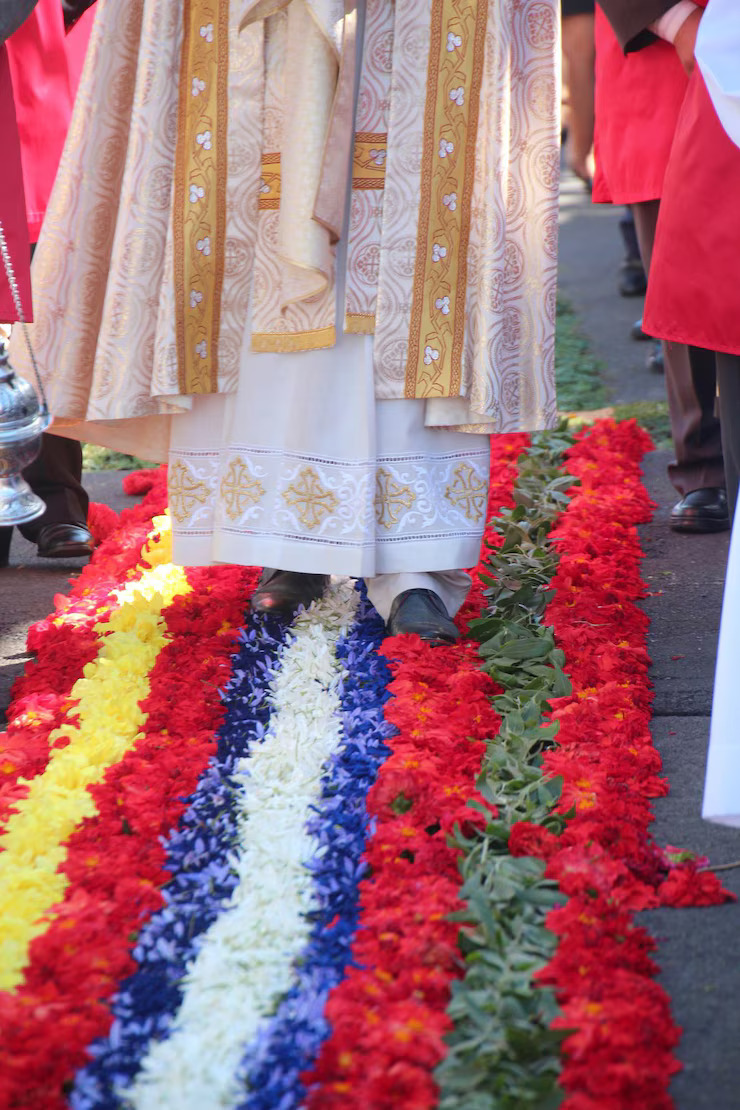
Some traditions are connected to the seasons and to flowers. On Pentecost Sunday in Rome, red rose petals are dropped from the oculus in the Pantheon to symbolize the tongues of fire (Holy Spirit) descending on the Apostles. In Poland, the village of Zimna Wódka (“Cold Vodka”) is known for making carpets of flowers for the Corpus Christi procession. Priests carrying the Holy Sacrament walk only on these flower carpets. Many people wear traditional clothing during the procession to publicly express their connection to the faith.
Christian faith cannot be separated from the local traditions. Since pagan times, the Holy Church adopted many feast or rituals to help Christianize them. This is because people love celebrating things that they know, and they also create new celebrations over time. It is interesting how people from different regions express their faith in different ways, but all with the same goal — to come closer to God.
Jakub Pokuciński
Sources:
Po co jeść, skoro można pościć? Płaszczanica – prawosławny Grób Pański Pożegnanie Alleluja – Liturgia.pl
 VOICES
Leave a comment