
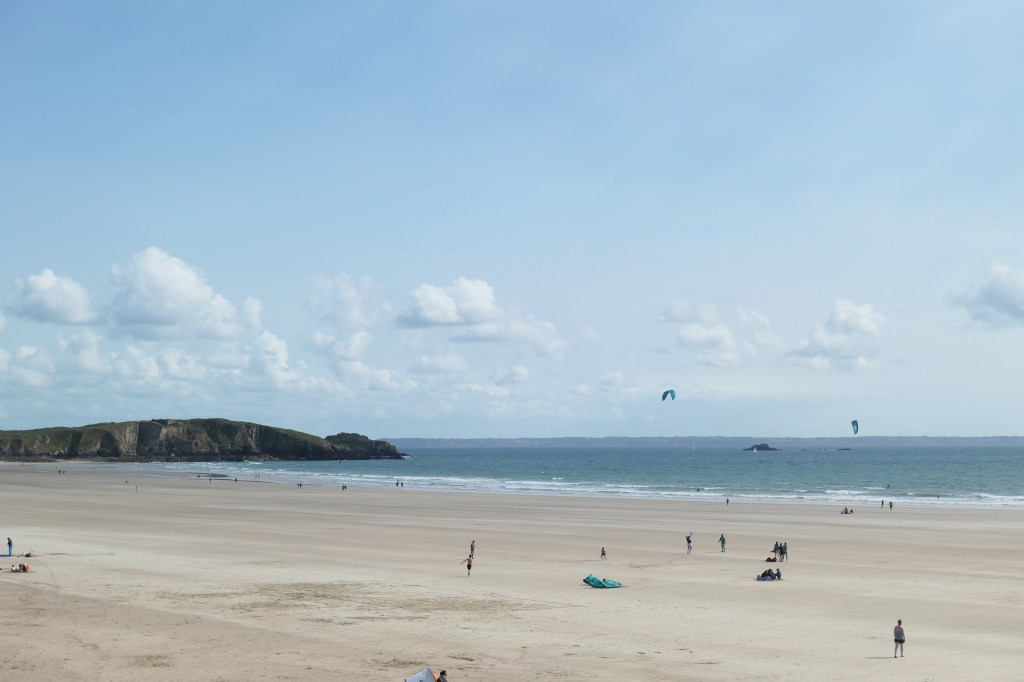
As temperatures soar past 40°C in many French cities, one department remains curiously out of sync with the rest of the country. On the far western edge of mainland France, in the coastal stretches of Finistère, café terraces are full, locals wear sweaters in the evening, and thermometers rarely climb above 25°C. Here, people don’t talk about heatwaves but about when it’s finally warm enough to take a dip in the Atlantic.
Long known for its Celtic traditions, granite cliffs, lighthouses, and bracing sea air, Finistère is quietly emerging as something else: a temperate haven in an overheating country. While Toulouse and Marseille endure record numbers of “tropical nights” and rising heat indexes, parts of coastal Brittany, especially in northern Finistère, seem to operate on a different meteorological rhythm.
France is heating up. According to Météo-France, the national meteorological institute, the number of annual heatwaves has doubled since the early 2000s. The summer of 2022 marked the longest heatwave in French history, with temperatures in some cities surpassing 42°C. In July 2025, the pattern repeated itself. Once again, a part of the country experienced long phases of punishing heat, prompting health alerts, changes in working hours, and a surge in emergency room visits due to dehydration and heat stroke. Experts and health authorities now openly warn that these extremes are not anomalies, but symptoms of a new norm – a country where summers may become too hot for normal life in many regions.
In Brest, where I grew up, summer temperatures average just above 21 or 22°C, rarely exceeding 26°C, even during national heatwaves. Rain remains common, but not oppressive, light drizzles are part of the rhythm of life here. Meanwhile, cities like Paris or Bordeaux are now experiencing 28–32°C as a common summer norm, with spikes into the 40°C. The contrast is no longer just geographic. It’s existential.
The coastal areas of Brittany, especially in the northwest, benefit from the Atlantic’s cooling effect, which slows rising temperatures. While southern France faces increasing risks of drought and desertification, Finistère maintains a mild, temperate climate, making it one of the few areas seen as a potential refuge in a warming Europe. From the Bay of Morlaix to the Presqu’île de Crozon, with Brest at its center, North Finistère remains remarkably insulated from the country’s extreme heat spikes. Oceanic inertia, the moderating influence of the North Atlantic Current, steady sea breezes and persistent cloud cover all contribute to what feels like natural air conditioning on a regional scale. But this stability may not last forever. Finistère is not immune to climate change, only temporarily shielded. As ocean temperatures continue to rise and global patterns shift, even this refuge could face new pressures in the years ahead.
And the public is catching on. In 2024 and again in 2025, Brittany launched a striking new tourism campaign: “Partez touriste, revenez Breton.” (Go tourist, come back Breton) Targeting not just beachgoers, but heat-fatigued urbanites, the campaign embraces humor, self-deprecation, and immersive imagery. Posters in metro stations such as Paris or Rennes display slogans like: “Ici, l’eau n’est pas froide. Elle est bonne une fois dedans.” (The water here isn’t cold. It’s good once you’re in it.) Backed by strong digital outreach, the campaign marks a strategic pivot: positioning Finistère not as a fallback option, but as a deliberate escape, for those seeking authenticity, calm, and a break from climate anxiety. Though initially aimed at boosting off-season tourism in autumn, it now stands as a model of successful regional communication: smart, distinctive, and proudly local. It also speaks to the Bretons themselves, reigniting a connection to place.
As southern France becomes increasingly unlivable during the summer, the idea of seasonal or even permanent internal climate migration no longer feels far-fetched. Finistère may become a laboratory for how France, socially, economically, and ecologically, learns to adapt to life in a warmer world.
But to reduce Finistère to a meteorological exception would be to miss its deeper identity. This is a region of fierce cultural pride. The Breton language is still visible on street signs, taught in bilingual schools, and heard during fest-noz gatherings, lively community dances with traditional music, now recognized by UNESCO as intangible cultural heritage. The coastline is rugged and dramatic, scattered with lighthouses, seaweed farms, and white sand beaches that remain surprisingly uncrowded, even in midsummer. The GR34 coastal trail, once used by customs officers chasing smugglers, now stretches over 2,000 kilometers as one of France’s most beloved hiking routes. In villages like Plouarzel or Carantec, life moves slowly. Neighbors greet each other. Crêpes made with buckwheat are a daily staple. Small harbors remain working, not just picturesque. If you decide to visit, I recommend some of my favorite spots: the Île de Batz, the Presqu’île de Crozon, or the wild beaches of Plouguerneau. But it’s worth remembering: their charm lies in their tranquility. To preserve that, we must avoid turning them into overcrowded summer hotspots.
Finistère stands at a crossroads. It could become a model of sustainable tourism, slow, local, and deeply respectful of nature. But that future depends on choices made today: avoiding overdevelopment, preserving public access for residents, and protecting the delicate balance that makes this place unique. For now, Finistère remains one of the few places in France where summer still feels bearable, even restorative. It won’t promise sunburns or poolside mojitos, and you’ll often need a sweater in the evening. But it offers something rarer: breathable air, rhythms shaped by tides rather than thermometers, and a way of life where slowness isn’t a fad, it’s tradition. Finistère is more than just a destination. It’s a glimpse into the future, not a utopia, but a living experiment in adaptation. And perhaps that’s why it’s no longer just a refuge. It’s becoming essential.
Camille Baudouin
Sources:
Meteo France – Changement climatique : quel impact sur les vagues de chaleur ?
Weather Spark – Climate and Average Weather Year Round in Brest
Press-agrum – Nouvelle campagne touristique de la Bretagne « Partez touriste, revenez Breton»
Unesco – Le fest-noz, rassemblement festif basé sur la pratique collective des danses traditionnelles de BretagneObservatoire de l’environnement en Bretagne – Pourquoi la douceur du climat breton n’est-elle qu’apparente ?
 VOICES
Leave a comment