
Can you count to ten in a language you learned in school? How many bones are there in the human body? Who was the first president of the United States? When was your first date? What is the formula for the perimeter of a circle? What is the capital of Australia?
Asking these questions triggers your brain. Sometimes you know the answer because you remember it; other times, you just forget or simply don’t know. After all, when are you ever going to use some of this information? This article will help us to understand how we remember.
HOW DOES OUR MEMORY WORK?
Imagine you are waiting for your meal at a street food restaurant, and the cook tells you that you are number 22. You will remember this until it is your turn to pick up the food. A few days later, you won’t think about this information anymore. This is an example of using your short-term memory. How can we use the memories?
In our everyday lives, we have to process tons of information about the world and our surroundings. We don’t always retain it, but when we do, we use different types of memory. Short-term memory refers to recalling information for a few seconds to a few hours, while long-term memory can keep the information for years. When it comes to working memory, it is involved when you repeat an action or piece of information until you remember, like tapping your phone number several times to memorize it.
Long-term memory can be categorized into explicit and implicit memory. The first one involves the conscious and intentional recollection of factual information, personal experiences, or concepts. It can be further divided into:
- Episodic memory, which refers to personal experiences and emotions. For instance, at the end of the European Youth Olympic Festival, all the volunteers went to Ragusa to evaluate the experience, eat a traditional Macedonian meal, dance, and have fun.
- Semantic memory, which relates to factual information and general knowledge. For example: Macedonia, capital Skopje, population about 2.10 million, etc.
On the other hand, implicit memory is unconscious and influences our thoughts and behaviors without conscious awareness. It allows us to perform tasks automatically, such as riding a bike or playing an instrument, even if we are not actively thinking about how to do them.
HOW DO WE REMEMBER?
The first time you visit Skopje, you will likely look for practical places first such as supermarkets, workplace, city center, etc. To do this, you might start by using Google Maps. Gradually, you begin to recognize landmarks like statues, street names, and restaurants that help you get oriented and feel more familiar with the area and draw a mental map of the city. Once you know it is thanks to the engrams. What are they?
There is no single location in the brain where memories are stored. Different brain areas handle different types of memory:
- The amygdala of the brain processes emotions,
- The striatum is involved in skill learning,
- The hippocampus helps with storing and retrieving explicit memories.
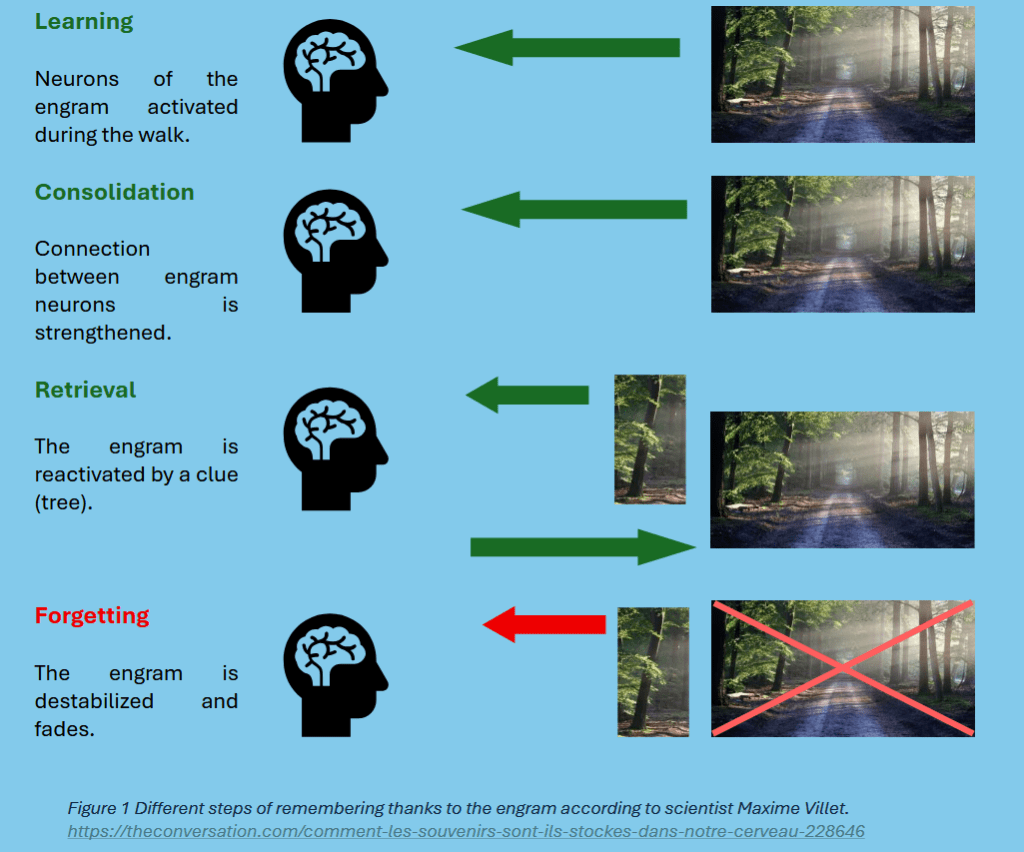
Indeed, memories are formed and maintained through networks of connected neurons known as engrams. These neurons are activated during the process of remembering. Explicit memory involves three main processes: acquisition, consolidation, and retrieval. (see figure 1)
When we forget something, it is often because the neural connection doesn’t follow its usual pathway, and access to the stored information fails. This leads us to…
HOW OR WHY DO WE FORGET?
There is this film called “50 first dates” where the actor Adam Sandler’s character falls in love with a woman who has a form of amnesia. She lives the same day over and over again, forgetting everything she experienced the day before. This is an exaggerated example, but it highlights how memory loss can affect us.
Amnesia is a deficit in memory caused by brain damage or brain disease. There are two main types of amnesia. Retrograde amnesia which is the inability to remember events that occurred before a specific incident (like an accident or surgery). Anterograde amnesia is the inability to form new long-term memories.
There are some diseases relating to memory disorders such as Alzheimer often associated with aging, agnosia which is the inability to recognize certain objects, persons or sounds.
Sometimes, we forget things simply because we haven’t had the chance to apply or reinforce what we have learned. This highlights how important repetition is in helping us to remember.
How can we make a memory unforgettable? Take, for example, a volunteering experience in Macedonia: building bonds, visiting new places, and sharing special moments. As it was written in a kafana: “One moment lasts a second, but a memory lasts forever.”
AS A CONCLUSION:
I am pretty sure that you have learned something from reading this article, but will you remember the difference between a semantic and an episodic memory? What is an engram again?
Loline Thomas
Sources:
Greshko, M. (n.d.). Souvenirs : comment sont-ils créés, retenus ou oubliés ? National Geographic France.
Villet, M. (2024, May 5). Comment les souvenirs sont-ils stockés dans notre cerveau ? The Conversation.
Wikipedia contributors. (2025, July 2025). Amnesia.
Wikipedia contributors. (2025, June 2025). Explicit memory.
 VOICES
Leave a comment