
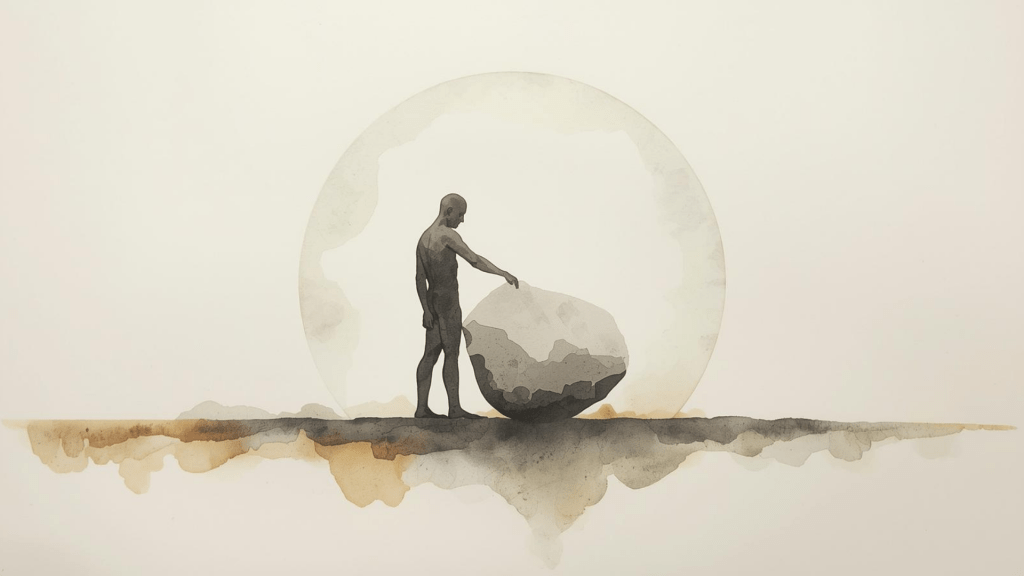
There are days when I wake up and everything feels heavy for no reason. The air, the noise, the thoughts. It feels like I am walking through a loop: repeating, trying, failing, repeating again. In those moments, I think of Sisyphus. The man cursed to push his stone up the mountain forever, only to watch it roll back down every single time.
In “The Myth of Sisyphus”, Albert Camus wrote that we must imagine Sisyphus happy. Not because his punishment makes sense, but because he learns to live without needing it to. That single idea changed something in me. I realized that maybe the point of life isn’t to find meaning, but to live even when we know there isn’t one.
I’ve always searched for meaning. It’s almost instinctive, I want to know why things happen, why people leave, why sometimes I feel too much, and other times nothing at all. I’ve spent years trying to build a reason for everything, as if that would protect me from the emptiness. But life doesn’t follow our logic. It’s unpredictable, strange, sometimes cruel, and maybe that’s okay.
When I first read Camus, I didn’t see philosophy, but I saw honesty. The kind that doesn’t try to comfort you, but instead tells you that it’s okay if the world doesn’t make sense. For someone like me, who feels things deeply and searches for truth everywhere, this felt like a strange relief. The absurd is not the enemy; it is the mirror. It reflects what it means to be human: to keep walking, to keep feeling, even when everything is uncertain.
Sisyphus is a symbol of our condition. His mountain is our existence, it’s the routine, the effort, the weight we all carry. His rock could be anything, for example, I feel like mine changes shape: sometimes it’s anxiety, sometimes loneliness, sometimes the weight of simply existing. But each time I push, I find a rhythm. What matters is not the stone itself but it’s the act of pushing it. Each step, each breath, becomes a quiet form of resistance.
In Macedonia, I’ve felt that balance between chaos and calm. Some days are heavy, and others flow with simplicity. I sit in cafes, surrounded by languages I barely understand, and I realize that it doesn’t matter. Life keeps happening with or without explanation. There’s comfort in that. Maybe the absurd isn’t about despair, but about courage. The courage to live fully, even when the universe doesn’t answer back.
Sisyphus, to me, is not a tragic figure. He is human. He is all of us. He knows the stone will fall again, but he walks down the mountain with peace. Because he understands that his freedom lies not in escaping his fate, but in embracing it. That is the quiet rebellion Camus talks about: not screaming against the absurd, but smiling at it.
I think a lot about what it means to “love life,” especially when life feels heavy. Maybe it’s not about joy, or success, or perfection. Maybe it’s about attention, about being present for what is, even when it hurts. To me, loving life means looking at the absurd and saying: “I see you, and I choose to stay”. I’ve learned that life doesn’t need to be extraordinary to be real. It just needs to be felt.
So when life feels meaningless again, I try to remember: the point is not to find the answer, but to keep asking the question. Life doesn’t owe us meaning. But we can still make it beautiful. And perhaps, somewhere between the rising and the falling, between the silence and the laughter, we too can learn to imagine ourselves happy.
Cassandre Journoud
Sources:
Based on “The Myth of Sisyphus” by Albert Camus.
AI images created in Canva.
 VOICES
Leave a comment