
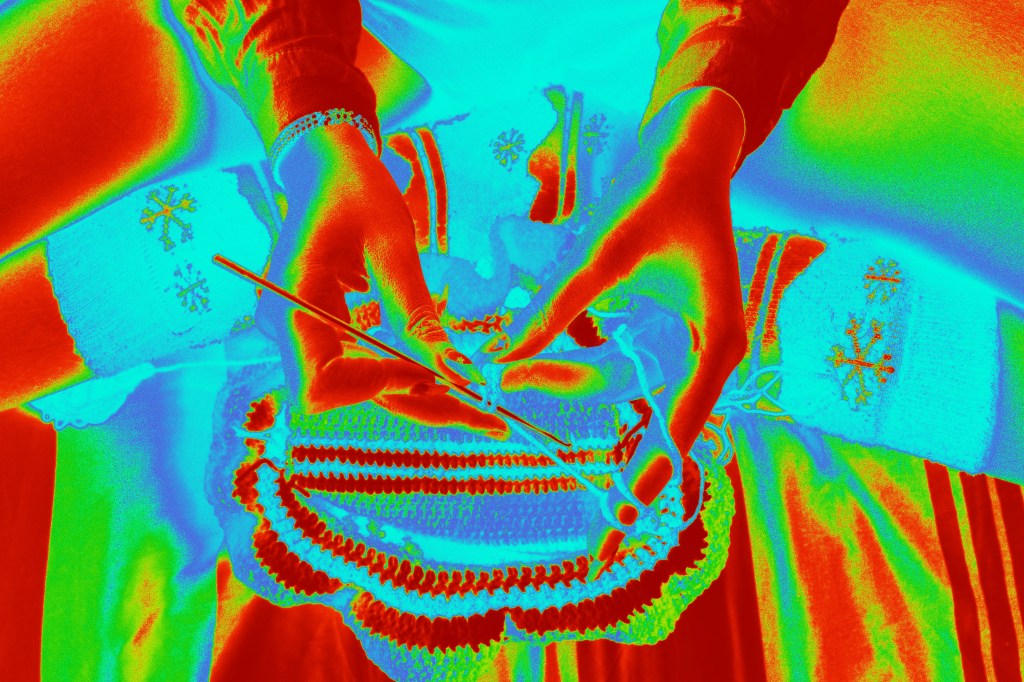
When people ask about my hobbies, I tend to feel embarrassed, undermining myself, thinking I don’t actually have a real hobby. Because, while I am sitting around, knitting or crocheting, other people are running around or working on their cars.
It feels like no matter how complex the stitch or the pattern may be, the yarn of femininity is too deeply woven into crocheting or knitting to be seen as a complex skill by society.
Fiber arts in general have been around since at least the Viking Age. Crafts such as weaving were not originally undnerstood as gendered practices; it was not until the Industrial Revolution that they became associated with specific gender roles. The origins of crochet itself are more contested, yet some historical evidence suggests that it evolved from the production of large fishing nets, which was a typical “manly” activity. Moreover, until the late Middle Ages, the production of clothing was largely relegated to women, a fact reflected even in the royal households, where embroidery was regularly practiced by queens themselves.
A couple of years ago, I tried to tame the crochet hook for the first time, but I was unsuccessful. However, after a while, it somehow clicked, and it even became enjoyable.
Still, I didn’t tell many people about the new skill, hadn’t I just tried to cut off the expectations that come with femininity by chopping off my hair?
But why is it so bad to be feminine, and why does “You are not like other girls” turn into the biggest compliment in this society?
We always saw femininity as something shallow and stupid, like your only interest being makeup and high heels. Even though I do not know what would be so bad about that either.
A toxic relationship of depreciation between how we as a society see men and women has existed for ages. Therefore, hobbies became one more point to divide male from female, important from unimportant, exciting and nerve-racking from boring and lame.
That leads to women having to defend their hobbies that are seen as too “feminine” over and over and over again to be taken seriously. When do we not have to fight to be taken seriously would be the question with the shorter answer.
“Stitches against violence” chose to fight. The movement based in Vienna chose the act of knitting and crocheting as a protest form by doing that in a tram during rush hour as a clear and tangible message against gender-based violence.
Hobbies are not just connected to gender but also sexuality. If a man starts to indulge in a hobby deemed feminine by society, their identity could shift from just being a man to a feminine or homosexual man. This ideology threatens the ability to express yourself freely, because a lot of people identify themselves through their interests.
But we do not live in a world of black and white, so a primarily male-dominated field like programming is more closely connected to fiber arts than one might expect.
In the early 19th century, the Jacquard loom, an automatic weaving machine, was invented. It was a groundbreaking invention, using punch cards to control complex weaving patterns. Each of those cards encoded instructions – essentially a binary system: hole/no hole – zero/one. An idea that directly inspired early computing pioneers.
Honestly, being able to do any kind of fiber craft is pretty cool, even healthy. The automatic repetitive movements while knitting or crocheting are soothing for the brain and can even help to prevent anxiety.
So maybe fiber arts aren’t so boring after all. Perhaps it is simply our habitual worldview that demands we downplay everything feminine.
Nelli Winzer
Sources:
The Slate Speaks: Toxicity Toward Men and Women’s Hobbies – The Slate
Art History 101: Unraveling the History of Textile Art – .ART
The Jacquard loom: Innovation in textiles and computing | National Museums Scotland
Elizabeth Wayland Barber, Cloth and Human Experience – edited by Annette B. Weiner & Jane Schneider
 VOICES
Leave a comment