
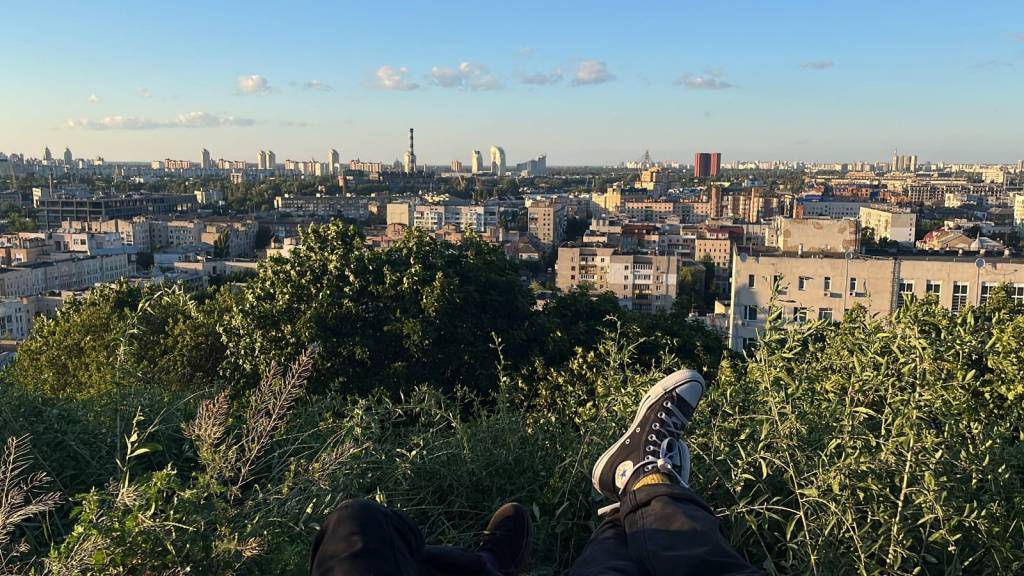
“So today, the 25th of November, is my birthday! It’s 00:53, I’m 21 now, and as I type this, I feel extremely loved, thanks to my wonderful friends, and I hear the air alert. But honestly? I’m not scared nor care now, I’m happy at the moment, I’m loved and seen, so war can be silenced for just a moment.”
“I’m sorry if we get disconnected. In one hour, there will be a power shutdown again.”
Words leaving the mouth of Sofia at the beginning of our call casually.
Sofia, a 21-year-old book illustration student and my interview partner.
Even though 1.900 km away, her voice rings clear and content through the speaker of my phone. Nobody understands what it’s like to live in a war zone, not even she did, till the first air strike hit her hometown.
What do you do when the war starts? You’re just sitting in the shelter, like, 24 hours for a month, right? Well, at the beginning, Sofia had to stay in the shelters a lot because the town was close to the front. The nights were particularly rough, but during noon she used to meet with her friends quite often.
Being just 17 at the beginning of the war, she met to smoke with them as often as possible before they left the country; nobody cared to check an ID anymore. “We thought, oh, we’re so cool!”
But Sofia isn’t 17 anymore, the war went on, and so did life. Leading her to move away to Kyiv for her studies.
Therefore, she not only had to tackle the usual hurdles of the newly won independence that comes with moving out, but also faced power cuts and missile strikes.
Especially the first power cuts were exhausting because no one was prepared, particularly if it’s your first months of living alone. Even though it might seem romantic to sit by candlelight, not only wasn’t work possible without proper light or electricity to charge your computer, but the food went bad in the fridge as well. Now, people adjust with power banks and flashlights, while the government tries to plan power cuts as short as possible.
Going to university, partying and celebrating with friends might sound unimaginable in Kyiv from an outside perspective.
“Yeah, the first time when the war just started, the city was quiet, almost empty. No one was on the street.
I think, who would walk around at first days of the war, like, what?”
But Kyiv changed, people gradually started to go out again and after four years, the city has adjusted, living the best life it can. Lots of places closed, lots of new places opened. Many people moved from other cities that are currently occupied to Kyiv and started their businesses there. The youth especially became more engaged in the city’s life, organizing different events, meetings or fairs.
A lot of people became more politically aware as well, giving hope to each other by not blindly agreeing with everything but standing up for their rights.
But the city did not change by itself; the people changed themselves.
It comes naturally to adapt and form new habits for people. “I think it’s just hard to spot them. There’s a lot of change, all my routine changed. But one of the cute habits: I used to say just good night, and that’s all, but now I say good night, wish you a quiet and peaceful night. My friends and family also wish me a quiet and peaceful night all the time, because of the night bombing.”
A change forced by war is the curfew from 12 p.m. to 5 a.m., especially for young people like Sofia, it was tough. “I remember I was dreaming that I will move to Kyiv, and I will spend nights with my friends, going out, like, just going around the city. You cannot do this right now, but still, there’s a lot of interesting cultural life here.”
Instead of the buzzing nightlife, they got the buzzing of drones. Still, nightlife adapted to day life fluently.
“It’s already the fourth year of the war, it’s starting to become a habit that you are planning everything around your time that you can spend. You know the time limitations in these parties, when are they closing, how long do you need to go from point A to point B, at what time the metro stations are closed […]
I was almost angry that I need to do all this, like, it’s not fair. I thought it’s not fair. I want to party all night, I want to go and spend time with my friends all night, but time passed, and I understood that, yeah, it’s not fair, but what can I do, I can sit here and just ruminate on this, or I can pick myself up and plan something with my friends that will end before the curfew.”
Even though it might seem like a huge restriction to us, Sofia explains, “when you are living like this, you don’t have a problem with that, because it’s not only me that is changing my routines. It’s also places that are hosting these events are changing their routines […] like, sometimes I just think, oh, thank God, we have a curfew, so I need to be home at some time, because sometimes I’m really tired and I don’t have an excuse to leave.”
A habit takes approximately 21 days to form, and a lifestyle around 90 days. Therefore, coming to another country and being outside at night might even feel weird. Sofia experienced this herself on a trip to the Czech Republic, where she asked her friend when they had to get back, who just reacted in confusion.
How are humans supposed to survive a war without letting the bombs crash their minds and hope?
The first few months, in particular, showed the new social cohesion within the community.
“When the worst only started, everyone was so close to each other. Everyone was so welcoming”, Sofia remembers, explaining that people from safer areas offered shelter in their homes for others from the dangerous areas. When the water pipes in her hometown got destroyed and with that the drinking water supply for two months, other cities brought water to them.
Culture is crucial during the war as a source of resilience, giving a sense of existing as a group amidst chaos. Therefore, music and warfare have always been intertwined, music serving practical military functions like coordinating movements but also giving comfort.
It can also maintain an identity, building a connection between the people, which is why it was of such importance that theaters, cinemas, or clubs reopened.
Especially clubs like ∄a cultural institution in Kyiv which became a shelter for up 200 persons at the beginning of the war. Since its post-invasion reopening, ∄ runs entirely as a non-profit to support the war effort through the K41 Community Fund, which aims to provide financial, humanitarian support to the community during the war. Having raised over €900.000 in general, they donated the earned money to organisations like Livyj Bereh, where volunteers build metal roofs to repair destroyed rooftops.
The people are giving each other hope again.
“Why are we still standing? It’s that people are thinking about other people”.
Still living in a war zone is challenging, from constantly checking the power cutting schedule to see if you can take the elevator, to evaluating whether I should seek shelter or is the bombing not that bad.
“At first I was scared. I remember the first time we heard a siren with my mom. […] It was really scary.” Nobody knew how to act; everybody just acted instinctively, but now sheltering looks different for everybody; some are chatting, some playing on the phone or reading a book in the shelters.
One time in a shelter, Sofia met a little, very bored girl, so she lent her her sketchbook and pencil. But the little girl just scolded her for not having coloured pencils with her.
The next time, she remembered to bring them.
“Now it’s not scary. It’s irritating and to be honest, sometimes it’s almost calming to hear the air alarm. Being so used to the alarm, it gives a feeling of comfort and familiarity.
So, what’s going on with us, watching the shining videos of “Cabaret” on TikTok, wishing to be able to watch it in real life. A musical set in 1930s Berlin, depicting the hedonistic, decadent nightlife of the Kit Kat Club inside, while outside, fascism grows, but no one thinks to stop dancing.
That is what “Cabaret” is about, it is about us, showing how blissfully unaware we fall in love with the trap of distraction.
The musical has seen many different versions throughout the years, the most famous one being the 1972 Bob Fosse movie. But now the version of the Molodyy Theatre, located in Kyiv, went viral on social media with its extravagant costumes and makeup.
The themes of political unrest linger unmistakably under the twirling dresses of the dancers while watching these clips of the Molodyy Theatre production of “Cabaret”. Noticing the parallels between Weimar Germany and present-day Ukraine adds another layer for the viewer to contemplate.
Of course, it is important to keep the theatres open for the people but what is going on with us posting thirst traps of the characters on TikTok, wishing to be able to see a musical in a war zone.
Ignoring the traces of grief and torture that war leaves behind under the thick mask of stage makeup, the shards and bomb remnants buried under the confetti of destruction.
“It was so diabolical to see, but it was so funny. […] Some part of me was really proud that our theatre is that good, that people want to go to a war country just to see a theatre play. What time are we living in?!”
While we crave the absurd wish to fly to Kyiv only to watch “Cabaret”, Sofia watches the war destroy her motherland. Either way she keeps going on with her life, supported by her community.
“I wanted to say that I don’t know what keeps me going, but it’s not true. It’s the people that keep me going. It’s my friends, my family, the Ukrainian community in general […] I wasn’t so patriotic before the war but now I love this country.
I love my town. I love living in my hometown and the people here are great.”
“Now, I’m writing this, the power is shut down, and I’m at a loss for words about how good this day was. Despite everything, it was just how I imagined. Sometimes it’s hard to manage everything with the circumstances that we’re living in, but it will never be the reason to stop living your best life, as best as you can.
And I refuse to be sad or scared on this day, because it’s my day.”
Nelli Winzer
Sources:
 VOICES
Leave a comment