
So, you’ve heard the roar. You’ve seen the beefy athletes collide. But the Six Nations can look like a chaotic pile of bodies if you don’t know what you’re looking for. Don’t worry. Let’s break down the beautiful game before we dive into the magnificent spectacle.
But please, I beg you, don’t think it’s like American football. Let’s see the rules and you will understand why.
The Golden Rule: Go Forward
The entire sport boils down to one simple idea: you must take the ball and run with it towards the opponent’s goal line. You cannot pass the ball forward. You can only pass it sideways or backwards. To advance, you run with the ball, or you kick it ahead and chase it.
The Objective: Tries
The ultimate prize is a try, worth 5 points. This is when a player grounds the ball in the opponent’s in-goal area (the end zone). After a try, you get a conversion kick for 2 more points to put the ball through the H-shaped uprights. You can also kick penalty goals (3 points) if the other team commits a major foul, or score a drop goal (3 points) by drop-kicking the ball through the posts during open play.
The Main Events: The Set-Pieces
When play stops, it restarts in two iconic ways:
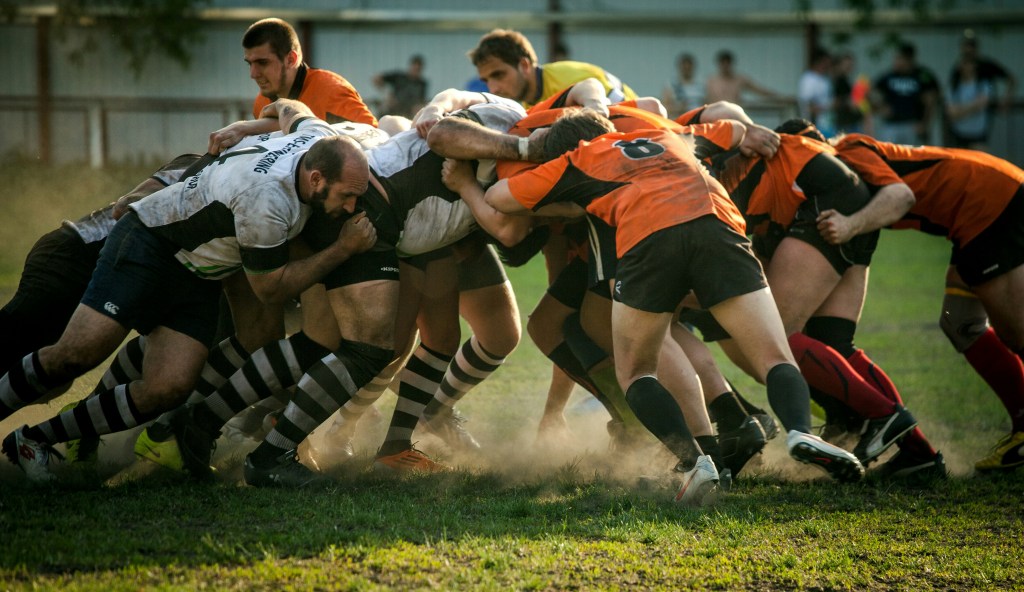
– The Scrum: eight players vs. eight players, all locked together creating something looking like a bridge of humans. The ball is thrown into the tunnel between them, and they fight to hook it back with their feet. It’s a raw contest of pure power.
– The Lineout: When the ball goes out of bounds, it’s thrown back in between two lines of jumpers. It’s like a perfectly choreographed high-jump competition, where players are lifted by their teammates to catch the ball in the air.
The game is played with 15 players per side, in two 40-minute halves. It’s fast, it’s ferocious, and the clock only stops for serious injuries or scores. It’s a game of continuous effort, courage, and split-second decisions, it’s not like in football where sometimes you have the opportunity to rest a bit.
Now, Forget the Rules for a Moment… And Feel the Championship!
The Six Nations Championship. It’s not just a tournament; it’s a gladiatorial theatre, a rolling saga of pride, passion, and raw emotion played out across six ancient nations. This isn’t a cold, sterile competition; this is folk history written in mud, sweat, and glory.
The six competitors are not just teams; they are emblems of identity, carrying the hopes of millions on their shoulders:
– England: The old empire, the inventors of the game, with the largest player pool and a relentless, forward-dominated power game. They carry the weight of expectation on their white shirts, and their Twickenham fortress is a cauldron of noise. They are often the villain, always the team to beat.
– Wales: The land of dragons, where rugby is the national religion. They are always extreme, extremely good or extremely bad, no in between allowed, and 2026 isn’t their best year to say the least.
– Ireland: The island unites to create a team that shows tactical genius on the field. Their recent history is one of dominance, built on many years of effort. They are one of the best teams worldwide, but they are not the only.
– Scotland: Clearly they are the underdogs with a point to prove. They play well but not enough to be considered favourites yet good enough to not be at the bottom, so people are often forgetting them.
– France: Les Bleus! The artists, the troublemakers, the first non-British team to have joined the tournament. They are capable of breathtaking, almost impossible flair one moment and sublime nonchalance the next. It’s “Champagne rugby”, they play for the beauty, the spectacle of the sport. France is always wonderful to watch and has many players that could be pretenders to the title of best players in the world.
– Italy: The proud gladiators, forever fighting, improving, and carrying the hopes of a nation that isn’t that good at rugby. But with time and years of effort they are no longer just participants; they are a team capable of historic upsets. So, when they win it’s always wonderful.
Now you know who plays, let’s talk about how the tournament is made.
Each team plays each other, where there are no weak matches.
The ultimate glory is the Championship Trophy, but it’s the Grand Slam that truly makes people scream in the stadiums, to own the title you need to beat everyone. To have a perfect record, beating 5 of the best teams in the world in 5 weeks, and with the injuries, the energy management, it’s very rare to be able to achieve it.
But, on the opposite side, let’s not forget the Wooden Spoon, a symbolic “prize” for the team that finishes last after losing every match. Let’s hope it will fuel determination and not just be seen as a humiliation from the players
So, now you know the biggest part to appreciate all the emotions of that competition. It is, quite simply, the greatest championship in rugby, and one of the most compelling, emotional spectacles in all of world sport.
Arthur Bonhoure—Tolfo
 VOICES
Leave a comment