
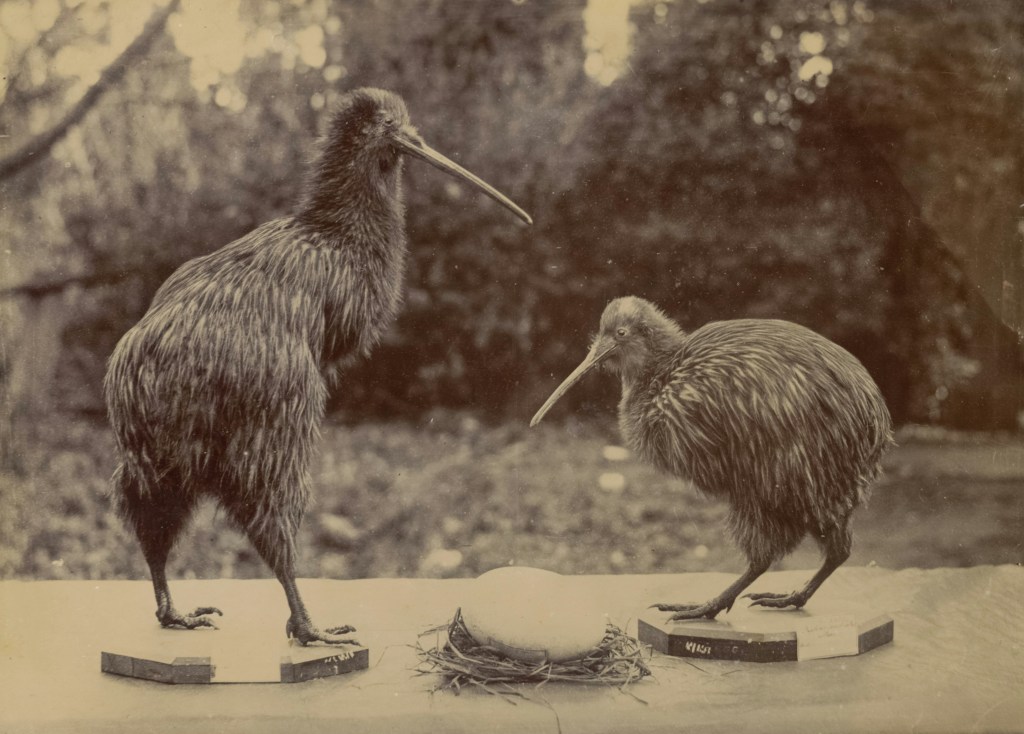
Yes, you heard right in the heading—it looks like a kiwi ball with feathers and a long beak. Its name is kiwi, New Zealand’s national symbol and treasure.
So, you may wonder why this bird is so special and weird-looking… Keep reading this and you will find out many interesting things about one of many rare species of animals that are native to New Zealand!
How does the kiwi look? Surprisingly, it has many unique features that help it live easier in the wild.
It has quite big claws and legs that are strong and used for running, since the kiwi is flightless and the only way it can escape from predators is to run.
It also has powerful claws that can be useful to attack predators like stoats and ferrets that come to their burrows wanting to take their eggs.
What’s even more interesting is that this bird has a long beak but the nostrils are not at the beginning of its beak like other species of birds, but actually at the tip of it.
This is very useful since the way it finds food is by digging its beak into the ground and detecting the worms in the soil; its sense of smell is very strongly adapted.
Kiwi’s feathers are long and loose, unlike other birds and makes it look more like fur. The feathers around the beak have developed into whiskers just like ones that cats have so that they can sense vibrations and touch. Isn’t it bizarre?
There are several species of kiwis, actually five official: Kiwi Pukupuku, Kiwi Roroa, brown Kiwi, Rowi Kiwi and Tokoeka Kiwi.
Their distant relatives are the Australian emu bird and the ostrich of the classification called ratites. They also have some similar features like the kiwi, for example, all of them cannot fly and have muscular legs to use as a defence mechanism against threat.
Kiwis are not active in the day time, since it’s more dangerous for them to come out of their burrows. They are nocturnal animals that spend most of their time in the dark forest running around, rustling through the leaves searching for food. Their eyes are small and not very useful as their eyesight is poor, however they use their amazing hearing ability and sense of smell to detect any predators or just to orient themselves in the dense forests of New Zealand.
Kiwis may look scary at first sight or when they make sounds that literally may sound like some prehistoric dinosaur. Instead, they are harmless little creatures.
In fact they are vulnerable and are endangered species that need our help for their conservation and growth of population.
They face many predators like stoats that were brought by the Europeans in the past to hunt rabbits and decrease their population. Instead, they have chosen the kiwi as an easier prey, especially their eggs as a source of food.
If we didn’t intervene in the kiwi’s protection, 95% of hatched newborn kiwis wouldn’t have survived in the wild. So, how do we save the kiwis?
A very fascinating strategy was brought by the people in New Zealand that really helped the population of kiwis to rise. All of the kiwis that are in the wild are tagged with tags or microchips in order to locate and supervise them from a distance. A team of kiwi experts take the eggs from the kiwi and they bring it to a wildlife centre, where it is hatched safely. When a kiwi hatches, it is blind and helpless, thus at risk in the wild. The first three to four weeks the kiwi spends the time in the wildlife centre to grow strong and independent. Like that it can be finally released back into its habitat to continue its journey of life.
Kiwis have been residents of New Zealand for millions of years and it’s extraordinary how these birds have adapted to life. Once there were millions of kiwis roaming through the forests of New Zealand, now about less than seventy thousand are left.
However, hopes are high as wildlife centres, conservation parks, other institutions and the people of New Zealand are working hard to save the amazing kiwi species and to ensure they can continue to thrive and be a proud symbol of New Zealand for the future generations.
Once again, the mysterious kiwi reminds us of the rarity of species that live on our planet and the impact they bring to animal conservationists, wildlife biologists and, of course, animal lovers that can contribute by sharing awareness and knowledge about this incredible species!
Lara Mihajlovikj
Sources:
Kiwi Bird | The New Zealand National Bird
Kiwi | San Diego Zoo Animals & Plants
Kiwi: New Zealand native land birds
New Zealand’s Most Famous Bird | Wild New Zealand
The Kiwi: What do we know about our national bird?
 VOICES
Leave a comment