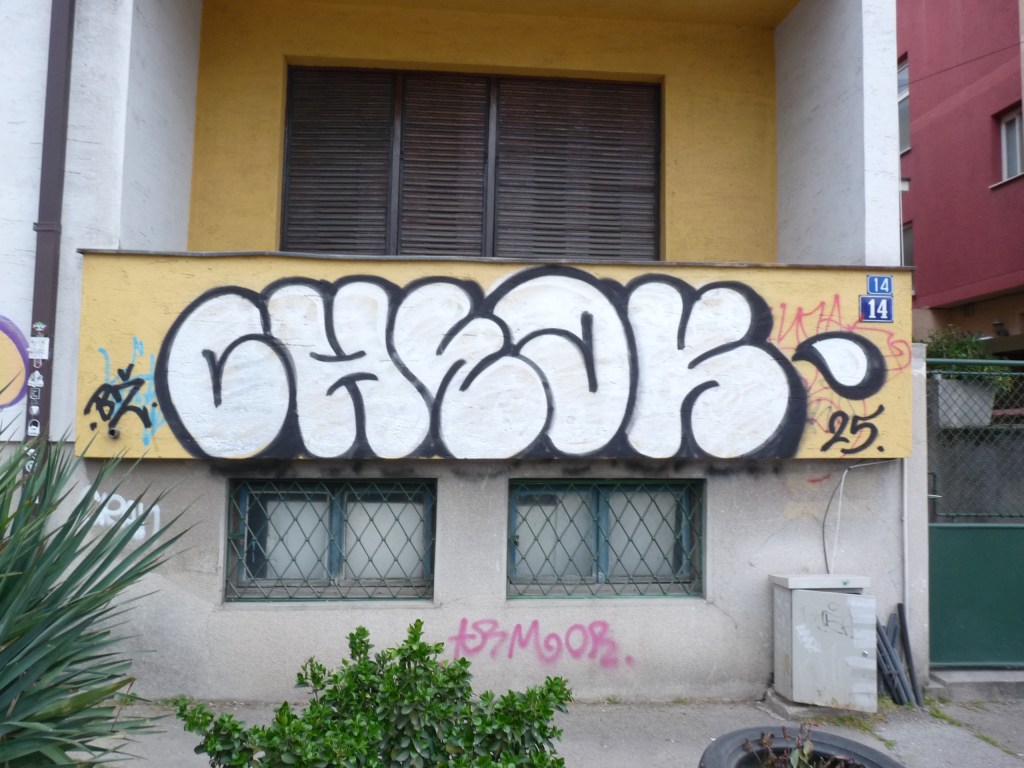
In my handbag you can find my keys, a lip balm, probably some coins but most of all a 30 centimetres portable scanner. I scan whatever I can. Posters, doodles on the walls, textures but most of all graffitis and tags. It has changed the way I look at cities. I walk and wonder: what can I scan? Therefore I did not lose this habit when arriving in Skopje.
Modern cities are spaces we pass through every day. Their lines, concrete blocks, and avenues guide our movement almost invisibly. The city tells us where to walk, where to sit, where to stop. Our paths have largely been designed for us, by architects, urban planners and geographers.
I grew up near Paris, a city famously reshaped in the 19th century when Baron Haussmann cut vast avenues through its dense medieval fabric. These boulevards were not only aesthetic projects, they were political. They reorganized circulation, visibility and control of the population.
But if the city is planned from above, how do its inhabitants reclaim it from below?
Public space is political space. Governments regulate it, police it and design it. Yet cities are also continuously renegotiated by the people who live in them. One of the most striking ways this negotiation appears is through graffiti and tagging.
Graffiti and tagging, as we recognize them today, emerged in the late 20th century within marginalized communities, especially black American and latino youth, in cities such as Philadelphia and New York, particularly in the Bronx. This practice developed during a politically charged time: after the civil rights movement, amid economic decline and urban neglect. Writing on walls became a form of counterculture. A refusal of a top-down organization of society. By placing their names in public view, writers reclaimed visibility.
In doing so, they also challenged the passive role assigned to citizens within consumer capitalism. Rather than merely consuming the city, writers insisted on actively shaping it. Tagging became a way to negotiate identity and belonging within a particular territory.
A wall might belong legally to a property owner, but visually it belongs to everyone who sees it.
Over time, a coded system of letters, styles and symbols developed. To an outsider, these marks may appear cryptic. But for those within the culture, they form a language: a map of presence, rivalry, collaboration and history.
I spoke with a Macedonian tagger who signs his work KO. For him, the issue is not whether the act fits within legal definitions. Graffiti is a way of living in the city. KO began tagging in his grandfather’s basement, practicing his name again and again.
“When I was younger I was changing my tag, to find myself, to find a logo so it can be recognisable. When people see it, they know it.”
Recognition is central to graffiti culture. A tag functions almost like a brand.
“It’s like Coca-Cola. If you see half the logo, you still know what it is.”
Through repetition and style, a writer develops an identity that others recognize across the city. You might not know someone but you know their tag. Sometimes even across countries.
“When I travel, I put my tag somewhere. Later, friends sent me photos. It means I passed there. It is like a game I don’t know, a lifestyle.”
In that sense, tagging becomes both record and game: proof of movement, presence and persistence. Like the Little Thumb as he says.
Graffiti also changes how a city feels.
“When there are no tags,” KO tells me, “a place feels like a hospital.”
For him, tags bring life into urban environments otherwise designed to remain neutral.
“You can read the history of the place. People passed there. They left energy.”
This idea resonates with theories about urban space and territorial identity. Sociologists have argued that markings in public spaces create invisible boundaries between insiders and outsiders. Tags signal that a space has already been claimed and interpreted by others.
They transform space into territory. The debate around graffiti inevitably turns to the question: is it art?
KO’s answer is ambiguous. For him, the distinction between graffiti and street art is often misunderstood.
“Everything on the wall is graffiti, tags, political messages. It has existed since the beginning of time. In caves, in Roman times people wrote political messages.”
“But I can say it is art, why not?”
Yet the contemporary art world often draws a sharp distinction. Murals commissioned by institutions are widely celebrated, while illegal tagging remains condemned. KO has experienced both sides.
“Some people won’t say it’s art but if they can make money (out of it) they will say it’s art.”
“Before, they chased us with the police, now they pay us.”
Today he paints commissioned murals and experiments on painting on canvas.
“The same people who are going to chase you or call the police if they see you tagging, are the same people who will see you paint and do a mural during the daytime and will say how beautiful it is.”
But he insists tagging remains the foundation of his practice and how we can not dismiss it.
“Tagging is the beginning of what I do now, tagging it is practicing.”
Over the past decades, graffiti and street art have increasingly entered mainstream culture. Artists like Banksy have achieved global recognition.
Berlin offers a striking example. Once known for its anarchic graffiti culture, the city has gradually incorporated street art into its branding. Tourist sites such as the East Side Gallery present curated murals celebrating Berlin’s alternative identity. Yet this institutional embrace often produces a paradox. While authorities promote “good” street art for tourism and cultural branding, strict laws against illegal graffiti remain in place.
What once existed entirely outside institutional frameworks now sometimes enters galleries and museums. But many argue that when graffiti moves fully indoors, something essential disappears. Street art is inseparable from its environment. Remove it from the street and it becomes something else.
KO explains as I wonder about the importance of the illicit part of tagging:
“It is part of it. I like the adrenaline, of the trains, the high places you climb. It’s part of my life also.”
Ronald Kramer highlights in Straight from the underground that graffiti’s shift has changed its vocabulary. Writers once spoke of “bombing” or “hitting”, while today, especially on legal walls, they say “painting”. Yet most graffiti artists still did not go through art school or follow a conventional path of institutionalized art.
“The street is my teacher.” as KO says.
When I arrived in Skopje, I became curious about the graffiti and a mysterious German word seen everywhere. One Saturday, a waiter revealed it was a local coded joke, a linguistic play only insiders understand. Graffiti creates a parallel system of reading layered over the city. Beneath official signs and street names lies another network of meanings. A hidden geography.
Whether considered vandalism, art or something in between or even the two combined, graffiti forces us to reconsider how we inhabit cities. It asks a simple question: who has the right to leave their mark on public space? Urban planners design cities. Governments regulate them. But every tag suggests another possibility: that the city is also written by those who live in it.
If we pay attention, really look around, we may realize that its walls are already full of stories.
KO compares it to an addiction:
“It’s like a disease. You can’t stop.”
He laughs.
“You should try.”
Carolina de Lima Uchôa
Sources:
Ronald Kramer, Straight from the underground: New York City’s legal graffiti writing culture, 2016
OliSunVia, Can street art survive Capitalism?, 2025, YouTube
 VOICES
Leave a comment