
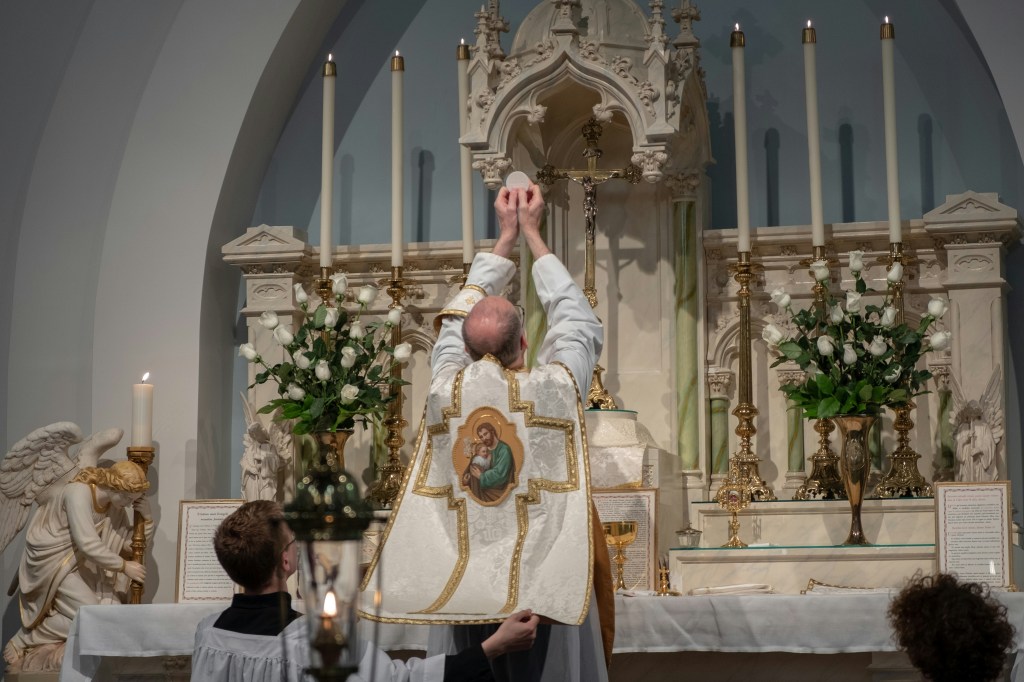
Traditional Latin Mass (Tridentine Mass) was the official rite of the Roman Catholic Church from the time of Christ up to 1969. Over the years, the Mass naturally evolved with the addition and modification of certain elements. However, from 1962 to 1965 the Second Vatican Council took place and changed many things. Pope John XXIII called it the “updating” of the church. The most important adjustment happened In 1969 when Pope Paul VI changed the rite of the Church into a new Mass. After making a new Mass as an official rite of the church, the traditional Latin Mass hasn’t been banned officially but except a few places hasn’t been celebrated.
New groups
One of the results of changing the Mass and doctrine was the creation of new groups of people called “traditionalists”.
The Fraternity of Saint Pius X (FSSPX) was established by Abp Marcel Lefebvre against changing the rite of the Mass and doctrine. While the society acknowledges the Pope and is part of the Church, it lacks formal canonical status. When Lefebvre consecrated four bishops without the Holy See’s approval, both he and the newly consecrated bishops were excommunicated. Officially, the FSSPX remains within the Church, and Catholics may attend Mass or receive sacraments there in certain circumstances but its status remains unregulated.
“Sedevacantist” is the group that is not united with varying views, but they generally hold that there is currently no valid Pope in the Catholic Church. Sedevacantists reject all teachings and changes introduced by the Second Vatican Council and afterward, maintaining the Mass, sacraments, and doctrines as they were before these reforms.
Status of Traditional Latin Mass
Until 2007, Tridentine Latin Mass was celebrated only with permission from the local bishop. Huge revolution happened with the decision of Benedict XVI, called “Summorum Pontificum”. In this document, the Pope confirms that the traditional Latin Mass was never banned and explains that what was sacred to previous generations cannot be considered wrong. For the first time in history, the Pope introduced the concept that there are not two separate rites but rather two forms of the same Roman rite. The traditional Latin Mass became known as “Extraordinary Form of Roman Rite.” The Holy Father wanted to point out the continuation of the old rite and the new rite, but not everyone agreed with this.
According to this document, the Holy Mass in the traditional rites could be celebrated by any priest without prior permission, provided they had the approval of the parish priest for public Mass. For 14 years the traditional Latin Mass grew enormously and there were many places where it was celebrated. A large number of new seminarians expressed a desire to celebrate the Extraordinary Form of the Roman Rite.
In 2021, Pope Francis decided to change the status of the old Mass with the document “Traditions Custodes”. He declared that there is only one Roman rite and it is a new Mass, and stipulated that anyone wishing to celebrate the old Mass must obtain permission from the local bishop. The traditional Latin Mass can no longer be celebrated in parish churches but only in designated places. New priests consecrated after 16 July 2021 can only celebrate the old Mass with permission from the Vatican. The Holy Father stated that the purpose of this document is that all faithful who are devoted to the old Mass have to return to the new Mass and accept all changes.
Differences in the look of the church
The changes to the Holy Mass have significantly influenced church architecture. The most important visual differences that every person can notice and were obligatory in the past are the altar and celebration of Holy Mass. The priests were turned backwards to the people and faced the crucifix which was always in the middle. The altar was required to have six candles, three linens, and to be elevated on three steps. The presbytery had to have balusters because Holy Communion was only received while kneeling. The ambo, used for delivering sermons, was typically located outside the presbytery, as the sermon was not considered part of the Mass rite.
Modern churches that celebrate new Mass, can also look like in the past but some of the parts are not obligatory. The altar shouldn’t be positioned next to the wall, but a bit away from it – because the celebration is facing the people. The crucifix can be in the middle or nearby the altar, and the number of candles can vary (typically 2, 4, 6, or 7 when a bishop is celebrating). A pulpit is also provided for reading the Scriptures and leading the service. There is no longer a requirement for balusters, as Communion can now be received while standing.
Differences in High Sung Mass
High Sung Mass, is the Mass where the priest is singing everything that is outloud and the choir is singing proper parts in Gregorian chant. In the Traditional Latin Mass, only Latin is used, with the exception of some regions in the Balkans, where Slavic language may be allowed. When the Mass is sung, the defining characteristic is the use of Gregorian chant, an ancient style that everyone can recognize. It is obligatory that parts called “propria” which are different in every Mass have to be sung. Gregorian chant is also similar to Byzantine and Coptic chant, having the same roots. At the same time there are more gestures and prayers. During the Mass the priest makes a sign of the cross 16 times, blesses the gifts 31 times, kisses the altar 8 times and much more.
The Old Mass includes many additional prayers and Bible passages. For instance, the prayers at the foot of the altar incorporate Psalm 42, and during the hand-washing rite, the priest recites Psalm 25. The Mass contains only one Eucharistic Prayer, known as the Roman Canon, which is the oldest and longest anaphora in the liturgy. However, this prayer is recited silently by the priest to preserve its profound sense of mystery, with the congregation hearing only bells and observing the actions at the altar. The most important thing is that priests have to strictly follow the rubrics, with no allowance for commentary or alterations, as he acts “in persona Christi”—in the person of Christ.
In the new Mass, Latin language can still be used, but most celebrations today are celebrated using native languages. Gregorian chant is permitted and encouraged, though it is rarely used. Simpler hymns and religious songs are more common. Following the reforms, most gestures were simplified, leaving only a few, and while additional Bible readings were introduced, many traditional prayers were removed. The new Mass is also more flexible. The priest, under certain guidelines, may choose from five new Eucharistic Prayers and has options for other parts of the liturgy. There is less rubrics and obligation so the priest has much more choice to make additional comments or speech beside the sermon. Another change includes intentional moments of silence, as part of the reform aimed to make the Mass less focused on mystery and more accessible to the faithful.
The aim of the Second Vatican Council and its reforms was to “open the doors” of the Church to bring in fresh air. However, some say that through those open doors everyone went through and left the Church. Most of the Eastern rites and Orthodox Church haven’t changed anything and preserved their tradition so why did the Roman Church have to do it? As a result, traditional groups within the Church are growing, while newer ones are seeing a decline. Despite strict regulations, the Traditional Latin Mass will continue to be celebrated and endured, as it is seen as a means of leading people to salvation.
Jakub Pokuciński
Sources:
 VOICES
Leave a comment