
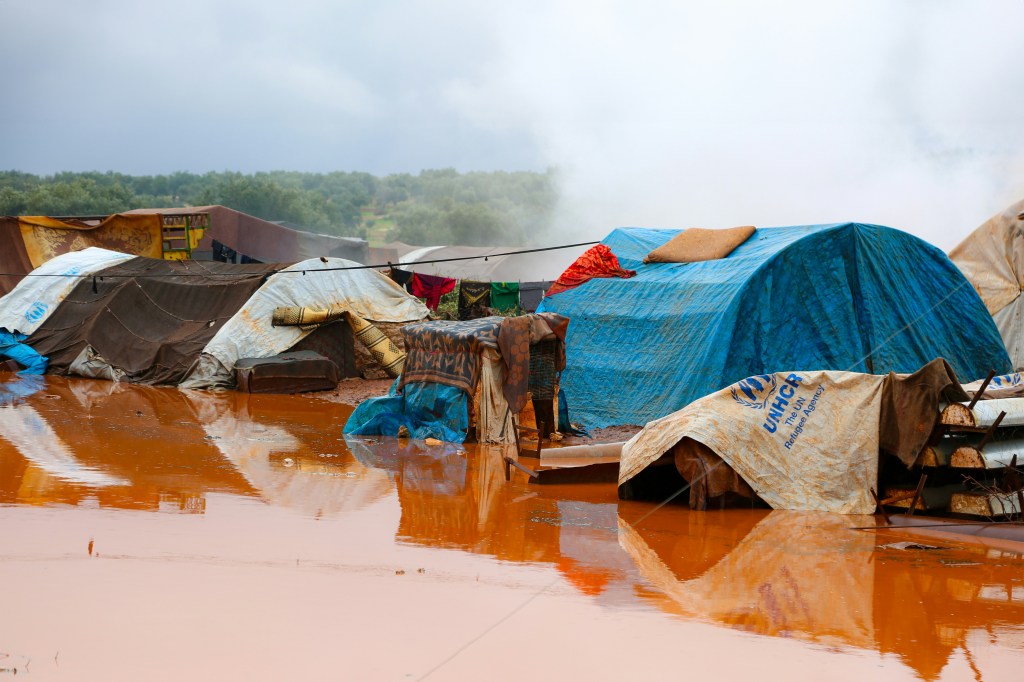
Imagine waking up every morning in a place you’ve always known, where the air smells familiar, the streets move to a steady rhythm, and the landscape gives you a sense of safety and belonging. Your life unfolds quietly: work, home, time with loved ones, small plans for the future. Everything feels stable, almost unchanging. Then one day, something begins to shift, at first subtly, then unmistakably. The river that once sustained life overflows and carries homes away, or it disappears entirely, leaving the land cracked and barren. Storms, droughts, wildfires, or rising sea levels stop being distant news stories and become your reality, forcing you to make a choice: stay and risk everything, or leave and become one of millions of climate refugees.
What happens when home becomes uninhabitable not because of war or persecution, but because of the climate itself?
Climate change is no longer an abstract future scenario but an increasingly visible driver of human migration. Droughts, floods, rising sea levels, and environmental degradation are forcing entire communities to leave places where life has become unsustainable. This is how the phenomenon commonly referred to as climate refugees emerges.
Despite its growing scale, for instance the Word Bank’s Groundswell report that estimated that climate change could force 216 million across six world regions to migrate within their own countries by 2050, the international legal framework has not kept pace with this reality. According to the 1951 Geneva Convention, a refugee “is a person who has a claim of persecution for reasons of race, religion, nationality, membership of a particular social group or rules in force outside his or her country of origin and is unable or unwilling to derive from this fear the protection of this country”.
What does it mean in practice?
Simply under current regulations, people displaced by climate-related disasters are not formally recognized as refugees, leaving them in a legal grey zone with limited access to protection and support. As a result, governments and institutions are facing an increasingly urgent question of how to respond to climate-induced migration that is already reshaping population movements around the world.
The importance of this issue becomes even clearer when viewed through the lens of recent history. The world has already witnessed how large-scale migration can challenge political systems, strain resources, and deepen social divisions, as seen during the European migrant crisis. Early warnings about rising instability and migration pressures had been voiced years before, including by leaders such as Angela Merkel, yet coordinated action came too late or proved insufficient. The result was not only a humanitarian emergency but also lasting political consequences across Europe. Climate-induced migration has the potential to unfold on an even larger scale, making it not just an environmental concern, but a critical global challenge that demands proactive and cooperative solutions before it escalates beyond control.
In the end, climate refugees are not a distant possibility but a growing reality that challenges the way we understand responsibility, borders, and human rights in the 21st century. As environmental changes continue to accelerate, the gap between existing legal frameworks and lived human experiences will only widen. Ignoring this issue risks repeating past mistakes on a far greater scale, while addressing it requires not only policy innovation but also a shift in perspective – recognizing that behind every statistic is a person forced to leave not by choice, but by necessity.
Karolina Tulik
Sources:
THE GENEVA CONVENTIONS OF 12 AUGUST 1949
worldbank.org: Climate Change Could Force 216 Million People to Migrate Within Their Own Countries by 2050
S. Mundy Race for Tomorrow: A Journey Through the Front Lines of the Climate Fight


Leave a Reply