
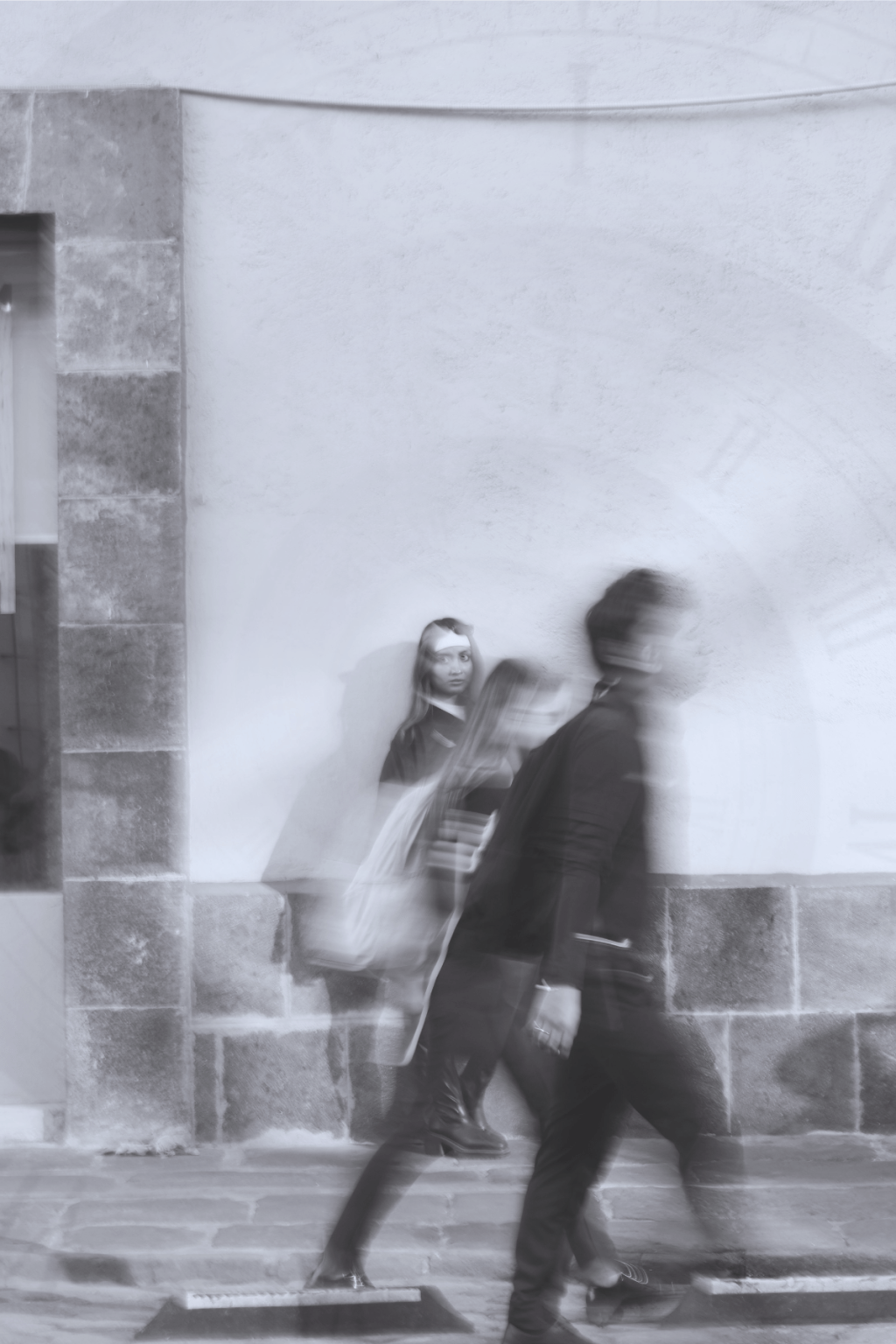
The pressure of a generation growing between expectations, comparisons, and relentless speed
How much is a life worth—if we measure it in years rather than in depth?
There is something quiet, yet constant, that follows us as we grow. It is not as loud as criticism, nor as warm as support. It is a feeling. A feeling that time is watching us. That society observes us like an experiment in progress—will we succeed, will we “become” something, will we justify someone’s belief… or someone’s doubt?
We are a generation that exists simultaneously as both hope and disappointment in the eyes of others.
For some, we are potential—future leaders, creators, changemakers.
For others, we are lost, distracted, “too absorbed in our phones, too detached from reality.”
And the paradox? Both sides expect something from us.
And that is where the pressure begins—not as an удар, but as a slow tightening.
As if you are in a room that is gradually shrinking, and no one has told you that you are supposed to leave.
We live in a time that does not stand still. Not because it cannot—but because it is not allowed to. Speed today is not a choice; it is a norm. On average, a person today is exposed to more information in a single day than someone in the 18th century would encounter in an entire lifetime. That is not just a statistic—it is a weight. The weight of other people’s lives, other people’s achievements, other people’s paths that we unconsciously carry with us.
And while we are trying to find our own voice, we are already overwhelmed by thousands of others.
So we begin to compare.
At 22, Wolfgang Amadeus Mozart had already composed over 30 symphonies and concertos. But what is rarely mentioned is that he began composing at the age of five—not as a hobby, but as the result of intensive, almost experimental education guided by his father. His “early success” was not just talent—it was system, pressure, and a life devoted entirely to one pursuit from the very beginning.
At 23, Isaac Newton was already laying the foundations of gravity—but this happened during a time when universities were closed due to the plague, and he spent years in isolation. His greatest ideas were not born in speed—but in silence.
Vincent van Gogh sold almost none of his paintings during his lifetime. Today, his work is worth millions, yet his own time failed to recognize him. What does that mean? That time is not always a fair judge.
And Charles Darwin spent more than 20 years developing his theory before publishing it. Two decades of doubt, research, hesitation—something that today would seem like “taking too long.”
So what are we really seeing when we look at these stories?
Not just genius.
But context.
Rhythm.
And most importantly—paths that were never shaped by the same template.
And here lies a thought we all know, yet rarely take seriously:
there are no rules.
There is no universal sequence according to which life is supposed to unfold. There is no exact moment when you are “supposed” to succeed, nor a formula that guarantees value only if something happens early. None of these individuals followed a rule—they wrote their own. And perhaps that is exactly why their stories seem like exceptions today.
But maybe they are not exceptions.
Maybe they are proof that the rule never existed.
And yet—we live as if it does.
As if there is an invisible schedule:
by this age—this,
by the next—something more,
and if you fall behind—you have failed.
But who wrote that schedule?
History? No—it is chaotic and unpredictable.
Society? Perhaps—but it changes faster than we can keep up with.
Or… is it us, trying to impose order where it does not naturally exist?
Maybe the real problem is not the pressure of time—but our need to control it. To turn it into something measurable, comparable, “correct.”
But life has never been that.
And this is where the most subtle pressure appears—the one we do not even notice.
It is not in the fact that we have to do something.
It is in the belief that we must do it immediately.
As if there is an invisible agreement:
if you are not “something” by a certain age—you are late.
But perhaps the most honest truth is this:
time is not late.
We are simply comparing ourselves to other people’s clocks.
In the end, maybe we are not pressured by the time we live in.
Maybe we are pressured by the idea that we have to outrun it.
But time has never been the enemy.
It is simply a space in which something may—or may not—happen.
And perhaps the greatest courage today is not to achieve something early.
But to allow yourself not to rush.
Not to become “something” because you are expected to—
but to become because you feel that it is your time.
Slowly.
Imperfectly.
But authentically.
In a world that is constantly running—the choice to move at your own pace is a quiet revolution.
— Anastasiја Gjorgjievska


Leave a Reply