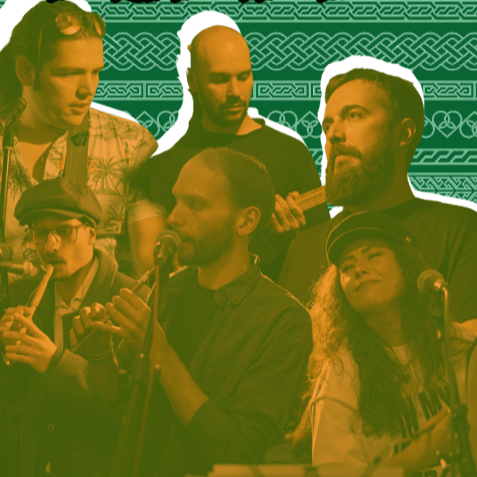
Walking through Skopje’s musical landscape you could expect traditional melodies, sure, but Irish ones? We propose you to meet six friends who have known each other for over a decade and have formed something that defies easy categorization. The Lorekeepers Guild, as they call themselves, exists somewhere between keeping a story and retelling it a fitting description for a band that has made its mission the preservation and evolution of Irish traditional music from their home in Macedonia.
The band is a six-piece ensemble brought together by a shared fascination with Irish music and, perhaps just as importantly, by the sheer joy of playing it together. Slobodan handles vocals and flute, Ivona contributes vocals and bodhrán, Bojan moves between whistle, mandola, and whatever other instrument the arrangement demands, Darko works his magic on guitar, bouzouki, and essentially anything with strings, while Kristijan provides drums and Andrej anchors the sound on bass guitar.
But before being bandmates, they are friends of more than ten years standing, a fact that has shaped their creative process in ways both wonderful and delightfully chaotic. “On the positive side,” they explain, “there is a kind of musical shorthand that comes from knowing each other for that long.” They know each other’s instincts, peculiarities, and moods, often understanding where someone is going with an idea before it is fully explained. “All polite boundaries disappeared approximately nine years ago.”
The band’s name tells part of the story itself. Lore is something passed down, like stories, songs, beliefs, and memories that survive because people keep telling them. A guild, historically, is a gathering of people united by a particular craft, like blacksmiths, bakers or merchants. Together, these concepts became a remarkably fitting description of what they do, six friends gathering around old songs, becoming their temporary keepers, and then sending them back into the world slightly changed.
“We like to think of traditional songs as little keepers of memory,” they reflect. “They travel through generations, change along the way, cross borders, and somehow remain alive.” The Guild does not attempt to preserve Irish traditional music behind glass like a holy relic that shouldn’t be altered. Instead, they play it from where they are, Skopje, with their own musical instincts and heritage inevitably finding their way into the arrangements.
There is something strangely familiar about Irish music to Macedonian ears. On paper, Ireland and Macedonia may seem quite distant from one another, but musically and culturally, that distance becomes surprisingly small. Both traditions share a deep relationship with storytelling, with songs that carry memory, loss, humour, rebellion, and belonging. Both have that wonderful ability to make melancholy and celebration exist in the same piece of music.
The band members were drawn to this world individually and in different ways, but once they began playing together, they started discovering how naturally elements of their own musical heritage could live inside these songs. “Every now and then, a Macedonian rhythm, melody or fragment of a traditional song finds its way in,” they explain. “We are not trying to make Irish music Macedonian, it happens more organically than that. Sometimes one old melody simply seems to recognize another.”
Not all of them have been to Ireland, yet! Ivona and Bojan have both visited, though separately and under very different circumstances. Ivona travelled there as a member of a Macedonian choir, performing in Cork and Dublin, so her first relationship with Ireland itself was fittingly through music. Bojan travelled privately and had the opportunity to explore more of the country, its landscapes and places. For the rest, Ireland has largely been encountered through its music, literature, history, and stories. “Perhaps that is one of the strange powers of traditional music: you can develop a relationship with a place long before you ever physically arrive there.”
The band hopes Lorekeepers Guild will eventually give all six members a reason to make that journey together.
When asked whether they consider Kneecap (an Irish hip-hop trio from Belfast, Northern Ireland, using Irish and vocal about Irish right to self-determination) to be Irish music, the Guild’s response is unequivocal, “Absolutely, although perhaps they belong to a very different room in the same house.” They argue that Irish music cannot only mean music that sounds as it did a hundred or two hundred years ago. A living culture keeps producing new forms of expression, and Kneecap are very much a product of contemporary Ireland, particularly of Northern Ireland, Belfast, the Irish language, politics, identity, and the realities of their generation.
Musically, what Kneecap does is obviously far removed from traditional Irish music, but culturally, the Guild would not place them outside Irish music at all. “If anything, there is something very old in the idea of using music to tell the story of your time, your place and your people, even when the instruments, language and attitude around that story have completely changed. Tradition survives not only by being preserved, but also by being argued with.”
The band’s relationship with Ireland began with music, but it inevitably became wider than that. When you spend enough time with traditional songs, you begin wondering what lies behind them. Who sang them first? Why did certain stories survive? Why are exile, home, rebellion, love, loss, and longing so persistent? Eventually, the songs lead you towards the history and culture that created them.
Perhaps this is another reason Ireland resonates with them as Macedonians. They come from a culture where music also carries much more than melody. Traditional songs can contain pieces of collective memory, identity, historical experience, and stories that survived because somebody kept singing them.
They are careful not to pretend Ireland is theirs or that they understand it in the way somebody born and raised there would. They approach it as outsiders, but very affectionate ones, with curiosity, admiration, and respect. “And perhaps our own background gives us a particular way of hearing it,” they reflect. “We do not experience Irish music as something exotic or completely foreign. Very often, underneath the different language and melodies, there is an emotional vocabulary that feels remarkably close to home.”
Irish traditional music remains something of a niche in Skopje, which, in a way, makes playing it there even more interesting. The Guild’s natural home has become Skopje’s Irish pub, where they play most often. They do not perform constantly, partly because this is quite a specific kind of music and there are not endless stages for it here. But over time, something much more valuable has happened, they have gathered their regulars.
There are people who come to hear them again and again, who know the songs, recognize the arrangements, and turn up whenever the Lorekeepers Guild is playing. That little community means a great deal to them.
And then there are people who encounter the music almost accidentally. They may walk into the pub without knowing what a Bodhrán is or expecting to hear a centuries-old Irish song in the middle of Skopje, sometimes with a Macedonian rhythm suddenly hiding inside it, and then, somehow, they stay.
The Guild actually likes that Irish music occupies this slightly unusual corner of Skopje’s musical landscape. They were never particularly interested in making the safest or most obvious musical choice. After all, a guild does not need to be enormous. It just needs enough people willing to keep the stories alive.
Lorekeepers Guild continues to perform regularly in Skopje, carrying forward the tradition of Irish music while allowing it to evolve through the distinctive lens of their Macedonian heritage.
We would like to thank The Lorekeepers Guild for accepting to answer our questions, it has been a pleasure to learn about them.
Nelli Winzer & Arthur Bonhoure–-Tolfo, the best colleagues ❤


Leave a Reply