
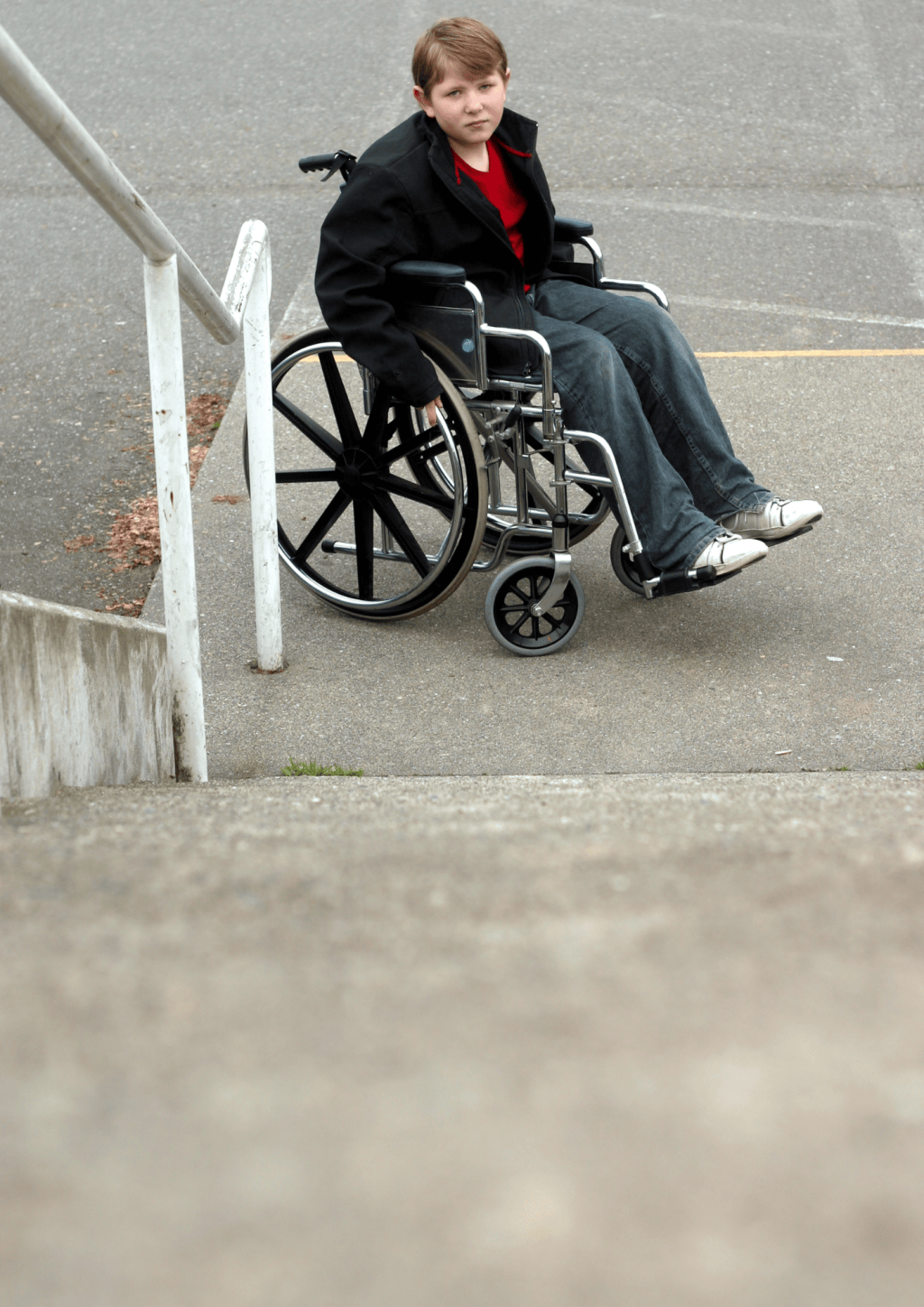
Cities count their citizens without saying a word. Who gets to cross the street, catch a bus, or visit a local office depends far less on who lives in a neighborhood and far more on how the street was designed. In Skopje, a curb dropping twelve centimeters straight onto asphalt or a steep bus step works like an unwritten ban. Pavements emptied by bad infrastructure then get used as proof that nobody was there in the first place. Think about it this way. The built environment filters the public square before anyone even leaves their house.
When we traveled to Spain for the VIVEKAS youth exchange (an Erasmus+ project focused on sports and inclusion), comparing Spanish host cities to our streets back home made something click. Assuming Skopje simply has fewer disabled residents than a city like Valladolid is a basic mistake. About one in six people alive today are disabled. Bioarchaeologists studying ancient human bones find that exact same proportion across history, landing on roughly 16 percent in nearly every period with reliable samples. Skopje has the same share of disabled residents as Valladolid. What it lacks is accessible concrete. Visibility comes down to permission. A city missing curb cuts or level bus boarding makes a hard physical ruling about who can leave home alone, forcing someone to plan a two-day logistics operation just to reach a job interview. Curbs enforce that rule instead of police.
The standard story tells us that accessibility is a modern luxury. First we survived, then we built wealth, and only then did we become kind enough to care. Our ancestors supposedly could not afford to help. Ancient bones complicate that narrative immediately. A child in northern Spain half a million years ago survived with a skull condition that fused her bones too early (Gracia et al. 2009). Living for years with that condition is impossible without constant support. Her group shared food with her long before agriculture, metal tools, or any written concept of charity existed. Four thousand years ago in Vietnam, a young man lived paralyzed from the neck down for a decade. His community fed him and turned his body constantly to prevent sores. He contributed no material labor, yet when he died, his village buried him in the main cemetery alongside everyone else.
Physical access modifications show up early in history too. Fourth-century BCE Greek builders cut stone ramps into eleven healing sanctuaries, including the major site at Epidaurus (Sneed 2020). That represents a deliberate construction program answering a simple question: who do we expect to arrive? Historical attitudes were often brutal and survival was hard, so this was no golden age. But the modern excuse falls apart anyway. Communities with no metal or economic surplus still fed people who could not feed themselves, cutting ramps into stone thousands of years before modern welfare systems were invented.
Two major shifts disrupted this baseline. The factory arrived first. Before industrialization, the pace of work was flexible. Someone who worked slowly or only during the morning still had a place in the local economy. Industrial factories introduced one rigid speed measured against an imagined ideal worker. Arithmetic followed soon after. Nineteenth-century statisticians created the mathematical concept of the average human, and eugenicists quickly turned that average into an enforced biological standard. Once the average becomes the ideal, every variation gets treated as a medical defect (Davis 1995). Combining industrial speed with statistical averages placed the entire problem inside the individual body. The dominant model demanded that society diagnose the person, attempt a cure, or simply store them away out of sight.
Mass institutionalization is the chapter most history books skip over. England held a few hundred people in charitable asylums in 1800, but that figure passed one hundred thousand by 1900. Workhouses operated on a simple rule: living conditions inside had to be worse than the hardest life outside. They trapped anyone who could not keep up with factory work. In the twentieth century, asylum logic expanded rapidly. The United States forcibly sterilized tens of thousands of people under eugenic laws, while the Nazi T4 program murdered up to 300,000 disabled individuals. For over a century, almost nobody built street ramps. Epidaurus had solved the basic engineering twenty-three centuries earlier. The medical model had simply placed the fault entirely inside the individual. If the body is considered defective, the street has no case to answer.
The turnaround came late, and it was driven entirely by disabled activists. A group formed in Britain in 1972, operating in secret because early members lived inside institutions and feared administrative punishment. In 1976, they published the sentence that reshaped the entire movement: society is what disables physically impaired people (UPIAS 1976). Impairment is a biological fact about a physical body. Disability is the structural barrier that a built environment stacks on top of that body. That distinction created real legal leverage (which matters because charity is always optional). You can withdraw charity whenever you like, but rights are compellable in court. Staircases suddenly acquired defendants once they counted as structural discrimination rather than personal bad luck.
Concrete design changes moved slowly and required intense pressure. In March 1990, protesters left their wheelchairs at the foot of the eighty-three marble steps of the United States Capitol, choosing to crawl up using only their hands. This was grueling physical labor rather than a quick photo opportunity. Activists dragged themselves up one step at a time for hours. The youngest participant was an eight-year-old girl who told organizers she would take all night if necessary. The building where laws were written literally required disabled citizens to crawl inside just to be heard. President Bush signed the Americans with Disabilities Act that July. Problem is, no polite argument had worked up to that point.
Individual initiative drove design breakthroughs as well. In 1960s Japan, Seiichi Miyake watched a close friend lose his vision and spent his own money figuring out how a blind person could read a street with their feet. Raised domes mean stop, while straight bars mean walk ahead. First installed outside a school for the blind in 1967, tactile paving now exists across four continents. You can spot these tactile strips on streets in Skopje today. Drivers usually just park their cars right on top of them.
Language evolved much faster than physical infrastructure. Ninety percent of major corporations claim to prioritize diversity, yet only four percent actively design products that disabled people can actually use (WebAIM). Nobody in that ninety percent believes disabled citizens do not exist. But here is the reality. Pavements remain far behind corporate statements. When Baltimore inspected 37,806 curb ramps in 2019, exactly 489 met basic legal standards. A stadium crowd stands up to applaud a wheelchair basketball final, then walks outside past a bus stop the athlete cannot board. Stella Young called this dynamic inspiration porn: using one group of people to make another group feel good about themselves. Stair-climbing wheelchair prototypes get venture capital funding while basic concrete ramps go unbuilt. Someone gets the warm feeling of having cared, while someone else still cannot get to work.
Skopje runs this exact same gap on a tighter budget. City officials cut ribbons and launch awareness weeks with enthusiastic speeches. Meanwhile, the curb right outside the building where the speech was given drops twelve centimeters straight onto asphalt. Public attitudes are not the root problem here. Awareness campaigns keep failing to fix physical pavements because they target feelings instead of strict legal enforcement. Meaningful change requires legal pressure and budgets that treat physical access as standard infrastructure rather than a special favor. Disabled youth belong in the rooms where city plans get approved. Activists have used a simple slogan for this principle since the 1990s: nothing about us without us.
Disability represents physical friction. It happens wherever a human body meets a space designed without it in mind. Changing the physical design changes the friction instantly. Macedonia signed the UN Convention on the Rights of Persons with Disabilities, where Article 9 guarantees equal access to public buildings and transport. That promise exists clearly on paper. Paper does not lower a curb or install a working elevator. A budget line with a strict deadline lowers a curb. A disabled professional with the authority to reject a bad blueprint gets an elevator built. Anyone can test whether a city takes access seriously right from the sidewalk. Every awareness week deserves one practical question: what funded, physical project does this speech attach to? If the answer is nothing, the city is just producing the feeling of access instead of real access. Societies choose how they build friction into their streets. The builders at Epidaurus made their choice twenty-three centuries ago. The demand today centers on concrete rather than sympathy, continuous curb cuts, and buses you can actually board. It is the ordinary right of any citizen to leave their house and be counted among the people who live here. Skopje has simply not given them permission to be seen.
Dorotea Grkovikj and Mihail Naumovski
Erasmus+ youth exchange “VIVEKAS: Youth participation through sports from an inclusive perspective” took place in Valladolid, Spain from 15.07 – 23.07.2026.
Hosting organisation: ASPAYM Castilla y León
Sources:
Archaeology, Prehistory & Antiquity
Gracia et al. (2009) – Craniosynostosis in the Middle Pleistocene human Cranium 14 from the Sima de los Huesos, Atapuerca, Spain. PNAS (DOI: 10.1073/pnas.0900965106)
Sneed, D. (2020) – The architecture of access: ramps at ancient Greek healing sanctuaries. Antiquity / Cambridge Core (DOI: 10.15184/aqy.2020.123)
Tilley, L. (2015) – Theory and Practice in the Bioarchaeology of Care. Springer (DOI: 10.1007/978-3-319-18860-7)
Trinkaus, E. (1983) – The Shanidar Neandertals. Academic Press.
Tiesler, V., & Cucina, A. (2007) – New Perspectives on Human Sacrifice and Ritual Body Treatments in Ancient Maya Society. Springer.
Verano et al. (2000) – Foot Amputation by the Moche of Ancient Peru. PubMed.
Industrialization & The Medical Model
Davis, L. J. (1995) – Enforcing Normalcy: Disability, Deafness, and the Body. Verso.
Oliver, M. (1990) – The Politics of Disablement. Macmillan Education.
Russell, M., & Malhotra, R. (2002) – Capitalism and Disability. Socialist Register.
Turner, D., & Blackie, D. (2018) – Disability in the Industrial Revolution: Physical Impairment in British Coalmining. Manchester University Press.
Zola, I. K. (1972) – Medicine as an Institution of Social Control. The Sociological Review (DOI: 10.1111/j.1467-954X.1972.tb00220.x)
Disability Rights & The Social Model
Charlton, J. I. (1998) – Nothing About Us Without Us: Disability Oppression and Empowerment. University of California Press.
Finkelstein, V. (1980) – Attitudes and Disabled People: Issues for Discussion. Disability Archive UK.
Heumann, J., & Joiner, K. (2020) – Being Heumann: An Unrepentant Memoir of a Disability Rights Activist. Beacon Press.
UPIAS (1976) – Fundamental Principles of Disability. Union of the Physically Impaired Against Segregation.
Contemporary Accessibility, Policy & Discourse
Byrne-Haber, S. (2021) – Performative Disability Allyship and Disability Optics.
Jackson, L., Haagaard, A., & Williams, R. (2022) – The Disability Dongle. CASTAC.
WebAIM (2025/2026) – The WebAIM Million. Official WebAIM project report.
Young, S. (2014) – I’m not your inspiration, thank you very much. TED Talk.


Leave a comment