
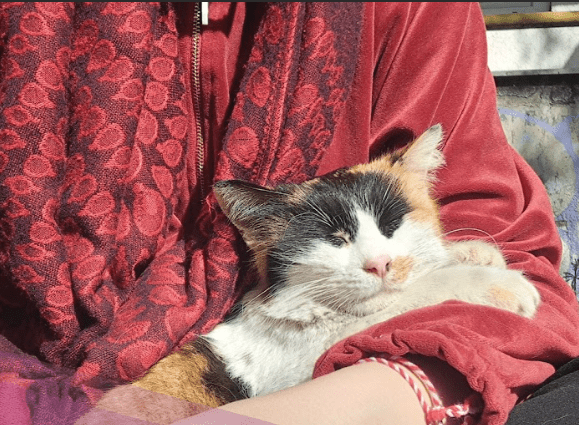
Once upon a time, there was a family that decided to adopt a kitten. A black, big eyed animal quickly became the purrfect addition to a family of five. The family now had two teenage girls and two babies. The babies—one with fur and the other one who just started to learn how to walk. But the magic did not last long. One feral day, when the kitten had its time for leisure and fun in the garden, a sudden loud sound frightened the pet and made it run away. He was too tiny to remember the way back. The kitten got lost.
The years were passing by and everything changed. Home once full with laughter and adorable meowing becomes more and more quiet. Sisters move out for studying to other cities and a giggly baby becomes a pupil in the nearby primary school. The young boy had a dream about having a company. He always loved cats, so there was nothing else he wanted to fill out the gap with other than a four paws friend.
One magical day his dream came true. On the doorstep to Łukasz’s big surprise was standing a black cat. The bond between the child and the animal developed at an incredible pace, and after a while, the two of them became inseparable. The cat plays with Łukasz, stays aside when he plays lego and sleeps in his bed when dad is reading to his son a goodnight book.
Stories like this may seem like simple fairy tales, yet in recent years the relationship between humans and cats has become an important subject of scientific research. Studies show that this bond is influenced by many factors, including the cat’s living conditions, the owner’s lifestyle, and even the owner’s understanding of feline communication. Research conducted on hundreds of participants suggests that cats who spend less time alone, live indoors, and experience fewer behavioral problems tend to form stronger and more positive relationships with their owners. Even factors such as housing type or the presence of other cats can shape the quality of this connection.
The growing popularity of cats in Europe is no coincidence. Modern lifestyles – smaller homes and less time spent indoors – make cats particularly suitable companions. At the same time, scientists describe what is known as the “pet effect” (Nugent and Daugherty, 2022). Simply living with a cat can reduce negative emotions, while interacting with one can increase feelings of comfort and happiness. However, this bond does not appear automatically. It requires understanding the animal’s needs, its body language, and its natural instincts. For instance many behaviors seen as “problematic” are, in fact, completely normal for cats. Recognizing signs of stress or communicating gently even through something as subtle as slow blinking – can significantly strengthen the relationship between human and animal.
The question remains: could it be possible that the cat from the story I told was the once-lost kitten? And how is it that animals can form such deep and immediate connections with humans? Science may explain part of it, but not all.
Perhaps we will never know the full answer. Yet one thing is certain: the bond between humans and animals is something beyond tangible. Nonetheless we need to remember that every day, countless cats are still waiting–lost, abandoned, or never chosen to form such a connection with someone. Maybe the real magic does not lie in finding a lost pet after years, but in giving a home to the one who is still waiting.
Karolina Tulik
PS. The cat is named Groszek (from Polish: Peas)
Sources:
David J. Menor-Campos, You and your cat: Factors affecting quality of human-cat relationship
Agnethe-Irén Sandem and Bjarne O. Braastad, The social bond between man and cat


Leave a Reply