
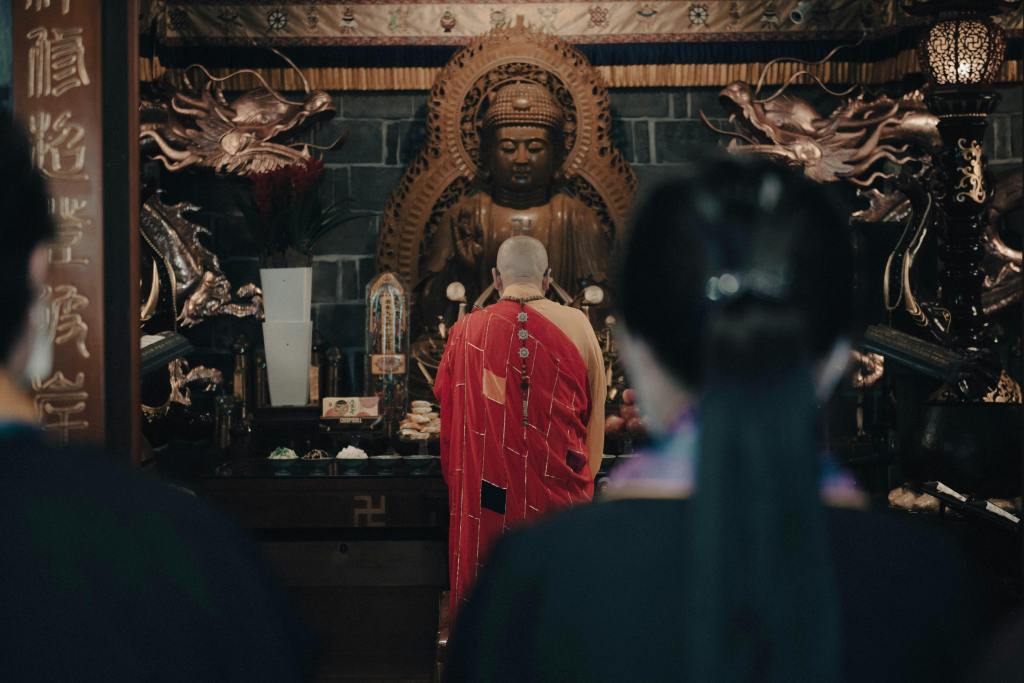
When a religion born between 563 and 483 BCE becomes a simple scented candle in our bathrooms or a “zen” tattoo in Bali…
One may wonder: what really remains of Buddhism?
Buddhism is one of the oldest religions still widely practiced today. It appeared in India in the 5th century BCE, founded by Siddhartha Gautama, a prince of the kingdom of Kapilavastu, who is said to have left his family and his life of luxury to set out in search of truth.
After years of asceticism, he attained Enlightenment, discovering the path to understand human suffering and free oneself from it.
From then on, he taught his doctrine throughout the Ganges valley, accompanied by his community of monks, the Sangha, until his death at the age of 80. Buddhism also contains foundational religious texts. These fundamental texts, called the Tripitaka (“the three baskets”), form the basis of Buddhist doctrine: the Sutta Pitaka brings together the Buddha’s discourses, the Vinaya Pitaka compiles monastic rules, and the Abhidhamma Pitaka contains philosophical and psychological reflections. Buddhism is not a single unified block: there are many branches, such as Tibetan Buddhism, Theravada, or Mahayana, each with its own interpretations and practices.
Unfortunately, our vision of Buddhism is not very representative.
Between clichés and cultural appropriation in the West, this religion, with its great cultural richness, is often reduced to a “zen” image: soothing, spiritual, but superficial. Sacred objects become decorative items: Buddha statues in gardens, scented candles bearing his image, “karma” incense, or tattoos of Sanskrit mantras, all without understanding their meaning. This romanticization of Buddhism erases the complexity of its thought and the diversity of its practitioners. It is part of a broader phenomenon: cultural appropriation, that is, the use of elements from one culture by another, often with a form of dominance, without respect for their significance. Thus, when a sacred symbol is turned into a decorative accessory, one moves away from history and spirituality; one would not put a crucifix “to look nice” in one’s bathroom, so why a Buddha? It is not just a “style,” it is a loss of meaning.
Moreover, this trend is strongly encouraged by marketing and commodification. This drift is not harmless: it follows a commercial logic and is also heavily influenced by the media. Buddhism has become a product to sell, a promise of “inner peace” in a world stressed or frustrated by constant external conflicts. Meditation cushions, “zen” retreats, or t-shirts such as “Be like Buddha” are marketed as if buying them were enough to achieve lasting wisdom. This phenomenon is not isolated. Other cultures have undergone similar superficial transformations in the Western imagination. The Arab-Persian world, for instance, has often been reduced to a fairy-tale setting inspired by One Thousand and One Nights: sandy palaces, flying carpets, and richly dressed women.
Everything becomes a theme: a thousand-year-old culture turned into a party aesthetic. Voodoo, too, is often demonized in films and associated with evil and witchcraft. These stereotypes, although they may seem harmless, desacralize and distort living cultures.
One can appreciate without appropriating.
That is where the nuance lies. To take a genuine interest in a culture means striving to understand it, to respect its symbols and the depth of its history. It is not about closing these traditions off from the world, but about avoiding stripping them of their meaning.
Between inspiration and distortion, the line is thin and it is up to each of us to remain aware of what we consume and what we transform.
Reducing Buddhism to a trend or a consumer product means missing what it truly is: a complex philosophy, a demanding practice, and a genuine quest for meaning.
Marco Zannou
Sources:
Who is Buddha? Origin, history and significance in Buddhism | Karmic Artisan
La diffusion du bouddhisme en Asie | lhistoire.fr
Occidentalisation | Wikipédia
Bouddhisme : scandales sexuels sous silence | France Inter
Video:
L’Histoire de Bouddha – Le Prince Siddhartha Gautam | Histoire et Mythologie en BD
L’APPROPRIATION CULTURELLE : c’est quoi le problème ? | Les EthnoChroniques


Leave a Reply