
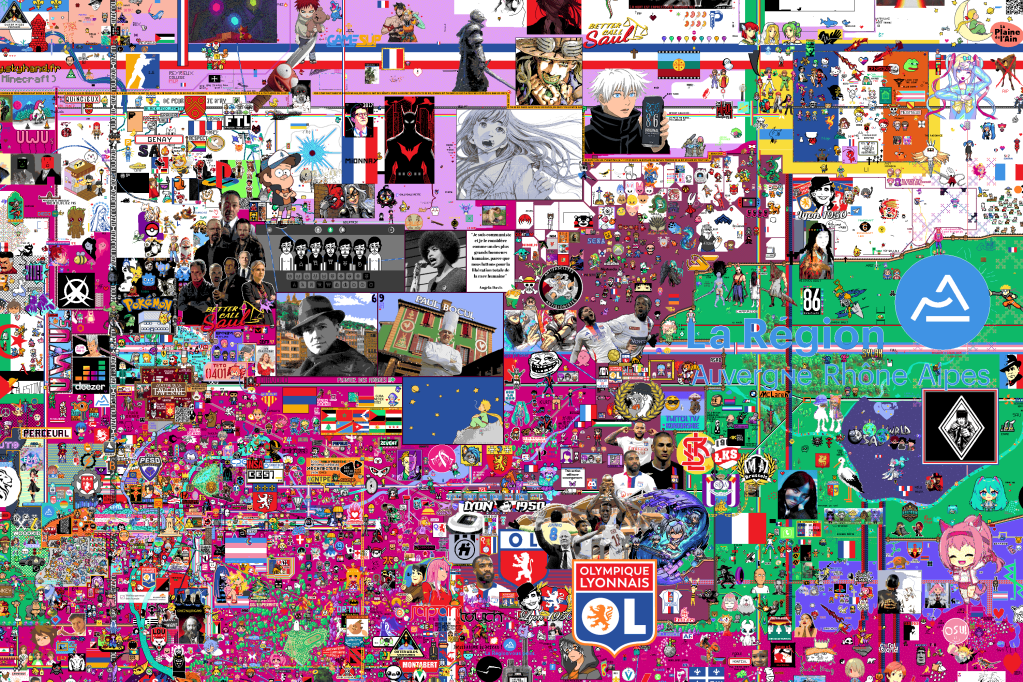
What happens when you give millions of internet users a blank canvas the size of the planet? You get the website Wplace, where millions of people are drawing their favorite characters, flags, or other kinds of art over their cities for the sole desire to be seen and the pleasure to create.
Launched in July 2025 by Brazilian developer Murilo Matsubara, Wplace is an ambitious online platform that lets users edit a pixelated world map. While the concept might sound technical, the execution is pure fun and a vibrant case study of participatory design, a process where the end-users aren’t just passive consumers, but active co-creators.
Let’s dive into why Wplace is so interesting.
At first glance, Wplace looks like Google Maps crossed with an old-school MS Paint file. The canvas is massive, over 4 trillion pixels (4’000’000’000’000) covering the entire globe. But here is the catch: you can only place one pixel every 30 seconds, meaning it would take more than 3’800’000 years for someone to cover everything by themself. And here is the interest.
This limitation is the secret sauce of participatory design. You cannot just sit down and draw a masterpiece alone. If you want to build something big, for example covering the entire city of Paris with propaganda or the logo of your favorite sports team, you need help.
The mechanics force players to form alliances. This transforms the act of design from a solitary activity into a social event.
What makes Wplace a particularly good example of participatory design is how the “product” (the map) becomes a mirror of the community’s values, humor, and politics.
Unlike traditional design, which is controlled by a top-down authority (like a city planner or a CEO), Wplace is organic. It is chaotic and crude, but it is also deeply authentic.
On the pop culture side, fans have covered Seoul in Squid Game art and blanketed Albuquerque with Breaking Bad monologues. Many users are also using the website for activism. The Gaza Strip features Palestinian flags and anti-war messages, while trans pride flags appeared prominently in the UK as a counter-protest to anti-trans rhetoric.
But the activists are not the scariest ones, there is a phenomenon called “voiding,” where users band together to erase an area with a solid color (usually black) to start fresh or just cause trouble. It is destruction as a form of creation.
Participatory design often fails because it feels like work. Crowdsourcing can feel like exploitation, and group projects can feel like a drag. Wplace avoids this by gamifying the experience.
The site features a “Droplets” economy and a leveling system. The more you draw, the more pixels you can hold, and the more colors you can unlock. There is a leaderboard tracking which countries are the most active, sparking friendly (and sometimes not-so-friendly) international rivalries. Many players have developed a fear for the Brazilian community for example.
Because the map is permanent, the design is never finished. It evolves in real-time. A user named Krista Rider started drawing a small neighborhood in Arizona; it has since grown to over 50 connected homes, built by strangers. Personally, I started drawing pokemon in the north of my home town, and thanks to the help of strangers we are now at around 400 of them while I write this.
Finally, no discussion of participatory design is complete without addressing the mess. Because everyone has a voice, not everyone uses it nicely. Wplace faces challenges with moderation, hate speech, and “griefing” (vandalizing others’ art). However, even this chaos highlights the core truth of participatory design: it empowers people to express themselves, for better or worse.
Ultimately, Wplace is a joyful reminder that the internet doesn’t have to be a series of algorithmic feeds. It can be a playground. It proves that when you give people a pixel and ask them to paint the world, they won’t just draw, they’ll build communities, wage pixel wars, and create something no single designer ever could have imagined.
It is messy, it is wild, and it is a lot of fun in the end.
Arthur Bonhoure–Tolfo


Leave a Reply