
If you have ever done an Erasmus+ training course, you probably have a Youthpass certificate somewhere on your laptop. Maybe in a folder called “documents” or “stuff” or “idk.” It says you developed competences. Important ones. European-framework-level ones. And if you are anything like me or the 30 other youth workers I met in southern Spain this April, you have absolutely no idea what to do with it.
This is the article I wish someone had written for me before I flew to Mollina, sat through sessions on the EU’s Entrepreneurship Competence Framework and slowly realized that I had been sitting on a goldmine of professional language I never learned how to speak.
The problem nobody talks about
Youthpass is the official recognition tool for non-formal learning in Erasmus+ youth projects. It is supposed to help you describe the skills you gained during a project so you can use them for your career, your CV, and your next opportunity. In theory, it is powerful. In practice, most of us collect these certificates like pokemon cards we never play with.
The reason is simple. Nobody teaches us the vocabulary. You finish a training course, you get a certificate that says you improved your “sense of initiative and entrepreneurship” and you nod and move on because what does that even mean in a job interview? What does it mean on a Tuesday morning when you are trying to convince your municipality to fund a youth project?
Enter EntreComp (and stay with me here)
The European Commission built something called EntreComp in 2016. It is a framework that breaks down “entrepreneurship as a competence” into 3 areas, 15 competences and 442 learning outcomes across 8 progression levels. Yes, 442. I read it so you do not have to.
Here is the thing, though. Once you strip away the EU jargon, the framework is actually describing stuff that you already do. It just gives it structure and professional weight. Let me translate.
The three areas are: Ideas and Opportunities, Resources, and Into Action. Think of them as: what you notice, what you bring to the table and what you actually do about it.
The 15 competences include things like: spotting opportunities, creativity, ethical and sustainable thinking, self-awareness, motivation, mobilising resources, working with others, coping with uncertainty and learning through experience. Read that list again. If you have ever run a project in an NGO, you have done all of these. You just never had the words.
And this is where it gets interesting. Each competence has 8 levels of progression from “I need guidance” all the way to “I am driving transformation in my field.” So it is not a checkbox. It is a mirror. It shows you where you are and where you could go.
What gamification has to do with any of this
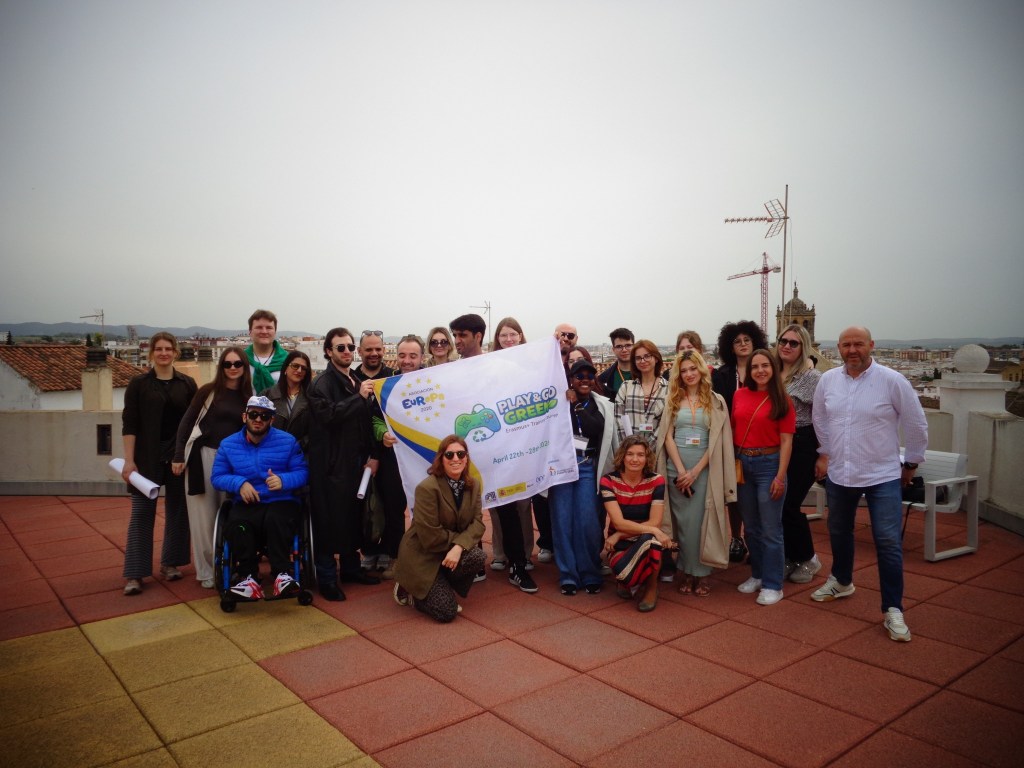
In Mollina, I participated in a training course called “Play and Go Green: Innovative Methods for Entrepreneurship Education.” The whole point was to take this massive framework and make it something you can actually feel and experience rather than just read about.
We did group-based Eco-Social Business Canvas sessions where you build a business model that accounts for environmental and social impact from the start. We went to Córdoba and walked through the city with what they called an “eco-lens,” looking at real businesses and identifying where green improvements could happen.
None of this felt like studying. All of it was learning.
And that is the point. When someone hands you a 43-page PDF full of competence grids and progression levels, your brain checks out. When someone puts you in a room with people from 10 different countries and says “build something together”, you suddenly understand what “mobilising others” and “working with others” and “coping with uncertainty” actually feel like in your body, not just on paper.
So what do you actually do with your Youthpass?
Here is my attempt at making this practical.
Step one: read it again. Actually read the competences listed on your Youthpass. Not like a formality, but like a skills inventory.
Step two: learn the language. EntreComp gives you the professional vocabulary to describe what you did. You did not just “help organize an event.” You mobilised resources, worked with diverse teams, took initiative under uncertainty, and created social value. That is not fluff. That is the language institutions and employers understand.
Step three: map yourself. Look at the 8 progression levels. Be honest about where you are. Level 3 in financial literacy and level 6 in mobilising others are not a failure. It is a starting point. It is self-awareness, which is literally one of the competences.
Step four: use it. In your CV. In your cover letter. In your LinkedIn profile. In your next project proposal. The framework exists so you can stop underselling the skills you built through non-formal education. Youth work is not a gap on your resume. It is where you learned to do things most people only read about in management textbooks.
The real takeaway
I flew 3,384 km to a small town in Andalusia. I spent a week with youth workers from across Europe. And the single most useful thing I brought home was this: the skills you build through non-formal education are real, they are recognized by the EU, and they have names. You just need to learn what those names are and start using them.
Your Youthpass is not a participation trophy. It is a professional document. Treat it like one.
Dorotea Grkovikj


Leave a comment