
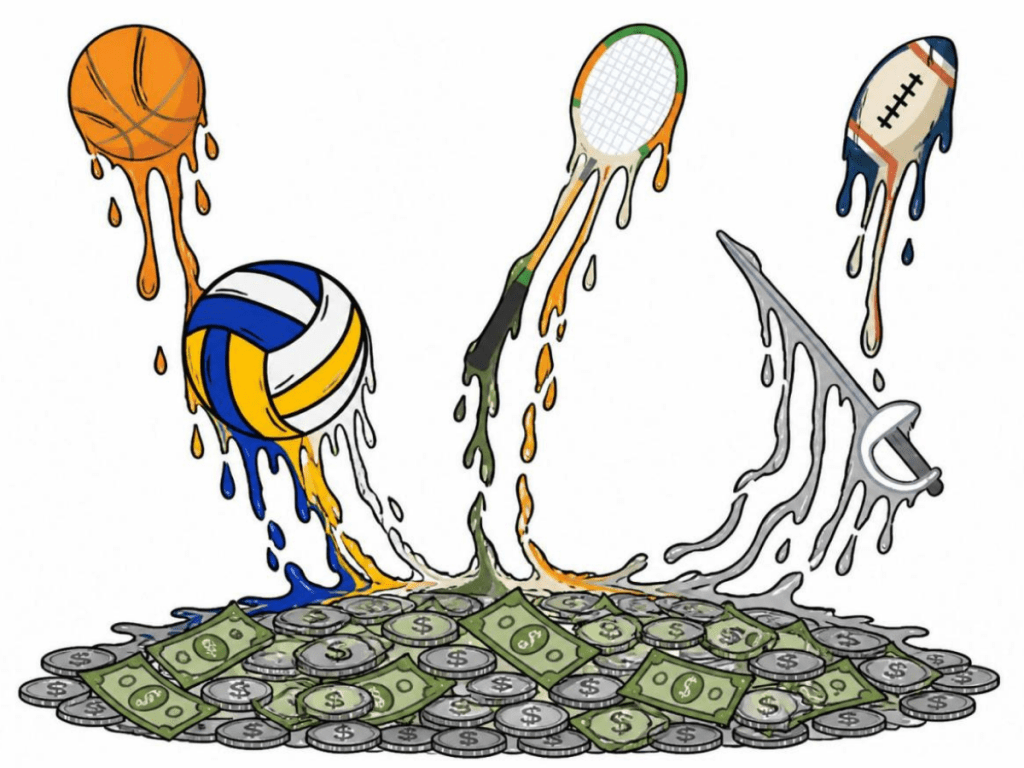
For a long time, sport was seen as one of the last spaces where human emotion ruled everything: the fear before a final, the tears of defeat, the uncontrollable joy of an unexpected victory. People watched competitions to feel something, to vibrate with strangers who, for a few hours, became their heroes. Yet, for several decades, a growing concern has emerged: is sport still a story of emotions, or only of billions?
When the first modern Olympic Games were organized, the idea rested on the nobility of effort and the brotherhood between nations. Athletes competed above all for honor, for the pride of representing their country, and for pushing their own limits. Sport embodied an ideal almost too beautiful: a world where merit, discipline, and perseverance were enough to create legends.
This memory of a purer sport remains deeply rooted in the collective imagination. We like to believe that the feats of yesterday were driven solely by passion and determination. This nostalgia doesn’t mean money was absent, but it wasn’t yet the dominant force. Emotion seemed to fill all the space.
With the arrival of international television channels, sponsors, and major brands, sport gradually changed scale. What was once a national or regional event became a global spectacle. The NBA is now followed on every continent, Formula 1 gathers hundreds of millions of viewers, and the Tour de France crosses cultural and linguistic borders.
This transformation brought more spectacular images, modern stadiums, immersive broadcasts, and total professionalization of disciplines. Sport became a global industry capable of making billions of people dream. But this expansion also introduced a new logic: that of performance, profitability, and constant growth.
In this new universe, athletes are no longer just competitors; they have become global figures, companies in their own right. Legends like Michael Jordan or Serena Williams embody both sporting excellence and immense economic power. Their influence extends far beyond courts and fields.
It’s fair that these athletes are rewarded for their talent and hard work. However, this evolution changes our perception. When advertising contracts, image rights, and marketing strategies become omnipresent, some fans feel their heroes slipping away. The emotional bond, once simple and direct, becomes more complex.
In almost every discipline, seasons grow longer, competitions multiply, and calendars become increasingly demanding. This inflation of events follows an economic logic: every match, race, or tournament generates revenue. The show must go on without interruption.
For athletes, this reality often means more travel, less rest, and constant pressure to perform. Behind trophies and medals hide tired bodies. When a competitor breaks down or withdraws, the public suddenly remembers they are not machines but human beings facing immense expectations.
To claim that money has destroyed sport would be unfair. Massive investments have enabled extraordinary progress: modern infrastructures, scientific preparation, and global visibility. They have also contributed to better recognition of women’s sports and opened professional careers for thousands of athletes.
Thanks to these developments, performance levels have never been higher. Records fall, disciplines evolve, and sport now reaches audiences that once had no access to it. Money has, in part, expanded the dream.
If the question of money stirs so much emotion, it’s not because it’s inherently negative it’s because it awakens a deeper fear: the fear of losing the magic of sport. Sport lives through unpredictability, surprises, and improbable stories. It thrives on those moments when the underdog triumphs, when victory seems impossible until the very last second.
When financial gaps grow too wide or decisions appear dictated by profitability, some fans fear that this magic is fading. They dread a sport that’s more predictable, more calculated, less spontaneous.
Money hasn’t killed sport, but it has profoundly transformed it. It has enabled its global expansion while introducing new tensions between passion and profit. The challenge for the future isn’t to eliminate money, but to preserve the balance between emotion and economy.
Because as long as sport continues to make us tremble, cry, and dream, it will remain alive. The day those emotions disappear, the question will no longer be whether money has changed sport but whether it has taken over completely.
Paul Goumault


Leave a Reply