
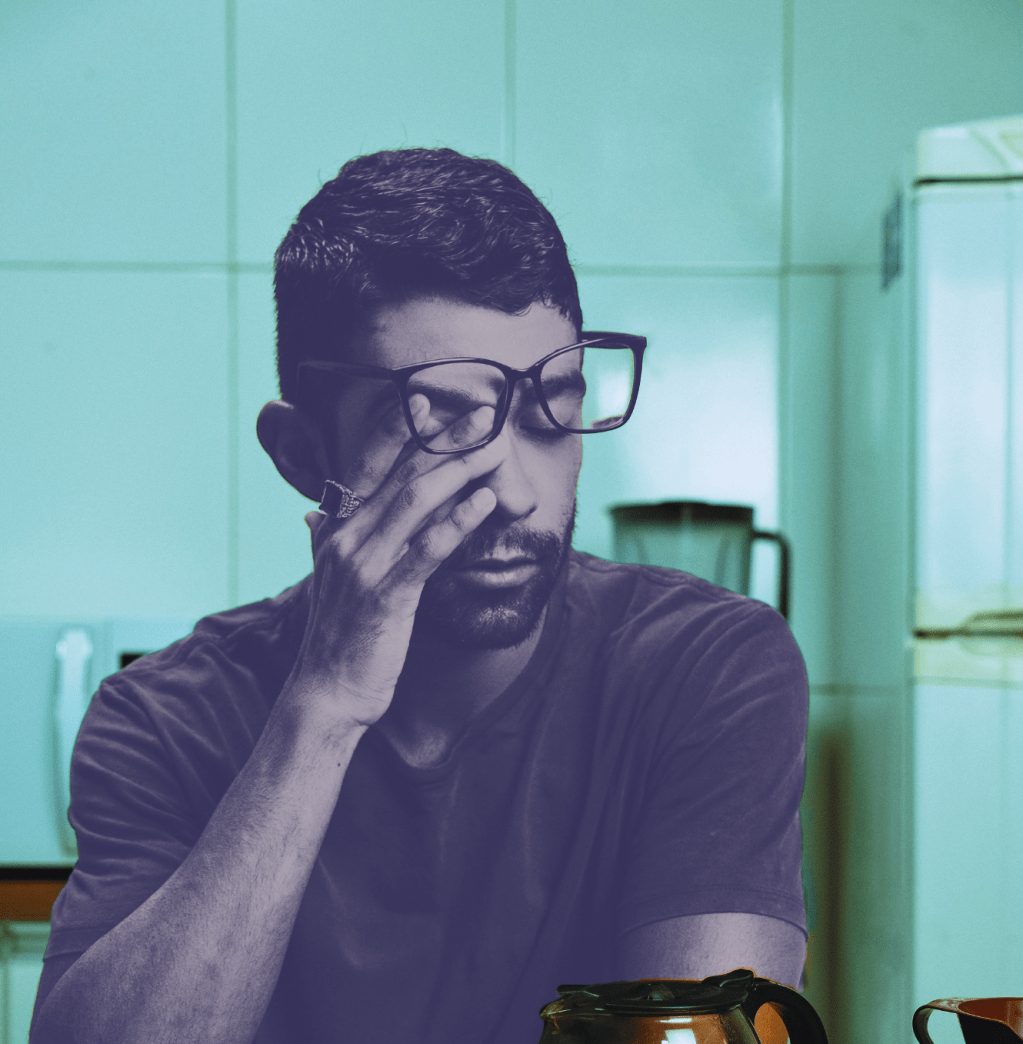
You probably don’t think of missing sleep as a form of injury, but that’s exactly what it is. Or even that sleeping is a task that you can postpone, absolutely not! Within 24 hours, your brain begins to fail in measurable ways. Within a week, your body enters a state of low-grade inflammation. And the more time passes the bigger the damages are. Here is what happens, stage by stage.
Short-term (1 to 3 nights): Your brain starts to malfunction. After just one night of less than six hours of sleep, your prefrontal cortex, the part of your brain that controls impulse, focus, and decision-making slows down significantly. Brain scans show a 30–50% drop in glucose use in this region. That means your brain is literally running on less fuel.
What you feel: You forget simple things. You lose your train of thought mid-sentence. Small frustrations feel enormous.
What you don’t feel: Your reaction time has slowed to the level of a drunk driver. But unlike alcohol, sleep loss removes your awareness of being impaired. You think you’re fine. You are not.
By the second night, your amygdala (the brain’s fear center) becomes overactive. Neutral things, a text message, a glance from a coworker start to feel threatening. Your body releases cortisol as if you are in danger, even when you are safe. You are not anxious because something is wrong. You are anxious because your brain has lost the ability to tell the difference between a real threat and a normal moment.
Medium-term (1 to 2 weeks): Your body starts to attack itself. If you continue sleeping six hours or less per night for more than a week, the problem stops being “in your head”. It becomes systemic.
Your immune system releases inflammatory chemicals called IL-6 and TNF-alpha. These are useful for fighting infections, but when they stay elevated for days, they begin damaging healthy tissue. Your blood pressure, which should drop by 10–20% while you sleep, stays high all night. Your cells become less responsive to insulin, the first step toward diabetes.
The most dangerous change is invisible: you start having microsleeps. These are one- to three-second blackouts where your brain briefly shuts down while your eyes remain open. You will not notice them. But if you are driving, crossing the street, or operating any machinery, those two seconds can kill you. Studies show that after two weeks of restricted sleep, your risk of a car accident is roughly equal to driving with a blood alcohol level of 0.10%.
By this stage, your brain also loses its ability to monitor its own errors. You will rate your performance as “fine” while objective tests place you in the bottom 10% of all people. This is not stubbornness. It is a neurological fact: the sleep-deprived brain cannot see its own failure.
Long-term (months to years): The damage becomes permanent. Chronic sleep deprivation, meaning six hours or less per night for a year or more, does not just make you tired. It physically shrinks your brain.
Long-term MRI studies show that people who chronically undersleep lose gray matter in the hippocampus, the region responsible for memory. The loss ranges from 8–12% over five years. This shrinkage directly correlates with a significantly higher risk of Alzheimer’s disease. In fact, each year of short sleep accelerates amyloid plaque accumulation (a hallmark of Alzheimer’s) by the equivalent of two to three extra years of aging.
Your heart pays a permanent price as well. Normally, blood pressure drops at night. In chronic short sleepers, that drop disappears. Over years, this forces the heart to work continuously at high pressure, leading to thickened heart muscle and a threefold higher risk of stroke.
But the most frightening long-term effect is on your immune system. Natural killer cells, your body’s first defense against both viruses and early-stage cancers, are produced almost exclusively during deep sleep. After months of sleep loss, natural killer cell activity drops by 50–70%. Large-scale studies have tracked the result: chronic short sleepers have a 40% higher risk of colorectal cancer, and a 50% higher risk of breast cancer. Sleep loss does not cause cancer by itself. But it silences the very cells whose job is to destroy cancerous cells before they form tumors.
The cruelest part: You won’t believe you’re damaged. At every stage, sleep deprivation impairs your ability to recognize sleep deprivation. The more sleep you lose, the more confident you become that you are functioning normally. This is why people who sleep five hours a night often insist they “don’t need more”. They are not lying. They are neurologically incapable of feeling their own deficit.
Some damage can be reversed. After a few bad nights, two or three full nights of sleep will bring most functions back. After weeks of restriction, recovery takes longer, up to ten days, and some inflammation may linger. But after years of chronic short sleep, certain changes appear to be permanent: the shrunken hippocampus, the silenced natural killer cells, the heart muscle that has thickened from years of midnight pressure.
You cannot bank sleep. You cannot “catch up” on weekends in any meaningful way that reverses long-term structural damage. The only intervention that works is prevention: a consistent seven to eight hours per night, night after night.
In a nutshell, sleep deprivation is not a badge of honor. It is not a productivity hack. It is a progressive, cumulative injury that begins with forgetfulness, escalates to systemic inflammation, and ends with permanent brain shrinkage and a dramatically elevated risk of cancer, heart disease, and dementia. The person you become after months of poor sleep is not a tougher version of you. It is a slower, sicker, more anxious version, one who lacks the insight to understand what has been lost.
The question is not whether you can function on less sleep. The question is what kind of future you are building, one short night at a time.
Arthur Bonhoure–Tolfo
https://www.science.gov/topicpages/a/alcohol-impaired+driving+crashes.html
https://neurologytoday.aan.com/doi/10.1097/01.NT.0000365758.57321.d5
Module 2. Sleep and the Immune System | NIOSH | CDC
https://labs.sciety.org/articles/by?article_doi=10.21203/rs.3.rs-8070202/v1


Leave a Reply