
One Piece and Gen Z’s New Language of Resistance
What is a pirate flag from a manga series doing at protests in different parts of the world?
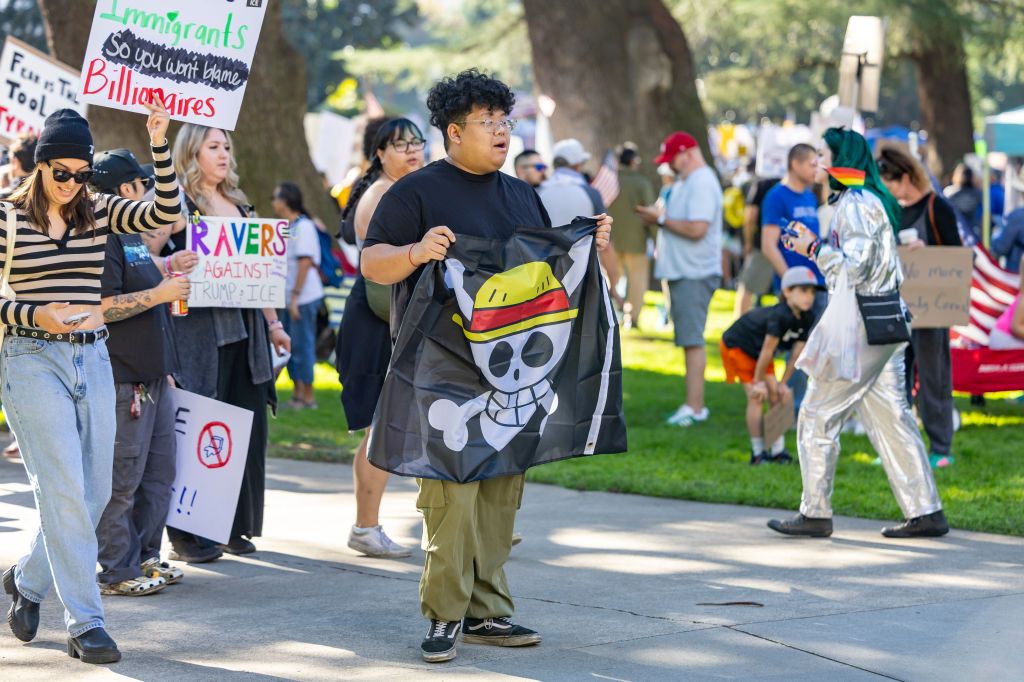
In 2025, amid growing public dissatisfaction in Indonesia, an unusual flag began to appear in the streets: a smiling skull wearing a straw hat. For One Piece fans, the symbol was instantly recognizable. It was the Jolly Roger of the Straw Hat Pirates.
But the flag did not remain in Indonesia. It later appeared in youth-led protests in Nepal and the Philippines, and eventually in demonstrations in France. Despite the different political contexts of these countries, young protesters began using the same fictional symbol to express ideas such as freedom, justice and resistance to authority.
So why One Piece?
Created by Eiichiro Oda and first published as a manga in 1997, One Piece follows Monkey D. Luffy and his crew on their journey in search of a legendary treasure. Yet behind the adventure, the story repeatedly explores themes such as freedom, injustice, discrimination, corrupt authorities and resistance to oppression.
Luffy’s journey is not simply a search for treasure. At its heart, it is also the story of someone determined to live freely and unwilling to let others decide how he should live.
Seen from this perspective, it is not surprising that protesters have given the Straw Hat Pirates’ flag a new meaning. In the fictional world of One Piece, it represents a crew determined to live freely. In the real world, it can become a way of challenging authority.
But what makes this phenomenon particularly interesting is not simply the political themes of One Piece. It is the fact that the same symbol can carry political meaning across very different countries.
When a Flag Crosses Borders
The One Piece flag became especially visible as a protest symbol in Indonesia. Before the country’s Independence Day in August 2025, people began displaying the pirate flag as a way of expressing dissatisfaction with the government. Its political meaning became even more visible during later demonstrations.
Soon, similar images appeared elsewhere. The flag was carried by young protesters in Nepal and later appeared at anti-corruption demonstrations in the Philippines. International media began describing it as a recognizable symbol among a new wave of Gen Z protests across Asia.
Then the symbol moved beyond Asia.
During protests in France in September 2025, One Piece flags appeared among more traditional protest banners. Some young French demonstrators explicitly said that they had seen the flag being used in Nepal and Indonesia. In other words, the symbol was not simply appearing independently in different countries; at least some protesters were consciously adopting a symbol they had seen used elsewhere.
There is an important point here: these protesters were not all protesting for the same reason.
Indonesia, Nepal, the Philippines and France have very different political contexts. The protesters were not necessarily members of the same organization, supporters of the same political party or followers of the same ideology.
Yet they were carrying the same flag.
That is what makes the One Piece flag more than just an interesting internet trend.
Is Gen Z Speaking a New Political Language?
When we think about political movements, certain images usually come to mind: party flags, ideological symbols, trade union banners, portraits of political leaders or slogans that have been repeated for generations.
But the shared cultural world of a generation that grew up with the internet looks very different.
A young person in Türkiye and another in Indonesia may live under completely different political systems. They may not speak the same language, support similar political parties or experience the same problems. Yet both may watch One Piece, recognize the same characters and understand what the Straw Hat flag represents.
Social media makes this shared cultural space even larger. An image from a protest can travel across the world within hours. Young people elsewhere can see it, reinterpret it and adapt it to their own political struggles.
And One Piece is not the first example of popular culture entering the language of protest.
The Guy Fawkes mask associated with V for Vendetta has been used by movements such as Anonymous and Occupy. The three-finger salute from The Hunger Games, originally a fictional gesture of resistance, became a real-world protest symbol, particularly in Thailand. La Casa de Papel, meanwhile, introduced a new generation to Bella Ciao, a song historically associated with the Italian anti-fascist resistance.
The One Piece flag may be the latest example of this relationship between popular culture and political protest.
But there is an easy conclusion to draw from all this: perhaps Gen Z is becoming less interested in traditional political ideologies.
The reality may be more complicated.
Not Less Political, Just Political in a Different Language
Carrying a One Piece flag does not necessarily make someone less political. In fact, the ideas associated with the symbol are deeply political: freedom, justice, solidarity, opposition to corruption and resistance to oppressive authority.
What may be changing is not the values themselves, but the language used to express them.
Previous generations often expressed political ideas through traditional ideological symbols. Young people today can find political meaning in an anime they grew up watching, a film scene, a song or even an image circulating on social media.
Popular culture, then, becomes more than entertainment. It can also become a shared cultural vocabulary for understanding and expressing political experiences.
And this vocabulary has one major advantage: it can cross borders easily.
The flag of a political party in one country may mean nothing to someone living thousands of kilometres away. The One Piece flag, however, is already recognizable to millions of young people around the world.
It does not even need to mean exactly the same thing to everyone.
For one protester, it may represent freedom. For another, resistance to a corrupt system. For someone else, it may symbolize friendship and solidarity.
Perhaps that flexibility is part of its power: it is familiar enough to be shared, but flexible enough to represent different struggles.
A New Protest Identity?
Still, the appearance of the same flag in different countries does not prove that a single “global Gen Z movement” exists. Sharing a symbol does not mean sharing the same ideology, political goals or identity.
But it may reveal a smaller and perhaps more interesting transformation.
The appearance of the same pirate flag in Indonesia, Nepal, the Philippines and France does not tell us that young people around the world think alike politically. What it does show is that young people living thousands of kilometres apart increasingly share stories, characters and cultural references that can be transformed into political symbols.
Perhaps this is where a new kind of protest identity is beginning to emerge in the digital age: not necessarily around one political party, organization or ideology, but through shared stories, images and cultural references that allow young people in different parts of the world to recognize something of their own struggles in one another.
This does not mean that ideology has disappeared.
Perhaps politics is not disappearing at all. It is simply learning to speak a new language.
Şevval Hakbilen
Sources:
The Guardian, “A symbol of liberation: how the One Piece manga flag became the symbol of Asia’s Gen Z protest movement”, 2025.
Le Monde, “The One Piece flag finds its place in protests across France”, 2025.
Bennett & Segerberg, The Logic of Connective Action, Cambridge University Press, 2013.
Salerno & van de Warenburg, “‘Bella Ciao’: A Portable Monument for Transnational Activism”, 2023.


Leave a Reply