
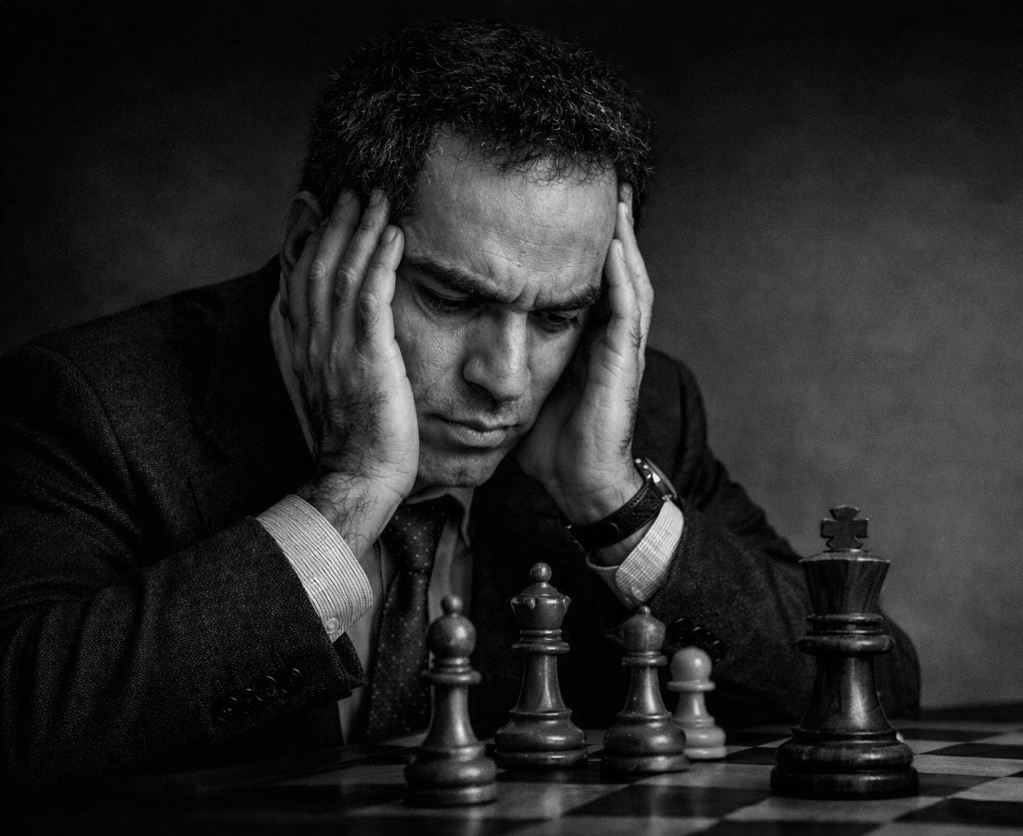
1989. In a silent room. A man faces an opponent unlike any other. It doesn’t breathe. It feels neither fear nor tiredness. It knows neither doubt nor pride. Yet it is about to challenge the best player in the world.
Standing before it is Garry Kasparov, the World Champion, considered by many to be the greatest chess player of all time. On the other side of the chessboard, there is not another grandmaster, but a machine.
At that time, the idea that a computer could defeat the greatest mind in chess seemed almost absurd. For centuries, chess had represented one of the purest symbols of human intelligence. Every game requires logic, creativity, anticipation, intuition, and incredible mental endurance. Many believed that no machine could ever rival the human mind.
Kasparov shared this belief. In 1989, he faced Deep Thought, a computer designed by a team of engineers passionate about artificial intelligence. The result was unequivocal: Kasparov dominated the machine. Humanity remained the master of chess.
At first glance, this victory appeared to be nothing more than a sporting event. Yet it represented far more than that. It symbolized the superiority of human intelligence over technology. For a few more years, the world could still believe that certain abilities would remain exclusively human.
But in IBM’s laboratories, defeat was not the end. It was the beginning. The engineers went back to work. They improved their algorithms. They developed an even more powerful computer. Its name was simple: Deep Blue.
Contrary to the way we think of artificial intelligence today, Deep Blue did not “think” like a human being. It did not understand chess. It developed no intuition. It knew neither the beauty of a combination nor the satisfaction of a spectacular sacrifice.
Its strength lay elsewhere. It calculated. Again. More and more. Where a grandmaster could analyze a few dozen promising positions, Deep Blue was capable of examining millions of them every second. It did not seek to be intelligent; it simply explored an enormous number of possibilities before choosing the one that seemed best.
This approach seemed almost brutal. Yet it worked.
In 1996, Kasparov agreed to face Deep Blue. The entire world watched the confrontation. For the first time, a computer won a game against a reigning World Champion under official conditions. The event made headlines around the world. Many already imagined that human dominance was coming to an end.
But Kasparov responded. He understood the machine’s style of play. He changed his strategy, avoided positions where pure calculation was decisive, and led the machine into more complex situations. After six games, the verdict came: Kasparov won the match 4–2. Man had defeated the machine.
This victory went far beyond the world of chess.
It reminded us of an essential truth: intelligence is not merely a matter of computing power. Experience, intuition, and creativity still possess a value that computers seem incapable of reproducing.
For a few months, many believed the question had been settled. Then IBM announced a rematch.
For an entire year, Deep Blue was completely redesigned. Its power was multiplied. Its processors were improved. Its databases were enriched with thousands of games. The world’s best chess specialists worked alongside the engineers to correct every one of its weaknesses.
In May 1997, Kasparov met his opponent once again. This time, the pressure was immense. He was no longer playing only for himself. He was playing to represent all of humanity.
Every move was followed by millions of people. The media presented the duel as a battle between the human mind and technology.
The match was extremely close. Kasparov won the first game. Then something changed.
During the second game, Deep Blue played a completely unexpected move. A move so subtle that Kasparov became convinced that no computer could have found such an idea on its own. He began to doubt.
And in chess, doubt is often more dangerous than a bad position.
The champion lost confidence. He hesitated more. He looked for traps where there might not have been any. His true opponent was no longer just the machine.
It was his own mind. After six games, Deep Blue eventually won the match by 3.5 to 2.5. For the first time in history, a computer defeated the reigning World Chess Champion in an official match.
The symbol was immense. Many saw it as proof that artificial intelligence had surpassed human beings.
Yet that interpretation was misleading. Deep Blue knew how to do only one thing: play chess.
It was incapable of driving a car, recognizing a face, learning a new language, or even understanding why it was playing.
Kasparov, on the other hand, could do all of those things.
The real lesson, therefore, was not that the machine had become more intelligent than man.
It showed that a machine could become better than a human at one extremely specific task.
That distinction is fundamental.
Even today, the artificial intelligence systems around us operate according to this principle. Some outperform the best doctors in detecting certain abnormalities in medical images. Others instantly translate hundreds of languages, generate text, create images, or analyze enormous amounts of data in just a few seconds.
But each of them excels in a particular field.
Human intelligence, on the other hand, remains remarkably versatile.
The story of Kasparov and Deep Blue teaches us something else as well: the greatest technological revolutions often begin with events that seem insignificant.
At the time, many considered this encounter to be nothing more than a chess match.
Looking back, we now know that it announced the arrival of a new world.
Today, artificial intelligence writes, draws, composes music, assists researchers, helps doctors, and supports engineers in their discoveries.
The duel between Kasparov and Deep Blue now appears as the first chapter of a story that is still being written.
But perhaps the most important question is no longer:
“Can machines defeat humans?”
The real question now is:
“How can humans and machines learn to work together?”
Because the goal may not be to replace human intelligence, but to complement it. History has shown that a machine could win a game of chess. What remains to be seen is whether, together, humans and artificial intelligence will be able to meet the far more complex challenges that await our society.
Paul Goumault
Sources:
YouTube: Ego – Le jour ou l’homme a battu la machine


Leave a Reply