
I wake up bright and early in the morning, to the sound of crows below my 5th-story window. I am afraid that this will be the last morning I wake up in my comfortable bed.
It was 5:30 in the morning and my ride was coming at 5:50 to take me up into the mountains. My father had arranged with a truck driver, explaining that I was studying biology at university, and needed to examine some of the rare plants in the national park. As I quickly prepared for the day, I thought back to a conversation with my family from the day before. They were very afraid of what I might find up in the mountains. Everyone has heard the rumors of drug operations and other illegal activity up where the broken terrain and general inaccessibility make illicit activity that much easier. The Administration of Protected Areas in our Elbasan Region as well as the State Police, have recently been publicizing intensification of patrols and monitoring of drug activity in these remote areas, the sort of activities that people might take extreme measures to keep from being exposed. My parents just wanted to be sure their only son would return at the end of the day, and to be honest, I felt a little bit of their fear myself. And these fears would be validated before the end of the day.
Rrajcë Skëndërbej is a remote village with a landscape that one cannot believe exists anywhere in the world. It has recently been given international recognition from UNESCO for its forests, and this was my destination.
The time was 5:50, and the driver was right on time. He saw me and he said, “Come student, we do not have time to lose, my bosses are monitoring me with GPS.” He nods at my father, and starts moving the car before I have even closed the door. He says “mirupafshim!” (goodbye!), and the car takes off.
“Have you taken food and water with you? We have a long road…”
“Yes,” I told him.
“Ok, very good,” he says, and continues talking to me, explaining that the trip is around 3 hours each way, and that we should be back in Librazhd around 2:30 in the afternoon.
I was trying to analyze each of his gestures, the way he seemed confused at all the cars passing by us, how he was constantly sweating and had 3 simple telephones on him, which had long batteries. He saw me with my own telephone in my hand, and he said:
“When we are up there, you will switch that off, I will tell you where you can take photos of flowers that you need. We are going over 1900 meters above sea level and I will tell you when to take photos. If you take photos of other things and spread them around, we will be in trouble.”
After an hour on the road, the driver stops for coffee and invites me. At this remote roadside café, I saw several other truck drivers. I noticed that they did not speak in the local Librazhd dialect, but seemed to be from other cities.
“And him, who is he?” One of the drivers asked in a gravelly voice. He seemed bothered by my presence.
“He is a student from Librazhd, studying biology, and for his diploma he needs to see some rare flowers in the park. Will we help him or not, our compatriot, to get a good grade? He is the same age as my daughter.”
“If he is with you, you can take the risks,” answered the other driver. As the coffee break went on, the conversation turned to business. The drivers argued back and forth amongst themselves over who would get to take the best wood, and thus the best payday, from the logging happening at the higher altitudes. I was feeling a little awkward at this point, and a little bad that I had misled the driver about my purpose. But it was a “white lie”, for a good cause – keeping myself safe.
And so we continued onward and upward. The ongoing trip was terrifying, the sort of trip where I was constantly holding my breath as the driver willed his truck up the narrow, treacherous dirt roads. We spent the next 45 minutes going 10 meters forward, 5 meters backwards. At one point, the driver stopped the car and put sticks and stones under the wheels to get it through the mud. A little further on, on a particularly narrow stretch, I closed my eyes because I could not bear to look anymore out of fear. At points we only had 3 wheels on the road, the 4th being forced up onto rocks or up into the air. To make things worse, the driver was in a bad mood after his argument with the other drivers at the coffee stop, cursing at every bump in the road. But he was a devout Muslim and he trusted in his faith, saying “if Allah wills it, we will go forward, but if Allah wills it, we will die now.” This did not reassure me.
Further along the road I saw a construction vehicle, of the type used for opening new roads in the mountains. Here I gave a quick thought to just how much money must be coming through this remote section of the mountains to be able to afford to bring construction vehicles up into the mountains to open new roads.
I also saw muscular young men, both from the local area and elsewhere in Albania, appearing every half hour or so to check up on us and make sure we were staying on the road. When the spotty cell phone reception came through, I noticed that I had missed 9 calls, from my father and other family members. They were concerned for me, and I was a bit afraid myself. But I did my best to remain professional, and to take in every detail that I could.
Finally we arrived in a village, where young guys from the area climbed on to the back of our truck and began their daily work. I had a chance while they were taking a water break to take photos of what I was seeing. An old village woman approached me when she saw what I was doing. She said to me:
“Do it, do it, show everyone what is happening here.” She pointed at the sap of the trees that had been felled. “We elders, we call that the ‘tears of the tree’. The trees cry when they are chopped. Oh my boy…it hurts my soul.”
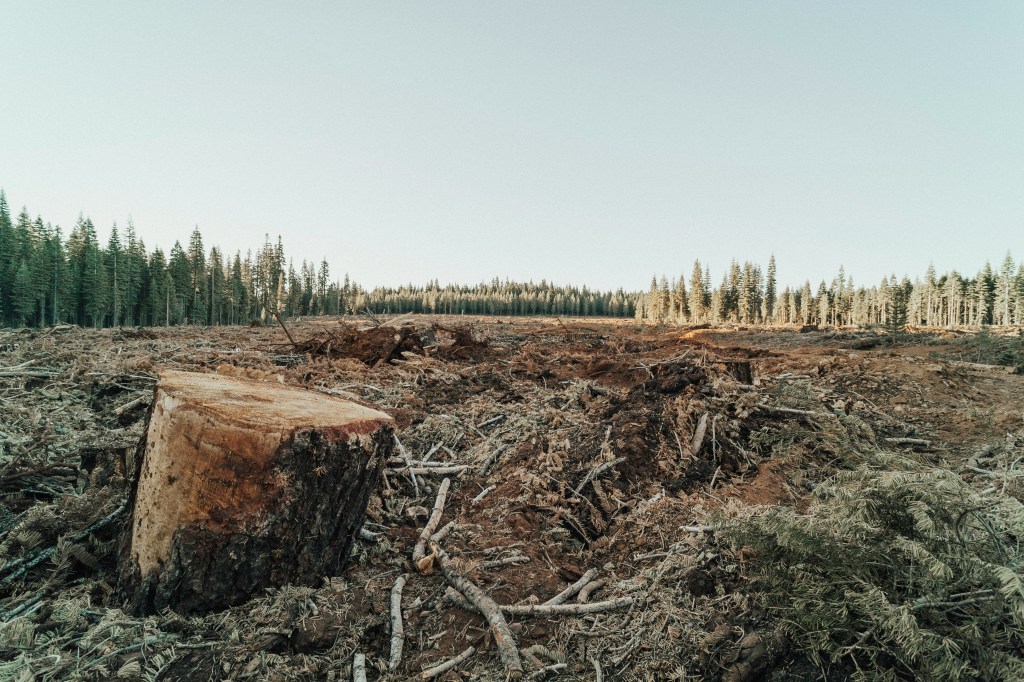
In front of me was a big mountain, completely deforested. I felt for a moment that I might be out in the Sahara desert, but up in the mountains, so bad was the situation. A whole mountain range was being conquered by deforestation. These mountains bear the name of our national hero, Skenderbeg, who fought to defend Albania with his sword.
Today, the blades of business are destroying the land.
Arlis Alikaj
Author’s Note: These are my diary entries from a trip to report on illegal logging in Shebenik-Jabllanica National Park, a UNESCO protected area.


Leave a Reply