

Do you like karaoke, singing in the shower, or anywhere you can? Do you play any instruments or write lyrics? What if the songs you listen to could define your personality?
Everyone likes music: there are no exceptions. We all react to music in some way: singing, humming, or tapping our feet to the rhythm. Some studies have found a connection between the types of songs you enjoy and your mindset, as well as how you are likely to behave.
The Big Five
Although “The Big Five” might sound like a secret intelligence agency, it describes five major dimensions of human personality. The groundwork for this model was laid in the 1930s by Gordon Allport and Henry Odbert, who identified around 18,000 words related to personality traits. Later researchers refined this list, and by the 1980s, psychologists Robert McCrae and Paul Costa developed the modern Five-Factor Model, better known as the Big Five. This theory outlines five key personality traits that vary across individuals:
- Openness refers to a person’s willingness to experience new things, creativity, adaptability, and curiosity for learning. It includes being open to new experiences.
- Conscientiousness refers to thoughtfulness, self-control, goal-directed behaviors, planning, and consideration of one’s actions. It also includes being mindful of deadlines and well-organized as opposed to procrastinating.
- Extraversion refers to sociability, assertiveness, and emotional expressiveness, whereas introversion is associated with being more reserved and preferring solitude.
- Agreeableness refers to traits such as trust, altruism, kindness, and affection.
- Neuroticism refers to emotional instability, including tendencies toward stress, moodiness, and getting upset easily.
These traits exist on a spectrum. Imagine a scale from 0 to 10, where 0 indicates the absence of a trait and 10 represents its maximum expression. This is an example of how we can scale the characteristics. Personality can change over time and may be influenced by various factors such as economic conditions, social environment, and education. You are not stuck to one personality for your entire life.
GAME:
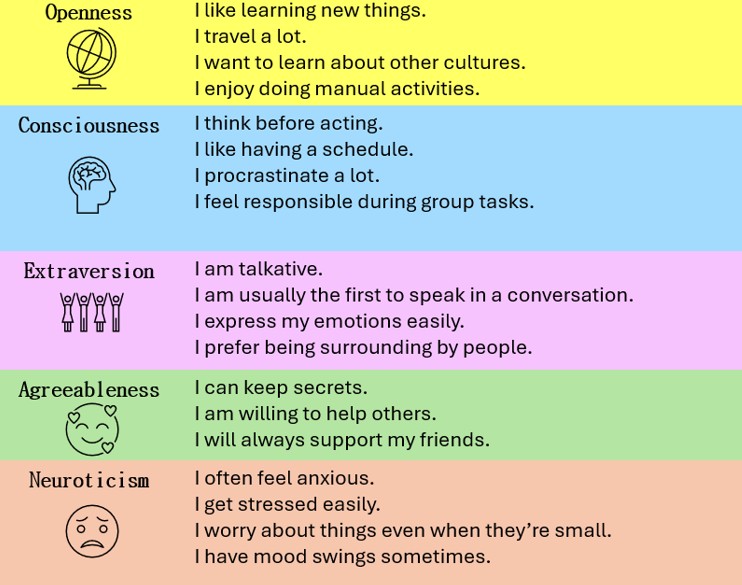
Rate each statement from 0 to 5 where 0 = Not at all true for me and 5 = Completely true for me
For each trait, total your scores. If your average score is above 2.5, you are likely to show that trait. If your average is 2.5 or below, you likely lean toward the opposite.
Music genre
Let’s begin with some definitions: have you ever wondered what the difference between music and noise is. Can noise be music? What are different genres of music?
Music is an ordered sound often associated with the following adjectives: pleasing, harmonious, emotional. For instance, you can make music with instruments such as guitar solos in rock music, the voice of Ariana Grande, etc. On the other hand, noise is disordered sound, which is usually unpleasant, disruptive or annoying. For example, traffic noise can be disturbing. The frequency of music is different during the melody whereas noise is constant and regular.
Some research counts around 1,300 music genres, others 6,000. The point is that each website takes into account different parameters such as rhythm, tempo, place, melody, time, etc. This will be a short list of the possible music genres. However, what we can highlight are the main categories with examples of subcategories and singers as you can see some of them in the following table:

There are more categories such as traditional music or other instrumentals but in this article, it is impossible to list all the music. If you want more information, this website offers examples of music genres: https://www.chosic.com/list-of-music-genres/.
Music and personality
There is no accounting for taste: everyone has their own.
What if we could detect who you are and how you are thanks to music? Indeed, research suggests that each music genre is associated with specific personality traits, but studies warn about the association because it does not always represent reality. However, these associations should be taken with caution, as they don’t always reflect the full picture. In fact, people tend to enjoy a wide range of musical styles, sometimes shifting genres dramatically within a single day. Several factors can influence musical preferences, including age, gender, social class, income, and cultural background.
The following paragraphs will associate personality traits adjectives with some music genre.
- People who enjoy pop music tend to be extroverted, honest, and conventional, often displaying a strong work ethic and high self-esteem, though they might be less creative and more prone to feeling uneasy.
- Rap and hip hop fans often have high self-esteem and a bold, outgoing nature, but they typically show less openness to new experiences while embracing risk-taking behaviors.
- Country music lovers are usually hardworking, conventional, and emotionally stable, with an outgoing and conservative personality that resists change and new experiences.
- Fans of rock and heavy metal are often gentle and creative, though more introverted and likely to struggle with lower self-esteem.
- Indie music enthusiasts are typically introverted, intellectual, and highly creative, but they may be less hardworking, more passive, anxious, and have lower self-esteem.
- Those who prefer dance music are generally outgoing, assertive, and open to new experiences, although they might score lower in gentleness.
My theory is that there is music for every situation. Our musical choices depend on many factors: our background, where we grew up, the environments we’ve been exposed to, and the people around us. Personal tastes evolve over time, shaped by age where we are in the life cycle and influenced by emotions, moods, and daily activities. Whether we’re working, studying, exercising, or relaxing, music adapts to fit the moment. It becomes a soundtrack to our lives, shifting with our circumstances, needs, and inner states. After all, each person reacts differently to the music they listen to, what might sound intense to one and could feel comforting or energizing to another.
And nowadays, with tools like AI-powered platforms (like Suno), it’s even possible to turn those lyrics into full songs, melodies, instruments, and all. Technology is opening new doors for creativity, making music-making more accessible to anyone with a voice, an idea, or just a feeling they want to share.
So what is your favorite music genre?
Loline Thomas
Sources:
Chosic. (n.d.). Music genres explorer: 6000+ music genres & types. Retrieved July 20, 2025, from https://www.chosic.com/list-of-music-genres/
Elert, G. (n.d.). Music and noise. In The Physics Hypertextbook. Retrieved July 20, 2025, from https://physics.info/music/
Monzée, J. (2022, April 10). Découvrez votre personnalité à travers les musiques que vous écoutez. Retrieved July 20, 2025, from https://joelmonzee.com/decouvrez-votre-personnalite-a-travers-les-musique-que-vous-ecoutez/
Cox, J. (2022, July 14). What do music preferences reveal about your personality?Psych Central. Retrieved July 20, 2025, from https://psychcentral.com/lib/preferred-music-style-is-tied-to-personality
16Personalities. (n.d.). Music preferences by personality type. Retrieved July 20, 2025, from https://www.16personalities.com/articles/music-preferences-by-personality-type
Cherry, K. (n.d.). What are the Big Five personality traits?Verywell Mind. Retrieved July 20, 2025, from https://www.verywellmind.com/the-big-five-personality-dimensions-2795422
Retorio. (2020, January 10). History of the Big 5: Why this online psychometric test packs a punch [Blog post]. Retorio. Retrieved July 20, 2025, from https://www.retorio.com/blog/big-5-history-psychometric-test
 VOICES
Leave a comment